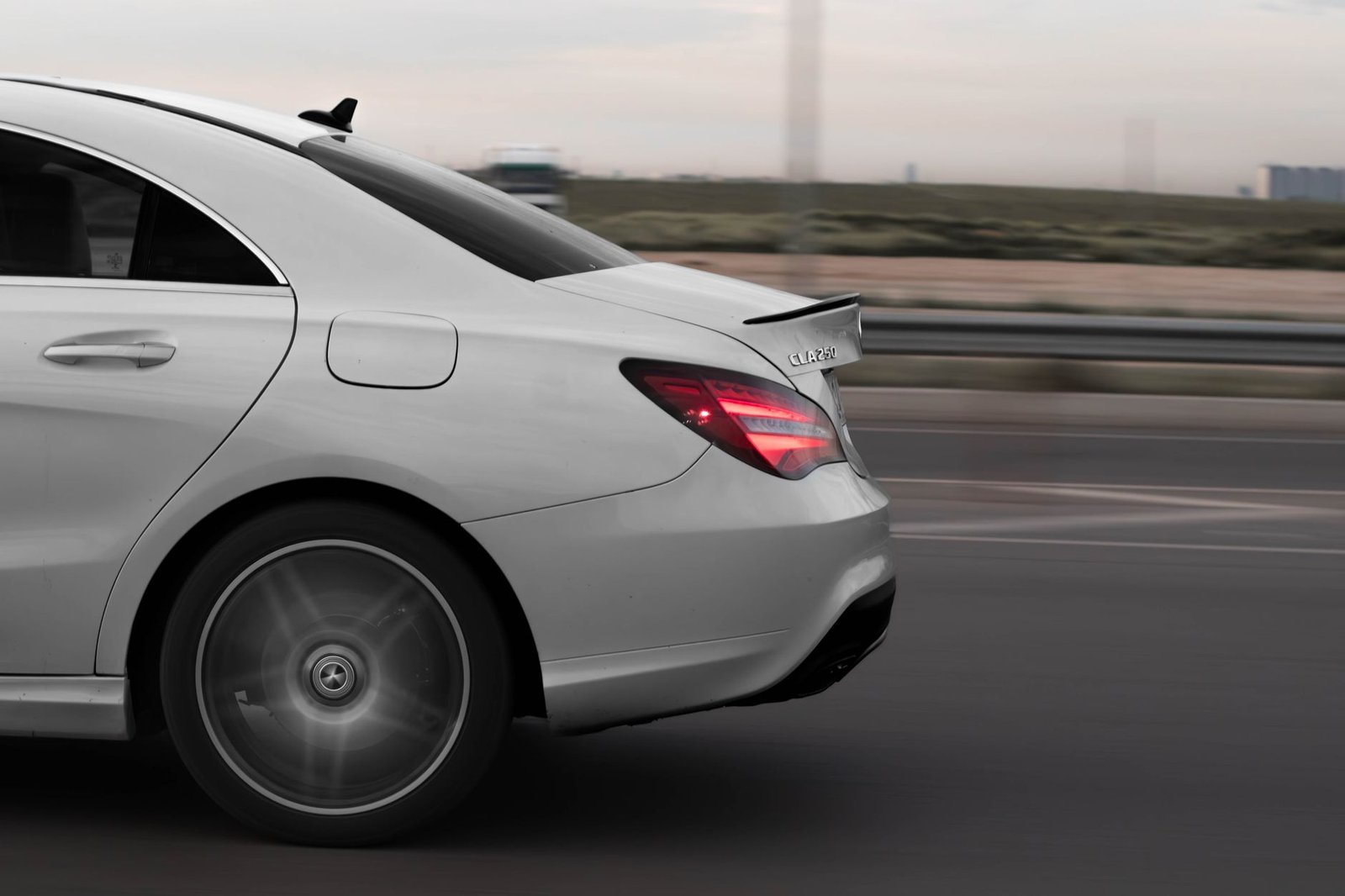
Tom Moloughney pointed his Mercedes CLA 350 4Matic at the New Jersey Turnpike last summer with a simple plan: hold 70 mph until the battery died. The car’s EPA rating said 312 miles. He went 385. That 73-mile gap isn’t a rounding error or lucky wind conditions. It represents something more fundamental about how automakers engineer electric vehicles when efficiency actually matters to their bottom line.
The Mercedes CLA range test results surprised people because most EVs perform worse than their EPA ratings in real highway driving, not better. The 4.44 miles per kilowatt-hour average puts Mercedes roughly on par with the Tesla Model 3, which posts around 4.6 mi/kWh in comparable testing. This matters because Mercedes typically prioritizes luxury over maximum efficiency, yet their smallest EV nearly matches Tesla at Tesla’s supposed specialty.
The Physics of Moving Air Around Metal
Electric range at highway speeds comes down to three variables: battery capacity, aerodynamic drag, and powertrain efficiency. The Mercedes CLA 350 4Matic carries an 85 kWh battery, which is unremarkable for the segment. The efficiency comes from how the car moves through air and converts battery electrons into wheel rotation.
Aerodynamic drag increases with the square of velocity. Double your highway speed and you quadruple the air resistance. This is why EPA testing cycles, which average around 50 mph with frequent stops, produce higher range numbers than sustained 70 mph cruising. Most EVs lose 20-30% of their rated range when you lock cruise control at highway speeds.
The CLA’s 4.44 mi/kWh at constant 70 mph means the car used roughly 87 kWh of usable capacity to travel 385 miles. For comparison, moving nearly 4,700 pounds of metal and glass at highway speed requires overcoming a substantial and continuously rising drag force. The tighter you can streamline the body and the more efficiently you can convert battery power to mechanical work, the farther you go on the same electrons.
Mercedes used two specific technologies in the CLA that matter: silicon carbide inverters and a two-speed gearbox. Silicon carbide semiconductors switch faster and waste less energy as heat compared to traditional silicon inverters. The two-speed gearbox lets the motor operate closer to its peak efficiency range across different speeds, rather than compromising with a single gear ratio.
Why Most Automakers Don’t Chase Maximum Efficiency
Building an efficient EV costs more money and requires engineering tradeoffs most companies won’t accept. Silicon carbide inverters run $200-400 more per vehicle than silicon versions. A two-speed gearbox adds weight, complexity, and another $300-500 in manufacturing costs. You also need the development engineering to tune the transmission shifts so customers don’t notice them.
Tesla avoided multi-speed gearboxes in production vehicles after early Roadster transmission problems. They instead focused on motor efficiency and aerodynamics, accepting the compromises of a single-speed reduction gear. The Model 3’s roughly 4.6 mi/kWh in Edmunds testing comes from a drag coefficient around 0.22 and a highly optimized permanent magnet motor, not fancy power electronics or transmissions.
Lucid takes a different approach, hitting approximately 5.0 mi/kWh through extreme aerodynamics and in-house motor technology. Their Air sedan has a drag coefficient of 0.20 and motors that run at higher voltages (around 900V vs. the CLA’s 800V architecture). But Lucid sells relatively few cars at prices starting around $70,000. Mercedes needs to move volume at $51,950.
The economic constraint is simple: efficiency improvements have diminishing returns. Going from 3.0 to 3.5 mi/kWh gains you about 17% more range. Going from 4.0 to 4.5 mi/kWh only gains 12.5% more range, but likely costs similar development dollars. Most automakers stop optimizing once they hit their target range number, because customers don’t pay extra for efficiency beyond that threshold.
Mercedes kept pushing because the CLA is their entry-level EV in North America. The all-wheel drive version needed to hit 300+ miles of real-world range to be credible against the Model 3 and upcoming competitors. The rear-wheel drive single-motor version achieves 374 miles EPA-rated, suggesting Mercedes tuned the platform for maximum efficiency first, then added all-wheel drive capability.
The Test Results Nobody Talks About
Moloughney’s consistency numbers reveal something interesting about how Mercedes calibrated the CLA’s systems. He recorded roughly 4.50 mi/kWh for the first 95 miles, 4.52 mi/kWh from miles 95-195, 4.46 mi/kWh from miles 195-290, and 4.44 mi/kWh for the final segment. That’s less than 2% variation across nearly 400 miles.
Most EVs show larger efficiency swings as battery state of charge drops. Voltage sag at low charge states typically forces the inverter and motor to work harder, reducing efficiency. The CLA’s flat performance suggests Mercedes either has very tight battery management controls or the two-speed gearbox compensates for voltage changes by keeping the motor in its optimal operating range.
Car and Driver’s separate 75 mph test produced 340 miles, about 45 miles less than Moloughney’s 70 mph result. That 5 mph speed difference created an 11.7% range reduction. The math checks out: aerodynamic drag at 75 mph is roughly 15% higher than at 70 mph, accounting for most of the range loss. The consistent relationship between speed and range indicates stable, predictable efficiency controls.
Summer test conditions matter. Batteries perform best between 60-80°F. Winter testing would likely show 20-30% range reduction from cold battery chemistry and cabin heating loads. Mercedes hasn’t published cold weather range data yet, but the 85 kWh battery gives enough margin that even a 25% winter penalty would still deliver around 290 real-world miles from the tested AWD car.
The Efficiency Story Most Coverage Misses
Publications reported the Mercedes CLA range test as surprising because it beat EPA ratings. They missed the larger point: Mercedes engineered for real-world highway efficiency rather than gaming the EPA test cycle.
EPA testing includes frequent acceleration and braking, which allows regenerative braking to recover energy. Steady highway cruising eliminates that advantage. Automakers can optimize for the test cycle with aggressive regen tuning and gearing choices that work well at 50 mph but poorly at 75 mph. Mercedes apparently didn’t.
The single-motor rear-wheel drive CLA achieves 374 miles EPA-rated versus 312 miles for the all-wheel drive version tested. That 62-mile difference reveals the cost of the front motor: roughly a 17% range penalty. But the AWD version still beat its EPA rating by 23% in highway testing, suggesting the efficiency engineering works across both configurations.
Most coverage also ignored the price positioning. At $51,950, the CLA 350 4Matic costs about $8,000 more than a base Model 3 Long Range but delivers comparable real-world range with arguably more interior refinement. Mercedes is pricing the car to compete on value, not luxury positioning. That’s unusual for a German premium brand.
What the Numbers Tell You to Watch
Real-world highway range at 70-75 mph is the metric that matters for American buyers. EPA ratings remain useful for comparing vehicles tested under identical conditions, but they don’t predict interstate trip charging stops. Track the gap between EPA numbers and verified highway tests at consistent speeds.
Cold weather performance will determine whether the CLA’s efficiency holds up year-round. Mercedes needs to publish winter range data from locations where temperatures drop below 20°F for extended periods. If the silicon carbide inverters and two-speed gearbox maintain efficiency advantages in cold conditions, that indicates robust thermal management.
Watch whether other automakers adopt similar technology combinations. If the next generation Hyundai Ioniq or Volkswagen ID.4 adds two-speed gearboxes and silicon carbide inverters, that signals the industry sees Mercedes’ approach as the new efficiency baseline. If they don’t, it suggests the cost-benefit analysis doesn’t work at higher production volumes or lower price points.
The single-motor rear-wheel drive version’s real-world highway range will show whether Mercedes sacrificed efficiency for all-wheel drive capability or achieved gains across the platform. Given the RWD car’s higher EPA rating, a real-world 70 mph result comfortably above the AWD’s 385 miles would confirm the efficiency story extends across the lineup. If it barely exceeds the AWD figure, the efficiency advantage would look configuration-specific rather than fundamental.