Introduction
A few months ago, when Tesla was rolling out its Cybertrucks, Tesla published a clever video of a Cybertruck beating a Porsche in a race. Not only did the Cybertruck beat the Porsche, it beat the Porsche while towing a Porsche, which is what made the video all the more remarkable.
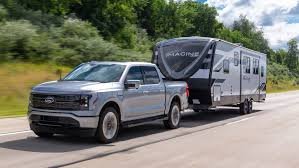
Towing is not an everyday part of life for most Americans but for certain pickup truck drivers, it is a critical part of their every day life or business. Whether you use the pickup truck to haul a trailer for work or an RV for road trips, having a pickup truck that can tow reliably is important. And while EVs are more efficient for everyday commuter driving, towing using an EV can still be a challenging proposition.
So, if you are deciding whether to use an electric truck for towing, here are some things to think about.
Electric Trucks Are More Efficient Than Diesel Trucks
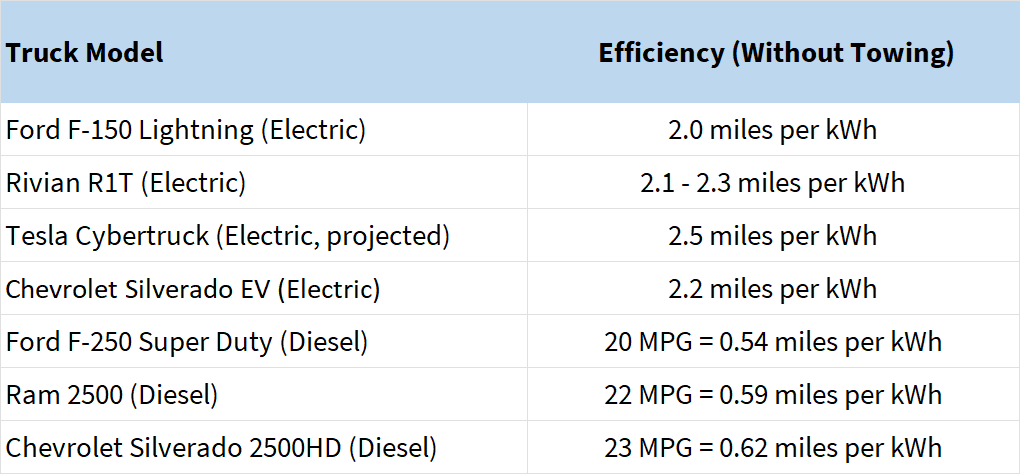
It is well known that electric vehicles on the whole are a lot more efficient than diesel vehicles in terms of energy input and output. This rule applies for electric trucks as well. This is primarily due to the better efficiency of the electric motor.
An electric motor is 80-90% efficient i.e. only 10-20% of the energy is lost. A gasoline powered ICE engine, on the other hand, is 30-40% efficient i.e. Diesel engines lose 60-70% of the total energy as heat through the exhaust and cooling systems.
The internal combustion process itself is inherently inefficient due to thermal losses, as the engine has to overcome friction, pumping losses, and heat dissipation. The result is that a Tesla Cybertruck is almost 5 times as efficient as a Ford 250 diesel truck.
But Its Not Just About Energy Efficiency
So, if electric trucks are more efficient than diesel trucks, doesn’t it make more sense to just buy an electric truck?
Its not that straightforward.
The improved efficiency of the electric truck is more than offset by the low energy density of batteries. Depending on the battery chemistry used, 1 kg of an EV battery can hold only 1-2% of the energy contained in 1 kg of diesel or gasoline. So while its true that EVs don’t need as much energy as diesel vehicles, they also can’t store much energy to begin with.

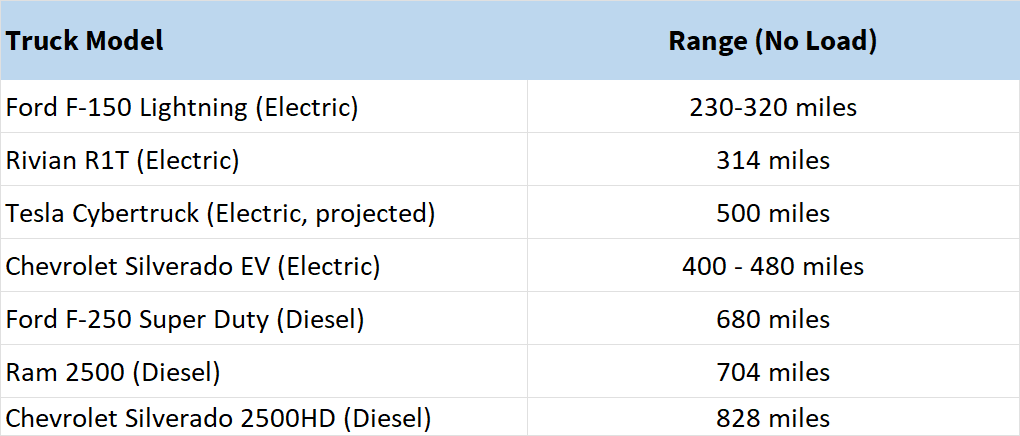
The net result of batteries having relatively low energy density is that electric trucks have a lower range compared to diesel trucks. The Chevrolet Silverado diesel has double the range of its electric version! The only way an electric truck can ever increase its range is to include a larger and heavier battery or find a battery chemistry that has more than twice the energy density of the existing ones.
So What Happens When You Tow?
When towing, both electric and diesel trucks lose almost the same amount of energy. Electric trucks are in fact slightly better at towing if you look at the absolute amount of energy spent when towing.
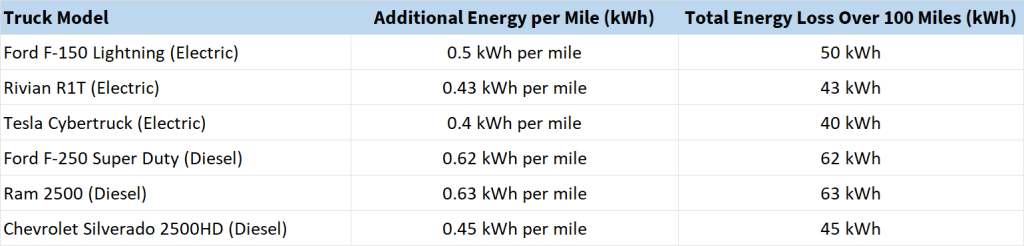
But here is the problem. Even though electric trucks lose a lower amount of energy when they tow, this energy lost represents a larger proportion of the total battery capacity than in say, diesel or gasoline powered trucks. In other words, electric trucks experience a greater proportional range drop when towing (typically a 50% reduction or more) while diesel trucks lose only about 20-30% of their range.
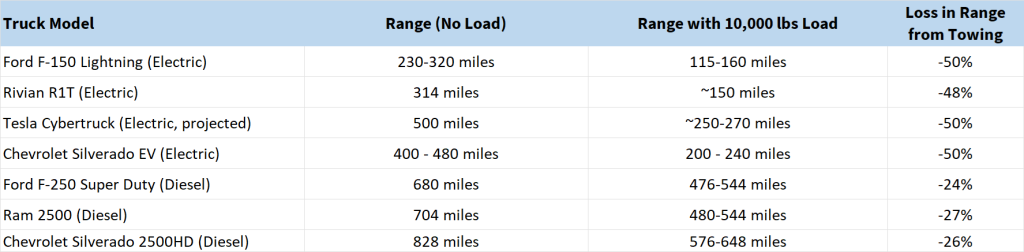
This loss in range can be absolutely devastating for an electric truck that already has a low amount of range to begin with. A Rivian R1T with 300 miles of range sounds palatable…just about….but when you have to tow an RV all day, you might have to make multiple charging stops instead of one.
Conclusion
Electric trucks are inherently efficient more efficient than their diesel counterparts, and their instant torque makes them excellent for towing in terms of pulling power. However, current battery technology limits their practical range when towing heavy loads over long distances. Diesel trucks, with their higher energy density and lower proportional efficiency loss, remain better suited for sustained, long-haul towing.
As battery technology improves and charging infrastructure expands, electric trucks will likely become more competitive in this area. For now, electric trucks are best suited for moderate towing distances, while diesel trucks remain the top choice for heavy, long-distance towing.