Introduction
In the up and coming world of commercial electric trucks, one way to signal that you are a serious truck technologist is to ask about the axle system or chassis layout of the truck. Pray, does your electric truck have a newly developed E-Axle, or does it have a more conventional central drive?
E-Axles
E-Axles or electric axles are a modern day innovation and a by product of the EV revolution. E-axles are possible because the simplicity of the electric vehicle has allowed for a distributed design that integrates an electric motor and power electronics system directly onto an axle, essentially creating an electric drive system within the axle itself.
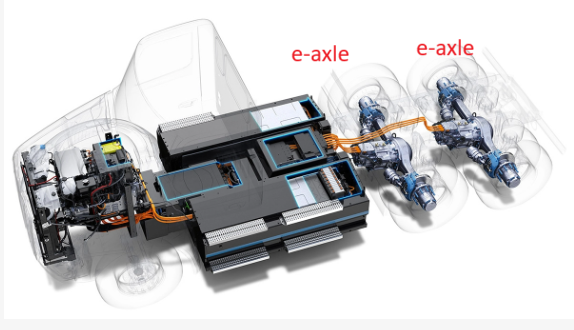
E-axles eliminate the need for a drive shaft that connects the central drive to the various axles. Instead of having a centralized motor, the DC power from the battery is first inverted and then passed on directly to standalone motors that are contained within the rear axle(s).
To those who might wonder why we are re-inventing the wheel, pun intended!, there are several advantages to employing an e-axle design –
Advantages of E-Axles
- Energy Efficiency – Eliminating the drive shaft that connects the centralized motor to the axle reduces the mechanical transmission losses that occur in central drive systems.
- Volume & Weight Efficiency – You also free up space in the center of the vehicle, allowing for flexibility around battery placement and cargo space. It also reduces the overall weight of the vehicle as there are now no drive shafts or heavy transmission systems that need to be incorporated. This results in improved energy efficiency (kWh per mile).
- Better Control & Torque – Since the motors in an e-axle are positioned right next to the wheels, it allows for better precision control and faster response times. They also allow for precise torque control to the individual wheels providing for better vehicle dynamics and traction.
In the trucking world, companies that manufacture e-axle based chassis include Tesla (Semi), PACCAR (Peterbilt), BYD and Daimler/Freightliner (eCascadia)
Disadvantages of E-Axles
E-axles do have a few drawbacks –
- They are relatively new, and each manufacturer that adopts it is going to take some time to get it right
- They are not easily serviceable. Since the axle now includes its own motor, axle or wheel repairs that would have been easier on a more conventional chassis will now be a lot more complicated
Central Drives
Central drives are the conventional or incumbent alternative to e-axles. An EV that uses a central drive power train essentially is simply replicating the layout of the internal combustion engine. In simplified EV terms, this will mean that the battery transfers AC power to one motor, that will then mechanically drive all the axles using a traditional drive shaft. It is called a “central” drive because it was more efficient for the internal combustion engine to generate all the power in one centralized location and then transfer it mechanically to the axles.

Advantages of Central Drives
Despite the advantages offered by an e-axle system, a lot of manufacturers decided to stick with the central drive system for the following reasons –
- Cost – Since there is very little deviation in design from the traditional ICE engine, manufacturers can leverage existing ICE production lines to manufacture a central drive based EV. Additionally, this requires no investment in new but untested e-axle systems which could take several iterations to get it right
- Serviceability – Compared to e-axles, central drives are a lot more modular, which means that each component can be taken out and fixed or upgraded individually without having to replace the entire powertrain system or e-axle which can be extremely expensive to replace.
- Suitability for High Wear & Tear Applications – Unlike the passenger EV which is light duty and sees minimal wear and tear, medium and heavy duty EVs are subject to a lot more stress and spend a lot of time at the repair shop. Having a more modular design that is easily serviceable could come in handy here and ensure that the truck is back up and running quickly.
Companies like Volvo Trucks, Battle Motors and a few others have stuck with the central drive system for their electric vehicles and are having a lot of success.
Disadvantages of Central Drives
But central drives aren’t without their weaknesses and don’t offer a lot of the advantages that are inherent to EVs.
- Lower efficiency – They’re heavier, bulkier, and less efficient than e-axles. The mechanical losses due to the more rigid design will result in kWh losses that could reduce the energy available to complete the route. This is a big disadvantage if the vehicle is required to carry a large payload or complete a series of energy consuming work tasks.
- Lower flexibility – The e-axle provides a lot of flexibility in design. This allows for a lot of new features like enhanced cargo space, payload, all of which go away if you are using a central drive system.
- Driver experience – EVs are known to provide an enhanced driver experience because of the high torque and extremely responsive motors. The rigidity of the central drive system slightly reduces this incremental torque and responsiveness. This impacts the overall driver experience and makes it “less fun” to drive an EV.
As EVs become more and more ubiquitous and as e-axles become just another component in the automobile supply chain, it is likely that almost all manufacturers will pivot to using e-axle systems. It is hard to believe that manufacturers will want to sacrifice efficiency and miss out on the design advantages that an e-axle provides.