Introduction
As the world races towards autonomous vehicles, one question is becoming increasingly important: What kind of vehicle makes more sense for autonomy – electric vehicles or internal combustion engines?
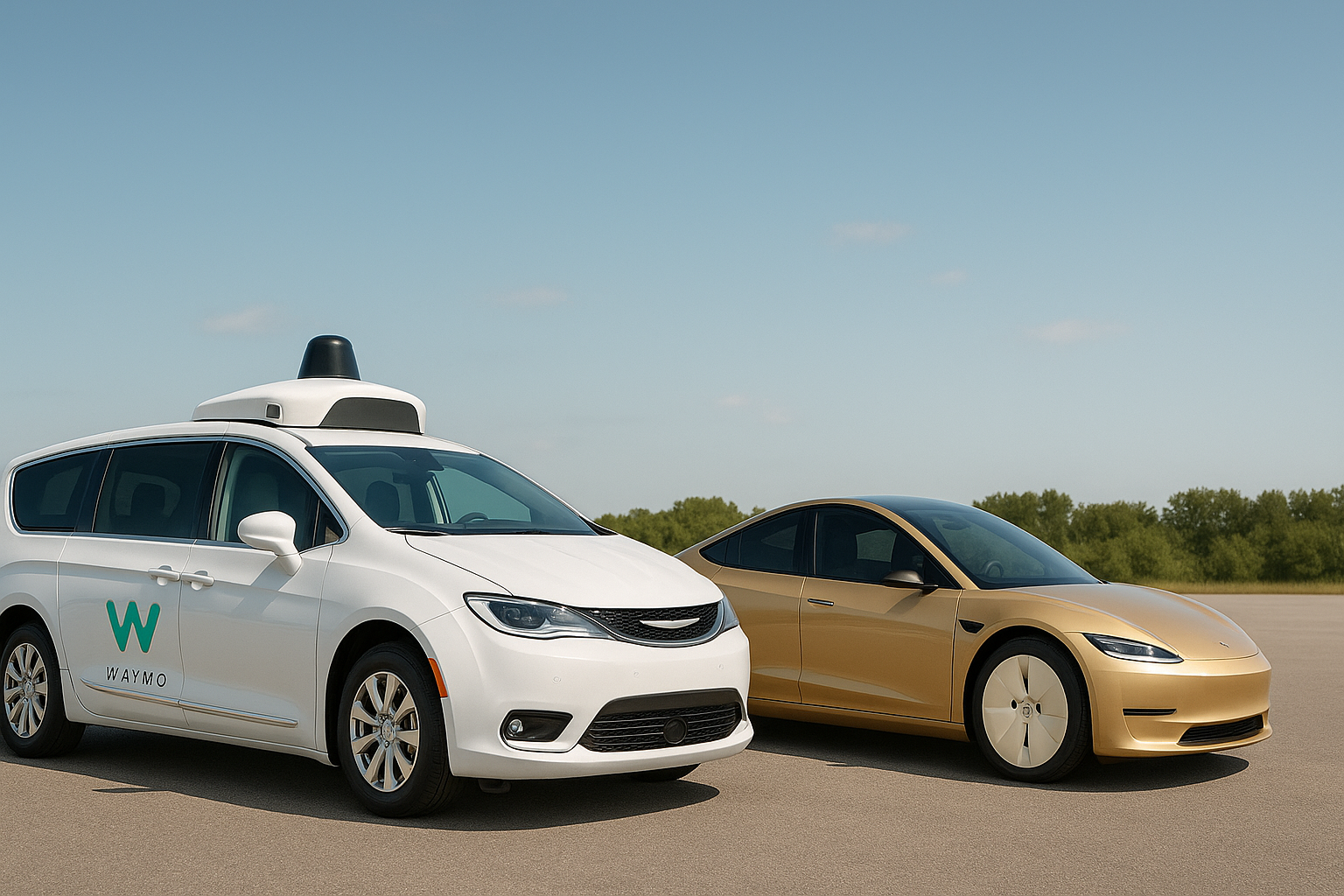
While some engineers argue that autonomy is agnostic to the type of powertrain, real-world deployments suggest otherwise. From Waymo’s robotaxis in San Francisco to Tesla’s cybercabs, the majority of autonomous platforms today are built on electric vehicles (EVs).
This isn’t just a coincidence. EVs aren’t just cleaner, they’re better suited for autonomy across the board. Here’s why.
EV Drive By Wire Systems Are Superior
The two biggest challenges for autonomous vehicles are perceiving the environment accurately and making safe, timely decisions.
Solving these problems doesn’t depend on the powertrain.
Or in other words, it doesn’t matter if the car is an EV or a gas car, it is still going to have to rely on a combination of cameras and LIDARs to understand its environment. Additionally, the software that does all the decision making in the place of humans will work the same in an EV and in an ICE car.
The question of EVs vs ICE becomes more relevant for transmitting the software’s decision to the vehicle and its end components i.e. the wheels, the brakes etc. Where EVs pull ahead is in how those decisions are executed: through more responsive drive-by-wire systems.
EVs are, almost universally, drive-by-wire systems that electronically control acceleration and braking. There is no mechanical linkage between the pedal and the motor.
Drive-by-wire systems use electronic signals which travel at the speed of light which allows for faster response times, whereas mechanical systems rely on the movement of components (pedals, linkages, fluids) which adds delay.
Its not just that, ICE vehicles often rely on legacy mechanical systems, which must be retrofitted with actuators and controllers to make it more suitable for autonomous driving. This makes autonomous integration more complex and less reliable. It also adds an additional point of failure and will also consume additional compute resources.
Electric Motors Are a Better Ride
It’s well known that electric motors provide a better ride experience compared to ICE engines.
They deliver instant torque, allowing for much finer control over acceleration and deceleration. For autonomous vehicles, this translates into smoother starts and stops, more confident maneuvering and safer responses to sudden changes.
Autonomous Vehicles Will Be All About Cost and EVs Are Cheaper to Fuel and Maintain
Autonomous Vehicles are going to be super focused on cost as customers will, in most cases, prefer to go with the cheapest option for going from point A to point B.
EVs will cost a lot less to fuel and will be cheaper to maintain as well which will allow AV companies to be competitive in the marketplace. Its not just that, a significant portion of the taxi market operates in urban areas and neighborhoods where cars stop and start a lot and are stuck in traffic for long periods of time. EVs perform better and are cheaper to operate on these types of routes.
But Wait — Can’t ICE Vehicles Be Autonomous Too?
They can. And a lot of people have asked the same question
Travis Kalanick, of Uber fame, posited that ICE cars could be a temporary autonomous vehicle solution because the power grid simply wouldn’t be capable of powering hundreds of thousands of EVs.
Aside from the fact that most EVs charge overnight when power demand is low (and don’t actually stress the grid), the autonomous vehicle market has already spoken in favor of EVs.
Case in point: Waymo initially had a hybrid Chrysler Pacifica in its fleet but is now fully electric. It now uses an all electric Jaguar I-PACE and plans to introduce new electric models such as the Zeekr RT minivan and the Hyundai Ioniq 5.
Tesla, which will launch its robotaxi services in Austin in the next few weeks, is obviously an EV company.
There are very few, if no ICE cars that are being used for autonomous operations today. It is theoretically possible, but highly unlikely.
Conclusion: Autonomy and Electrification Are Natural Partners
Electric vehicles aren’t just an environmentally friendly option, they’re a technically and economically superior foundation for self-driving technology. From smoother control to simpler maintenance and lower total cost of ownership, EVs give autonomous systems exactly what they need to scale.
Autonomy may not require electrification, but the smartest companies in the space are betting on both.