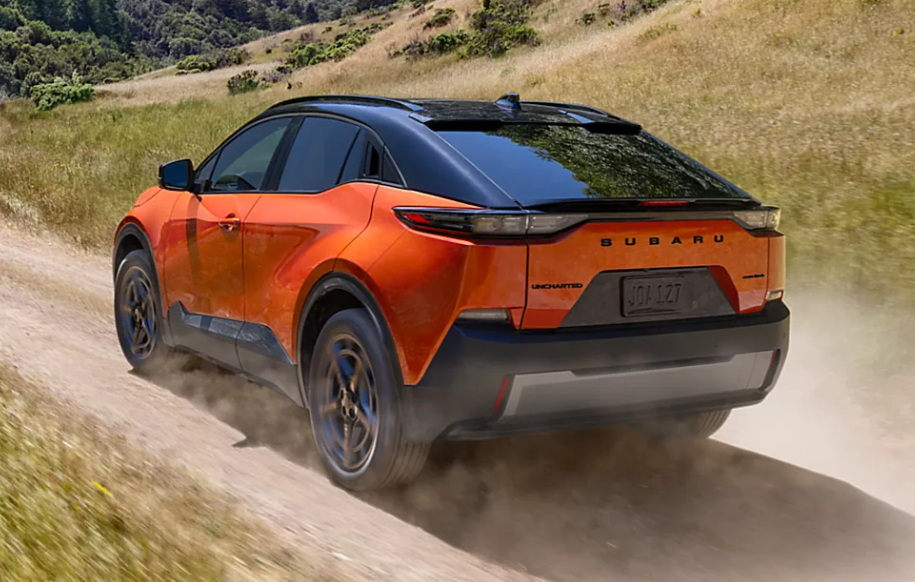
Subaru recently brought some journalists to Southern California to demonstrate the off-road capability of its new Uncharted EV.
The coverage predictably focused on approach angles, water fording depth, and how the electric powertrain delivers torque.
The implicit narrative Subaru was trying to sell was that electric vehicles can finally do what Subarus have always done, therefore Subaru customers will buy electric Subarus.
This reasoning contains a flawed assumption that explains why off-road-capable EVs consistently underperform sales projections. Subaru’s Uncharted can probably mud-slog as well as an Outback. But capability demonstrations don’t address the actual purchase friction for customers who buy vehicles based on where they might go once in a blue moon, not where they actually drive.
The Subaru Customer Paradox
Subaru sold more than 640,000 vehicles in the United States in 2025. Most buyers select Subaru specifically for all-wheel drive and ground clearance. Market research consistently shows these customers cite “preparedness” and “capability” as purchase motivations.
Yet, almost like a lot of pickup trucks, the overwhelming majority of these vehicles spend their service lives commuting on paved roads in regions that receive less than twenty inches of snow annually.
The Subaru buyer pays a modest premium, perhaps $2,000 over a comparable front-wheel-drive sedan, for the psychological security of knowing their vehicle can handle conditions they encounter maybe three times per year. A snow emergency. A muddy campground access road. A steep, rutted driveway at a mountain rental.
The premium is acceptable because it’s small relative to total cost of ownership, requires no behavioral change, and creates zero additional friction. The Outback doesn’t need different fuel. It doesn’t require route planning around capability infrastructure.
The EV Breaks Differently
Consider the same buyer now evaluating the Uncharted. The buyer isn’t paying $2,000 for preparedness. They’re now also accepting range uncertainty, charging infrastructure dependency, and cold-weather performance degradation all to maintain capability for scenarios that represent less than one percent of annual mileage.
The Uncharted AWD has an EPA-estimated 287 miles of range. In winter conditions with highway speeds, real-world range drops to approximately 200-220 miles. For the buyer taking that annual ski trip to Tahoe or Mammoth, this creates a mandatory charging stop that wouldn’t exist with the gasoline Outback. The “preparedness” vehicle now requires more preparation.
The scenarios where the buyer specifically values Subaru capability, such as mountain access roads, winter storm conditions, remote recreational areas are precisely the scenarios where EV infrastructure is sparsest and range degradation is most severe. And this mismatch is a big issue for Subaru.
Rivian R1S buyers skew heavily toward people who already own a truck or SUV for serious off-roading. The “off-road” EV becomes the daily driver. The gasoline vehicle becomes the insurance policy. The buyer who would have purchased one Subaru now needs two vehicles to achieve equivalent psychological security.
The Friction of Confidence
Subaru’s core customer base exhibits a specific risk profile: moderate earners who value reliability and preparedness over performance or luxury. Median household income for Subaru buyers runs around $75,000-$85,000. These aren’t people who can easily absorb vehicle ownership mistakes. The Uncharted GT AWD starts at $43,795, representing roughly seven months of gross household income for the median buyer.
The gasoline Subaru purchase carries minimal knowledge burden. The buyer understands how it works, where to fuel it, and how to maintain it. The purchase decision is essentially: “Do I like the vehicle at this price?” The operational model is completely legible.
The EV purchase, on the other hand, requires the buyer to develop a working mental model of range management, charging infrastructure, and cold-weather behavior. They must evaluate their own driving patterns, available charging locations, and edge-case scenarios. The purchase decision expands into territory most buyers would rather avoid: “Do I like the vehicle, can I make it work with my life, and am I correctly estimating my future charging behavior?”
Where the Uncharted Actually Fits
There is a genuine market for the Uncharted, but it’s smaller and different than Subaru’s existing customer base. The natural buyer already owns an EV, understands the operational model, and wants to add capability for occasional adventure use while maintaining the efficiency and low operating costs of electric drive for daily commuting.
This buyer exists primarily in regions with robust charging infrastructure and moderate climates coastal California, the Pacific Northwest, parts of Colorado. They likely have home charging. They’ve already solved the range-planning mental model. The Uncharted offers them incremental capability (better ground clearance and off-road tuning than a Model Y) without forcing them back to gasoline.
The volume here is perhaps 15,000-25,000 annual units if Subaru executes well. Not trivial, but not a mass-market Outback replacement. The product works for a customer who has already crossed the EV adoption threshold, not for the customer who chose Subaru precisely because it requires no threshold-crossing.
The Two-Car Transition Strategy
The more likely path for traditional Subaru customers into EVs doesn’t run through off-road capability at all. It runs through the second car.
The household that owns a gasoline Outback for weekend capability and a Civic for commuting can replace the Civic with an EV. The gasoline Outback remains the insurance policy. The EV becomes the optimized daily driver for the use case where range and charging infrastructure actually align with driving patterns.
The older Solterra essentially a rebadged Toyota bZ4X struggled despite being a perfectly competent vehicle because it asked the single-Subaru household to replace their insurance policy with a vehicle that had a coverage gap. The Uncharted improves on range and pricing, but the value proposition still works best for households that can spread the risk across multiple vehicles.
Subaru’s long-term EV strategy likely requires a bifurcation: maintain gasoline/hybrid Outbacks and Foresters for traditional customers, while developing EVs for urban and suburban buyers who are solving different problems entirely. The Uncharted might succeed, but not by converting existing Outback buyers. It succeeds by finding the small but real population of EV-native households who want more capability than a crossover offers.
The Lesson in Customer Definition
Vehicle capability demonstrations are useful for engineering validation. They prove the product can do what the manufacturer claims. But capability and purchase motivation are not the same thing. The Subaru customer isn’t buying maximum capability. They’re buying minimum sufficient capability with maximum reliability and minimum friction. The Uncharted delivers on capability while adding friction that didn’t previously exist.
The customer’s reluctance to buy a vehicle is directly proportional to the size of the behavioral change required. The smaller the change, the faster the adoption. The gasoline Outback required no change, it simply did what cars had always done, with slightly better traction. The Uncharted requires a non-trivial operational model shift for exactly the customer segment least interested in operational model shifts. That’s a recipe for a niche product in search of early-adopter buyers who happen to want Subaru styling, not mass-market success.