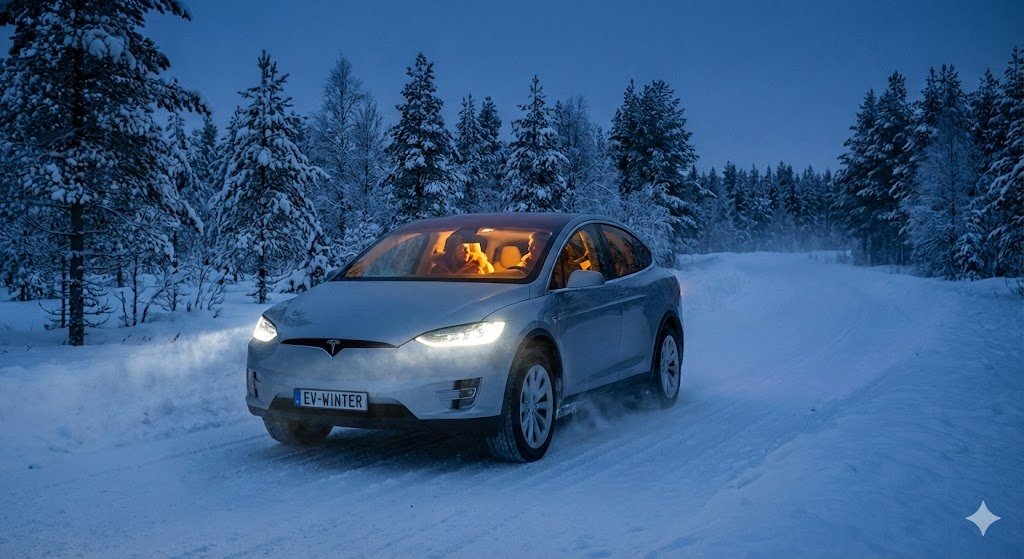
Every winter brings a fresh wave of stories about electric vehicles stranded in cold weather, batteries drained to nothing, owners left shivering. The coverage follows a predictable pattern: anecdote, alarm, and the implicit suggestion that EVs aren’t ready for real-world conditions. But the real world tells you a different story, one where the constraints are real but widely misattributed, and where the solutions have been quietly arriving for years.
What Actually Happens to an EV in Cold Weather
Lithium-ion batteries experience reduced electrochemical activity at low temperatures. The lithium ions move more slowly through the electrolyte, increasing internal resistance and limiting both discharge and charge rates. So there is energy loss that is incurred to overcome this resistance.
Real-world data shows EVs lose 15-20% of range at freezing, 20-30% at 14°F (-10°C), and 30-40% at -4°F (-20°C). The 40-50% figures sometimes cited typically come from extreme conditions or older models without active thermal management. The distinction matters: a 2024 model and a 2014 model are not the same vehicle, even if both are “EVs”. In fact, EVs are so rapidly evolving that ten years is an entire life time!
The Core Constraint: Waste Heat, Not Battery Chemistry
The central misunderstanding in cold-weather EV coverage is attributing range loss primarily to battery degradation. In reality, most winter range loss comes from a problem internal combustion vehicles solved by accident: cabin heating.
Gasoline engines are roughly 25-30% efficient. The remaining 70-75% of fuel energy becomes waste heat, enough to warm the cabin, defrost windows, and keep passengers comfortable at no apparent cost. This inefficiency becomes a useful feature in winter.
Electric motors are 85-90% efficient. They produce almost no waste heat. Every watt used to heat the cabin comes directly from the battery pack. Early EVs used resistive heating essentially a large electric space heater drawing 4-6 kW continuously. At highway speeds, this could consume 15-20% of available energy before the wheels even turned.
This is why heat pumps changed the equation. A heat pump moves thermal energy rather than generating it, achieving 200-300% effective efficiency compared to resistive heating. The same cabin comfort now requires 1.5-2 kW instead of 5 kW. Most EVs sold since 2022 include heat pumps as standard equipment, a transition that happened with little fanfare but significant impact.
EVs Are a Bit Too Transparent Compared to Gasoline Cars
Breaking down winter energy consumption reveals the hierarchy of losses:
Cabin heating accounts for 30-40% of winter energy use in EVs without heat pumps, dropping to 15-20% with modern systems. Battery conditioning, i.e. keeping the pack within its optimal 60-80°F operating window, adds another 10-15%. Reduced regenerative braking efficiency costs 5-10%, since cold batteries cannot absorb energy as quickly during deceleration.
Then there are losses that affect all vehicles but go unnoticed in combustion cars. Cold air is denser, increasing aerodynamic drag. Cold tires have higher rolling resistance. Wheel bearings and drivetrain lubricants thicken. These factors collectively add 5-10% to energy consumption regardless of powertrain.
The comparison to combustion vehicles is instructive but incomplete. A gasoline car’s winter fuel economy also drops 10-20%, but owners rarely notice because refueling takes the same three minutes regardless of temperature. The EV’s transparency about energy consumption makes its winter penalty visible in ways that gasoline obscures.
We Still Need More Chargers
All this boils down to the fact that the more practical constraint for most owners is not range itself but charging behavior. A 300-mile EV losing 30% of range still offers 210 miles more than five times the average American’s daily driving distance of 37 miles. For home chargers, cold weather barely affects Level 2 charging speeds; the vehicle simply charges overnight as usual.
DC fast charging presents a different picture. Cold batteries limit charge acceptance rates to prevent lithium plating, which can permanently damage cells. A battery at 20°F might accept only half its normal fast-charging rate until warmed. This is where preconditioning becomes essential: modern EVs can heat their batteries en route to a charging station, restoring near-normal charging speeds by arrival. The feature exists in most current models but requires drivers to use navigation to the charger, which not all do.
The buyers most affected by winter range constraints are those without home charging apartment dwellers relying exclusively on public infrastructure, or road-trippers crossing remote areas. For these use cases, the constraints remain real if diminishing. For suburban homeowners with garage charging, winter range loss is largely a non-issue managed through behavioral adjustment: plug in nightly, precondition before departure, use seat heaters over cabin heat.
Its Only Going to Get Better
Heat pump adoption has already addressed the largest single source of winter range loss. Battery thermal management systems have improved substantially, with newer packs reaching operating temperature faster and maintaining it more efficiently. Preconditioning software has become more sophisticated, with some vehicles now predicting departure times based on driver patterns.
Sodium-ion batteries, now entering mass production, offer better cold-weather performance than lithium-ion chemistries, maintaining higher discharge rates at low temperatures without the same degradation risks. If sodium-ion captures even a portion of the standard-range market, cold-weather performance could improve further.
The pattern here mirrors other EV adoption constraints: real limitations that improve year over year, often faster than the public narrative acknowledges. Range anxiety was a legitimate concern with 80-mile EVs; it’s largely psychological with 300-mile vehicles. Cold-weather performance was a genuine weakness when EVs relied on resistive heating; it’s a manageable trade-off with heat pumps and active thermal management.
The Actual Lesson: It’s All About Charging
Cold weather does reduce EV range, at least in most lithium battery based EVs today. The physics are real, and the constraint is not imaginary. But the framing matters. The largest losses come from cabin heating, not battery chemistry, and heat pumps have cut that penalty by more than half. The remaining losses are comparable to what combustion vehicles experience, just more visible.
For buyers in cold climates, the question is not whether an EV can handle winter millions of vehicles in Norway, Canada, and the northern United States demonstrate that it can. The question is whether the buyer has access to charging, which transforms winter range loss from a daily calculation into a non-event. That infrastructure constraint, not the physics of lithium-ion chemistry, is where the real adoption barrier sits.