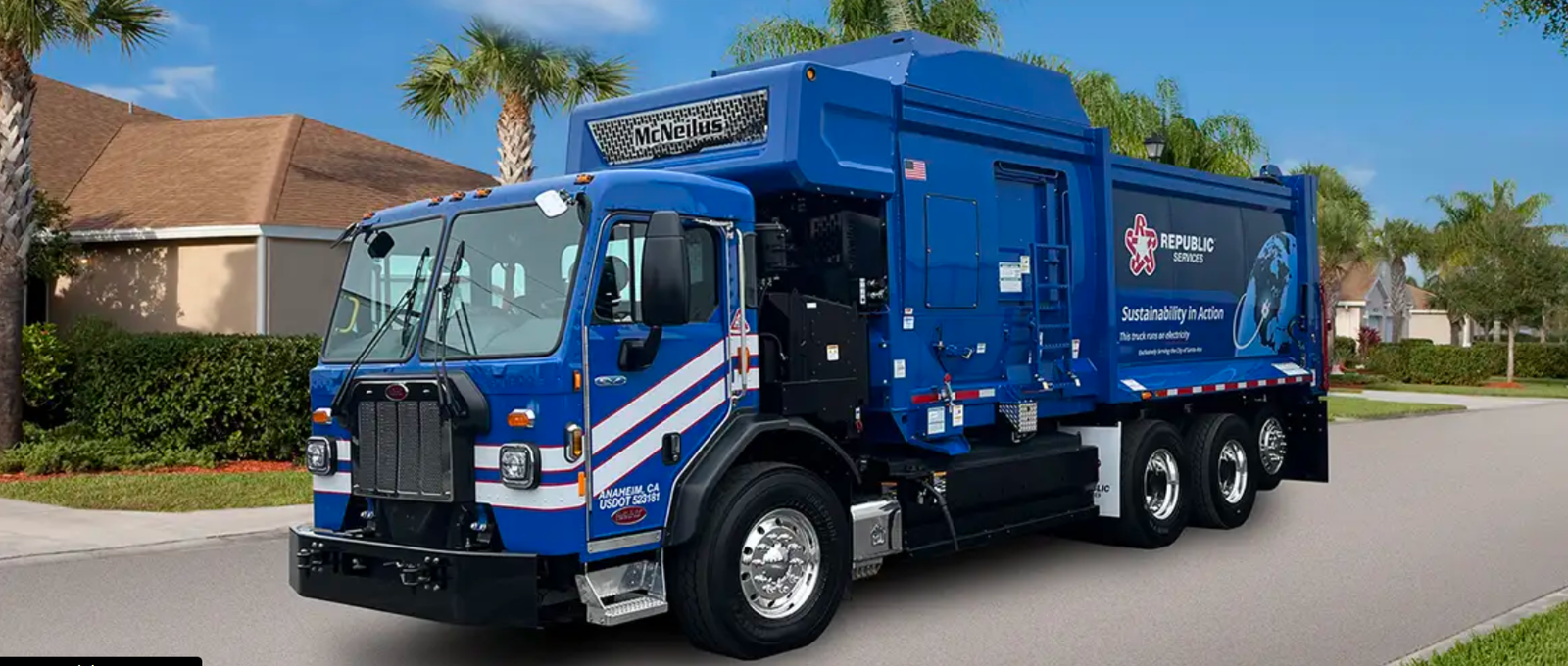
Diesel garbage trucks are some of the most polluting vehicles on the road, idling for long periods and crawling through dense urban routes. A diesel garbage truck emits somewhere between 50 – 150 metric tons of carbon dioxide every year and 200 – 500 kg of nitrogen dioxide, depending on the extent of its use. These are some of the highest emissions of any vehicle on the road. To put it in context garbage truck emissions are more than 20 times the emissions of a passenger gasoline car!
Several OEMs have stepped up with electric garbage truck models that are gradually getting traction. There are also firms like Roundtrip EV that are now actively helping waste management companies and municipalities across the country transition their fleets to electric by helping them procure the right rucks and set up the fast charging infrastructure that’s required to power these trucks.
In this post, we break down four leading manufacturers in the electric garbage truck market, Battle Motors, Mack Trucks, Peterbilt, and Oshkosh, and examine how their offerings stack up in terms of design, battery and performance.
Battle Motors
Battle Motors, formerly known as Crane Carrier Company, has been selling garbage trucks for many decades. It’s trucks are popular in the US Northeast and with a lot of municipalities nation wide. It has two electric garbage truck models: the LET 2 Electric and LNT Electric. These trucks cover a wide spectrum of use cases, from narrow alleys to full-width city routes. Battle’s electric lineup offers a smaller 240 kWh battery (LNT) and a larger 396 kWh battery (LET).
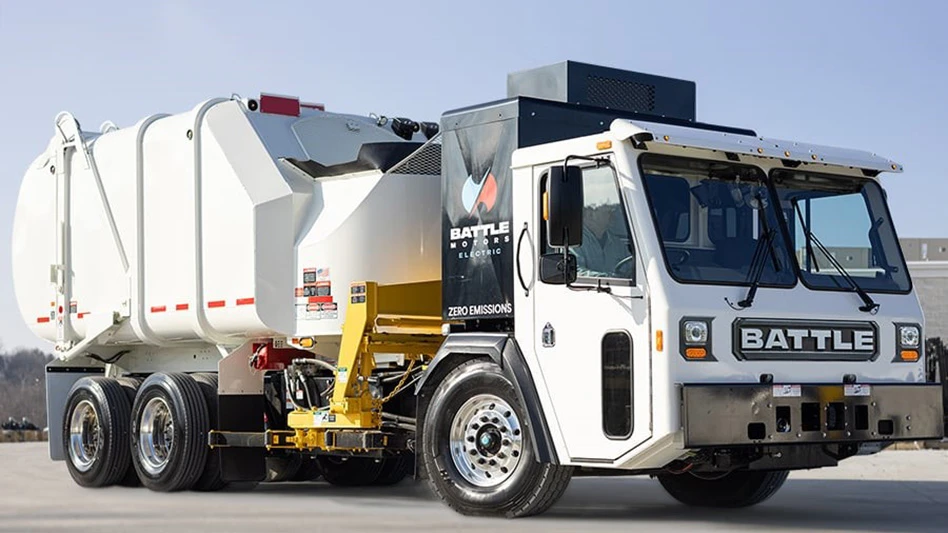
Battle’s design places the battery right behind the cab which places a lot of weight on the front axle. This is in contrast to other manufacturers like Peterbilt and Oshkosh who have chosen to spread the battery across the chassis or on either side of the body which helps distribute the weight more evenly across the front and rear axles.
Battle also uses a central drive chassis design as opposed to the e-axle design which while being a lot more easy to repair is also relatively less efficient. We think that as Battle continues to see more and more demand for electric demands, they will eventually transition to using e-axles.
Battle is famous for its low entry cab which allows drivers easy access. Their LNT model (LNT = Low Narrow Tilt) is particularly suited for dense and narrow urban streets where turning radius and visibility matter. They also offer a 3 man cab option which is quite popular with municipalities who have to comply with union requirements.
It’s chassis can accommodate both a rear loader body as well as an automatic side loader which allows customers to use it across all residential routes. Battle does not offer a chassis for a front loader body which rules it out from operating on commercial routes.
Mack
Mack’s LR Electric is perhaps the most recognizable electric garbage truck currently in operation. Designed from the ground up for city sanitation routes, the LR Electric combines twin electric motors with 376 kWh of NMC battery power.
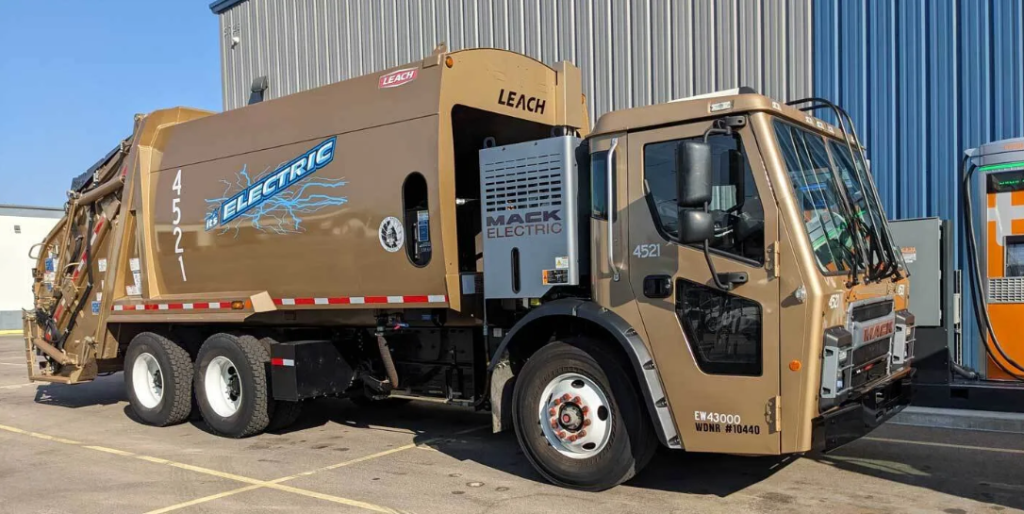
The Mack chassis is quite similar to the Battle chassis in that it has a central drive design and a battery position just behind the cab. The Mack cab also provides for low entry just like the Battle cab.
It’s battery size of 376 kWh though, is slightly lower than that of Battle and Peterbilt (which are closer to 400 kWh). Mack’s battery also uses the relatively older NMC battery chemistry technology which is slightly different from the LFP battery chemistry used by Battle and Peterbilt. Mack’s parent company, the Volvo Group, purchased Proterra’s battery business out of bankruptcy, and is perhaps the only refuse truck manufacturer that can source its own batteries. We expect them to gradually transition to using LFP batteries.
Mack’s chassis allows for both rear loader and side loader bodies but does not allow for front loader bodies yet.
Peterbilt
The Peterbilt 520EV is our first e-axle based electric garbage truck. We have spend a lot of time talking about pros and cons of the e-axle approach but but there is little doubt that eventually, as the market matures, all electric trucks will exclusively be using an e-axle because of it’s inherent efficiencies.
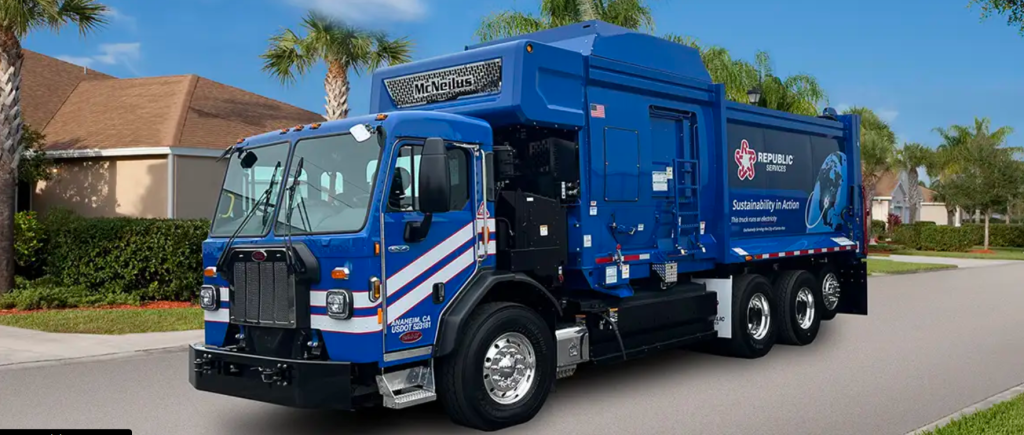
Peterbilt’s 396 kWh battery uses the LFP battery chemistry just like Battle. It also allows for both rear loader and side loader bodies but does not yet allow for commercial front loaders.
The cab uses a cabover design just like Battle and Mack but does not appear to have as much of a “low entry” cab compared to the two.
The battery positioning though is where Peterbilt has a few advantages. The battery appears to be distributed just behind the cab but also across the lower sides of the body. This allows the engineers a lot more design flexibility if they want to integrate heavier refuse bodies. The position of the battery also affects the aerodynamics of the vehicle. After all, there is a reason why advanced EV manufacturers like Tesla prefer to spread the battery across the chassis versus placing it in the frunk.
Peterbilt is now the only manufacturer to have two different chassis models for EV refuse trucks.
Peterbilt recently come out with a new and better “vocational” EV called the 567EV which it said can be used for rear loader trucks. Peterbilt’s diesel version of the 567 model is a pretty popular model in the refuse industry and the electric version of it should be no different.
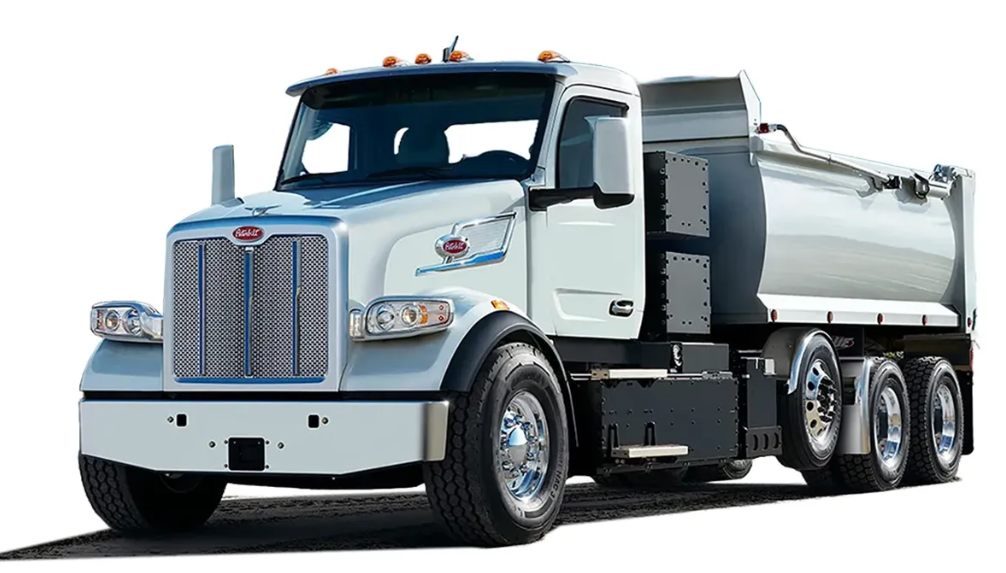
More importantly, these newer trucks have a battery than can go up to 625 kWh which will be more than sufficient for most garbage pickup routes. This larger battery size would make the Peterbilt 567EV, along with the Oshkosh trucks, the largest EV refuse trucks currently available in the market.
Oshkosh
Oshkosh Corporation doesn’t strike you as a garbage truck brand as there is no “Oshkosh garbage truck”. But Oshkosh does own the McNeilus brand which is a popular refuse body manufacturer that’s been around for decades.
Oshkosh has leveraged McNeilus’ expertise in refuse and Oshkosh’s electric experience to launch the Volterra line of electric garbage trucks which is the first fully integrated line of garbage trucks in the entire industry. Typically, every garbage truck you see on the street has to pass through two separate factories before being delivered to the customer: the chassis is manufactured at a Mack or Battle or Peterbilt factory, while the hydraulic refuse body is manufactured at a different factory owned by Heil or New Way or Labrie or Curbtender.
The Volterra garbage truck though is fully manufactured at the Oshkosh / McNeilus factory. This is a huge advantage as you do not lose time trying to integrate two different components at two different factories.
Oshkosh’s Volterra comes in two variants, the ZSL (Side Loader) and ZFL (Front Loader). With an NMC battery that has capacities ranging from 499 to 665 kWh, these trucks are well suited to operate on the longest and most intense urban routes.

Oshkosh has totally upgraded the garbage truck experience with its large glass cabin that offers a lot more visibility than its competitors. The truck includes several “first of a kind” innovations that include AI-based bin detection and electrified arms that reduce operation times. They also have a tight turning radii which allows them to navigate through tight urban corners and avoid unnecessary rear ending accidents.
The Volterra ZSL as the “SL” in the name indicates, is a side loader. Oshkosh hasn’t released a rear loader yet and has instead focused on producing the first electric front loader truck in the market, the “ZFL”, the “FL” standing for “Front Loader”. Unlike the ZSL, which is already up and running in several towns across the country, the ZFL will only just be starting production in 2026.

📊 Comparison Summary
| OEM | Model(s) | Class | Battery (kWh) | Notable Features |
|---|---|---|---|---|
| Battle Motors | LET 2, LNT Electric | 6–8 | 240–396 | LFP battery, narrow/full-width cabs, urban maneuverability |
| Mack Trucks | LR Electric | 8 | 376 | NMC battery, in-house battery manufacturing |
| Peterbilt | 520EV, 567EV | 8 | 396 (520EV), up to 625 (567EV) | LFP battery, e-axle |
| Oshkosh | Volterra ZSL/ZFL | 8 | 499–665 | NMC battery, e-axle, AI bin detection, 360 degree visibility |
Conclusion
Electric garbage trucks represent a major leap forward not just in reducing emissions, but in reducing fuel and maintenance costs for fleets. The average diesel garbage truck is infamous for having low mileage and is extremely hard and expensive to maintain. Any town or fleet that is looking to save money should be looking at electric garbage trucks.
Each OEM we covered here brings unique strengths: Battle Motors excels in maneuverability, Mack offers proven performance, Peterbilt pushes the envelope with e-axle efficiency, and Oshkosh offers a state of the art vertically integrated platform.
While each manufacturer has its own strength, the ultimate winner will be the OEM who can offer a reliable truck that can operate on as many routes as possible.