Introduction
A few months ago, we analyzed Base Power’s residential battery business model in detail and how they were strategically positioning themselves to succeed in a tough battery market. Since then, Base Power has been executing well and continuing it’s remarkable fundraising run. In April 2025, they raised $200 million in Series B funding. Six months later, they closed a $1 billion Series C, bringing total funding to $1.3 billion. The company is now valued at $4 billion post-money.
The investor roster reads like Silicon Valley royalty: Andreessen Horowitz, Lightspeed Venture Partners, Thrive Capital, Valor Equity Partners, and Addition (which led the Series C). The CEO, Zach Dell, is the son of Dell Technologies founder Michael Dell, which likely didn’t hurt when it came to opening doors with top-tier VCs.
Given this level of backing and their successful deployment ramp up, we thought Base Power deserved a second look. The analysis revealed an interesting dynamic: while Base was raising over a billion dollars, the Texas/ERCOT battery storage market they operate in was experiencing substantial revenue compression. So why are investors pumping in another $1 billion dollars into this startup at such an elevated valuation?
Batteries are Everywhere in Texas: That’s not good news for Base
Batteries have become a victim of their own success in Texas. While it made a lot of economic sense to deploy batteries to smoothen out the volatility in the Texas electricity market and capture that spread, the rapid deployment of batteries have reduced that spread which in turn has reduced the revenue available to battery owners.
The revenue decline for batteries in the ERCOT market has been precipitous. Average battery revenue in ERCOT fell from $192/kW (2023) → $55/kW (2024), an alarming 71% decline in one year. However, Modo Energy’s most recent projections for 2025 show revenues stabilizing around $45/kW-year, still down 77% from 2023 peak levels, but holding steady rather than continuing to free-fall.
This shouldn’t be surprising because ERCOT battery capacity grew from 200 MW in 2020 to 12.5 GW by Q3 2025.
Base Power Unit Economics: Scenario Analysis
Base Power’s Gen 1 system uses a 25 kWh battery with 11.4 kW continuous power output. At current market conditions, here’s how the economics break down:
| Scenario | Net Cost | Upfront Fee | Monthly Fees | Retail Spread | Variable Revenue (ERCOT) | Total Revenue | Payback Period |
|---|---|---|---|---|---|---|---|
| Base Gen 1 (Current market, 2025) | $17,500 | ~$700 | ~$240/yr | ~$600/yr | ~$513 | ~$2,053 | 8.5 years |
| Gen 2: 25% cost reduction | $13,125 | ~$700 | ~$240/yr | ~$600/yr | ~$513 | ~$2,053 | 6.4 years |
| Gen 2: 50% cost reduction | $8,750 | ~$700 | ~$240/yr | ~$600/yr | ~$513 | ~$2,053 | 4.3 years |
| Gen 2: Target for 3-year payback | ~$4,340 | ~$700 | ~$240/yr | ~$600/yr | ~$513 | ~$2,053 | 2.1 years |
Methodology notes:
- Gen 1 costs: Based on Tesla Powerwall pricing of ~$1,000/kWh for comparable residential battery systems
- Upfront fee: One-time installation fee of $695-995, using midpoint of ~$700
- Monthly fees: Customer subscription of $19-29/month ($228-348/year), using ~$240/year
- Electricity spread: Base purchases wholesale electricity at 3-5¢/kWh and sells to customers at 8.5¢/kWh. For a typical 12,000 kWh/year household, this generates approximately $600/year
- Variable revenue (ERCOT): Based on Modo Energy’s $45/kW-year projection for 2025. Base Power’s assumed 11.4 kW inverter generates 11.4 kW × $45/kW-year = $513/year from energy arbitrage and ancillary services
- Gen 2 targets: Conservative scenario (25% reduction), bullish scenario (50% reduction), and target cost reverse-engineered from claimed 3-year payback
Given that it is unlikely that Base Power will a. be able to increase its retail electricity spread or volume and b. increase its Variable Revenue given increasing battery penetration in the Texas market, Base Power’s quickest and surest way of being more profitable is from drastically reducing the cost of its largest input, the cost of its batteries.
Base Power is Fundraising to Reduce Cost
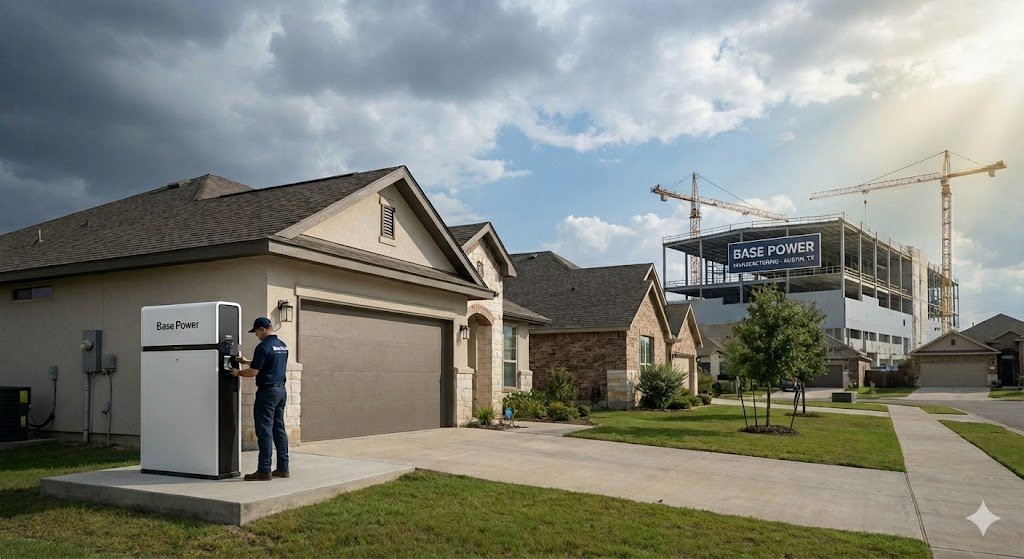
It is clear that the company’s strategy centers on achieving substantial manufacturing cost reductions rather than relying on price volatility in the ERCOT market. A lot of the Series C funding is for funding a factory at the former American-Statesman site at its headquarters Austin. There is going to be very little appetite amongst debt investors for funding another battery factory, so most of the factory will have to be funded using Series C equity.
If Base indeed goes to achieve a 50% manufacturing cost reduction through its Austin factory it’s payback drops to 4.3 years, making the system attractive to both its investors (from a profitability perspective) and its consumers (from a cost perspective).
Base still also has other revenue levers to pull if it continues to get widespread traction and scale. The retail electricity model provides predictable baseline revenue and potential margin expansion if required. If ERCOT revenues recover beyond $45/kW-year, economics improve further. Manufacturing cost reductions enable expansion to markets beyond Texas.
But we know that manufacturing improvements prove harder than anticipated. And there probably is a very good reason reason why even Tesla and Elon Musk, the most successful US manufacturer in the past 20 years still relies on its South Korean and Japanese partners for manufacturing it’s batteries.
If Base achieves only 25% cost reduction, which is the most likely outcome, payback will increase to 6.4 years which is still impressive but not transformative. The company would need continued capital support to sustain deployment rates while iterating toward better manufacturing efficiency.
Conclusion
Base Power has decided to do it the hard way. The startup graveyard in climate tech is filled with companies that thought they could make batteries in the US more efficiently than a lot of their East Asian counterparts. You would have to think that at least one of these startups will eventually succeed – that startup could very well be Base Power. The next 12-18 months of factory ramp-up will demonstrate whether Base can achieve the cost reductions necessary to make the business model work at scale.
What’s your take on Base Power’s manufacturing-first strategy? Share your thoughts in the comments.