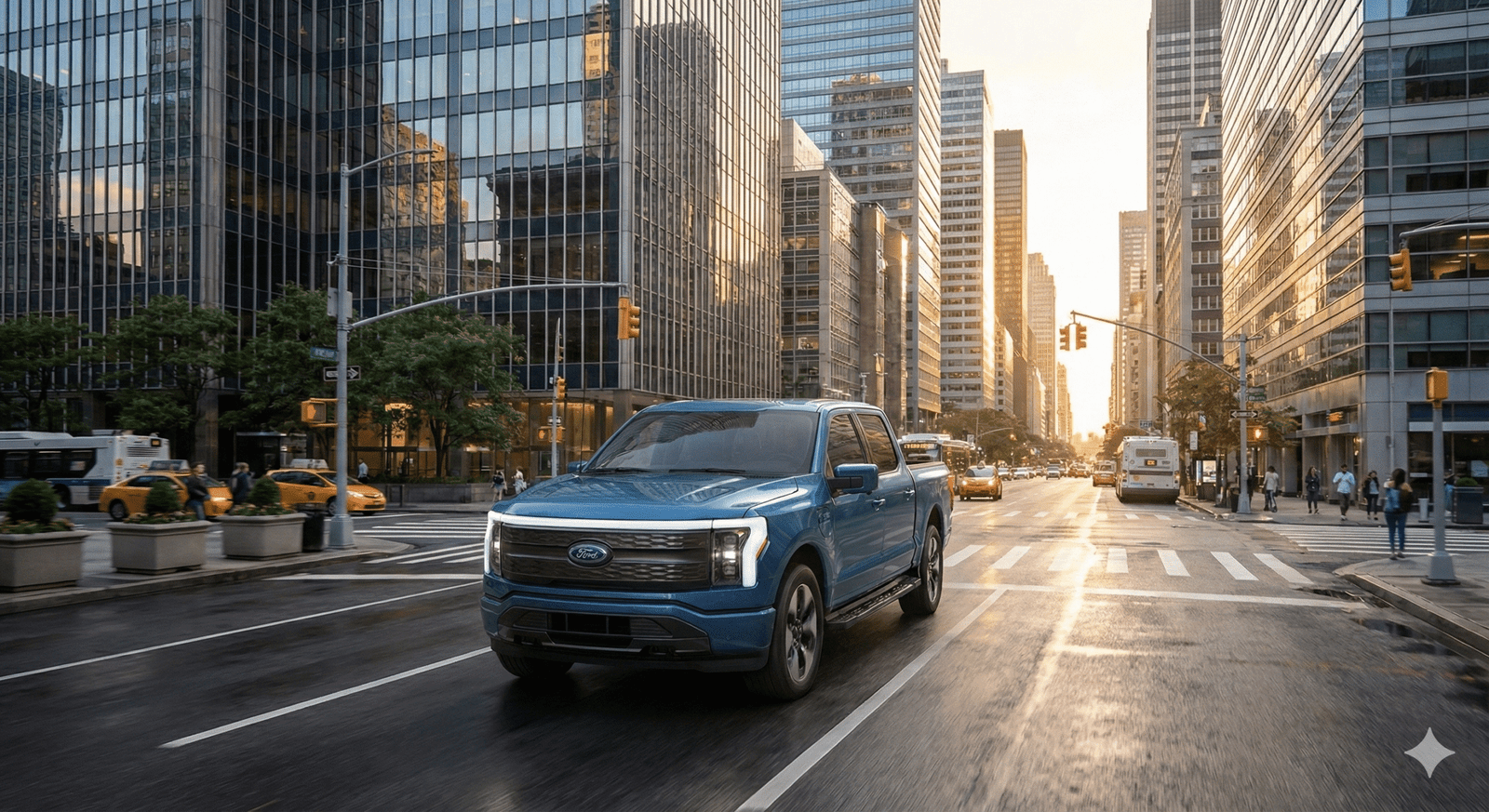
This week, Ford made official a shift that most people following the company closely have expected for some time.
The company announced a $19.5 billion write-down tied to scaling back earlier EV plans, reshaping several vehicle programs, exiting a battery joint venture, and reallocating capital toward hybrids, extended-range EVs, and non-automotive battery applications. As part of that reset, Ford confirmed that the all-electric F-150 Lightning will not continue in its current form. When the Lightning returns, it will do so as an extended-range electric vehicle rather than a pure battery-electric truck.
What Ford Actually Changed
Ford is no longer producing the current battery-electric F-150 Lightning. The next iteration of the truck will still be electrically driven, but it will include a gasoline-powered generator to recharge the battery when demand spikes. Ford expects EV like performance to remain intact, while reducing the need to oversize the battery for infrequent edge cases.
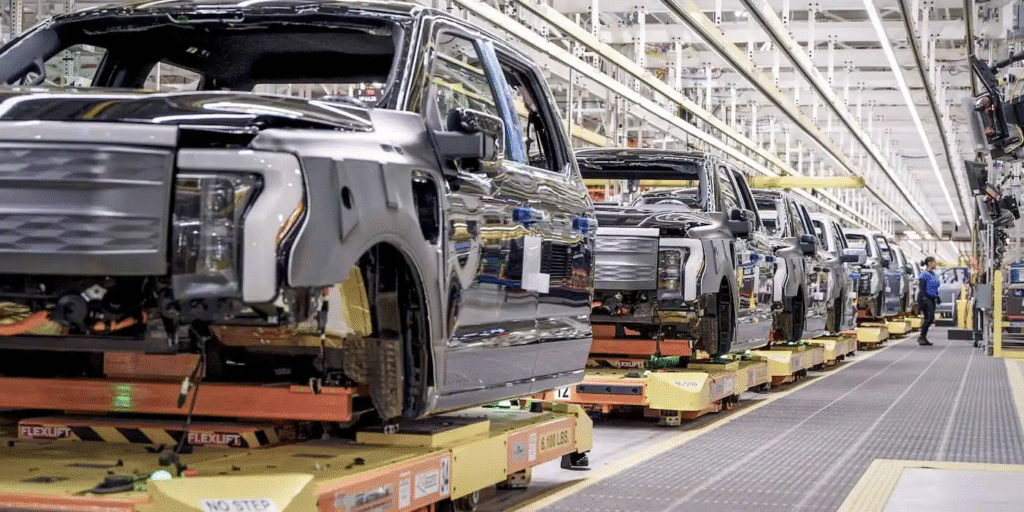
At the same time, Ford canceled plans for a fully electric commercial van in North America, shifted factories and workers back toward gasoline and hybrid production, ended its battery joint venture with SK On, and redirected its owned battery facilities toward grid-scale energy storage. Ford continues to plan a lower-cost, midsize electric pickup built on a new, dedicated EV platform later this decade.
This move, while expected, has come at a time when the bad news can’t stop coming for the EV industry. Apart from being a big loss for potential EV customers it has perhaps created a false perception that EVs on the whole are a temporary fad that may not last forever.
Ford’s First Mistake: Using the Same Chassis for Electric and Gas Trucks
So what went wrong for Ford?
To start, the F-150 Lightning was not designed from scratch as an electric vehicle. It was an F-150 gasoline vehicle first, a platform optimized for internal combustion, with an electric drivetrain fitted into it. That decision accelerated time to market, but it also locked in compromises around battery packaging, aerodynamics, manufacturing efficiency, and cost.
Successful EV manufacturers learned early that electric vehicles must be designed as EVs from day one. When battery placement, structure, cooling, and manufacturing are treated as first-order design inputs, costs fall faster and performance improves more predictably. Retrofitting an EV into an ICE architecture almost always delays that convergence. This is how most Chinese EV manufacturers have designed their EVs. This is also the reason why smartphone companies like Xiaomi from China have had more success making EVs than legacy automobile manufacturers in the US.
The Lightning was in a lot of ways a make shift vehicle that Ford used to capitalize on once surging demand in the beginning of the decade. But it was never positioned to be Ford’s most cost-efficient or scalable EV.
Towing Needs Good Aerodynamics
Its not just that. F-150 owners expect to use their truck for towing as well. And EVs are currently not the best powertrain for towing.
This is a physics constraint that’s hard to solve with existing BEV technology.
An EREV architecture relaxes that constraint. It preserves electric drive for most usage while avoiding battery oversizing for rare, high-drag scenarios. From an engineering perspective, it is a way of acknowledging limits rather than fighting them prematurely.
The Buyer Reality
There is also a demand-side constraint that matters just as much.
Buyers of large, expensive pickup trucks are not typically early adopters of new propulsion technologies. These customers value reliability, flexibility, and minimal behavior change. They expect the vehicle to handle every scenario without planning or adaptation. They also probably buy an F-150 precisely for the fact that its big and it runs on gasoline, and an electric version of it, even with all its benefits, may have been off putting to a lot of these folks.
A premium battery electric truck asks for the opposite: charging awareness, infrastructure trust, and tolerance for new tradeoffs. Some customers will accept that. Many will not, especially at $70,000 plus price points.
Leading the EV transition with this segment was always going to be slower than starting elsewhere.
But Ford’s EV Ambitions Aren’t Dead
But with all the gloom and doom its still important to remember that Ford has not stepped back from EVs totally. It adjusted it’s strategy to focus on a different customer segment for EV adoption. Its worth noting that just before Ford announced it’s discontinuation of the Lightning, it had an entire article in the New York Times about its new focus on smaller, affordable EVs.
The company now appears to believe that low-cost, purpose-built EVs are the correct starting point for mass adoption. These vehicles align better with early EV use cases: short city commutes, predictable daily mileage, and environments where charging is improving fastest.
This approach compounds advantages. Smaller EVs need less battery capacity, move down the cost curve faster, and expose more customers to EV ownership with fewer demands. As those customers become familiar with electric drivetrains and as Ford’s next-generation EV chassis and manufacturing processes improve more demanding segments become viable.
In this framing, the all-electric heavy pickup is not abandoned. It is deferred until the technology, cost structure, and customer readiness converge.
Capital Discipline and Time
The $19.5 billion write-down reflects the cost of getting the order wrong.
Large EV programs tie up capital for long periods, particularly when they rely on large batteries and legacy platforms. When adoption is slower than expected and global competitors iterate faster, flexibility becomes more valuable than persistence.
Ford’s reallocation of battery assets toward energy storage, its renewed emphasis on hybrids and EREVs, and its focus on de novo EV platforms all point in the same direction: reduce fixed bets early, preserve optionality, and let learning compound.
Part of this is also political, and also to send warm signals to an administration that is decidedly anti EV in its policies.
The Actual Lesson
Ford’s “retreat” from EVs is a disappointment. But it did not kill the Lightning because EVs do not work.`
It killed the Lightning in its original form because electrification succeeds at scale only when vehicle design, economics, and user behavior are aligned and fails when they are forced out of order.
The jury is out on whether Ford’s slight pivot will succeed in the long term. But at least its strategy of focusing on affordable, small EVs at scale has the potential to bring its cost curve down to a point where Ford can eventually build the big trucks that it loves to build.