A car that costs less than a used Honda Civic is now China’s volume leader. The Geely Xingyuan recently dropped to a starting price of $9,133, added 298 miles of range in its top configuration, and equipped features like automated parking that luxury sedans charged extra for just five years ago. The update arrived with minimal fanfare, a $567 price cut, and the kind of spec sheet that makes Western automakers quietly recalculate their cost models.
When the world’s largest car market standardizes prices that seem impossible to anyone building vehicles in Germany or Tennessee, understanding the constraint becomes critical. What does Geely exploit that competitors can’t replicate? And can that advantage travel beyond China’s borders?
The Fixed Costs That Don’t Scale Down
Building a car costs roughly the same whether you sell it for $9,000 or $40,000. The stamping press doesn’t care about your price target. The paint booth runs at the same temperature. Quality control stations take the same amount of floor space. These fixed costs create a brutal squeeze at the bottom of the market because you can’t engineer your way out of them.
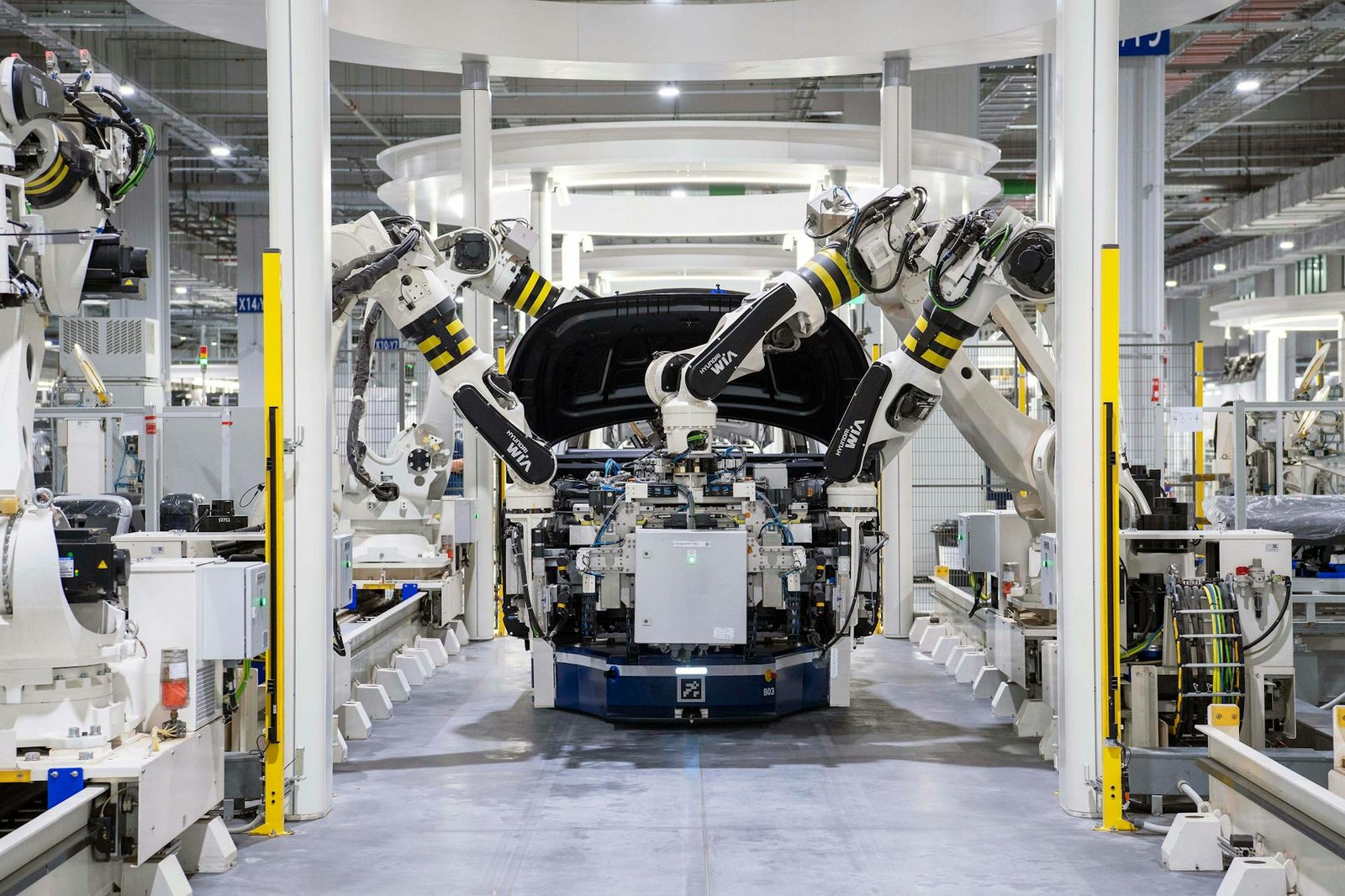
A typical vehicle assembly line requires about $500 million to $1 billion in capital investment before the first unit rolls off. Spread that across 100,000 units per year, and you’re adding $5,000 to $10,000 per vehicle just to cover the depreciation on factory equipment. Double your volume to 200,000 units and that per-unit burden drops to $2,500 to $5,000. Volkswagen builds multiple models on the MQB architecture for exactly this reason.
The Geely Xingyuan sits on a dedicated small-EV platform that shares components across multiple brands in the Geely empire. Variants appear under different nameplates, splitting fixed costs across production runs measured in hundreds of thousands. Adding the 47 kWh battery option and upgrading to faster charging (30 to 80 percent in 19 minutes versus the previous 30-minute spec) required no fundamental redesign. Geely inserted higher-capacity components into an existing, fully amortized architecture.
Western competitors trying to hit similar price points face a different cost structure. They’re either adapting platforms designed for more expensive vehicles (adding cost through over-engineering) or creating new dedicated platforms without the volume to justify the tooling investment. Ford’s attempt at a $25,000 EV reportedly stalled because the company couldn’t find a path to acceptable margins at that price point with realistic U.S. production volumes.
The Battery Equation That Doesn’t Add Up Elsewhere
A 47 kWh battery pack contains about $4,000 worth of cells at current Chinese production costs (roughly $85 per kWh at the pack level). Add the battery management system, thermal controls, and structural housing, and the complete pack assembly exceeds $5,000. At a $14,000 vehicle price (the top trim with the largest battery), that’s 36 percent of the retail price going to one component.
If your battery costs $5,000 and you need to sell the vehicle for $14,000, you have $9,000 left for everything else: the electric motor, power electronics, chassis, body panels, interior, assembly labor, logistics, dealer margin, and manufacturer profit. Strip out the battery entirely and you’re essentially building a $9,000 car with an electric drivetrain instead of an internal combustion engine.
The Geely Xingyuan solves this by accepting thin margins that would be unacceptable to publicly traded Western automakers. Many Chinese EV manufacturers receive direct or indirect government support through favorable financing, subsidized land for factories, or preferential treatment in permitting and grid connections. They also maintain lower labor costs, particularly in engineering overhead and compliance staffing.
Vertical integration eliminates margin stacking. When a U.S. automaker buys a battery pack, they’re paying a supplier’s cost plus that supplier’s profit margin. Geely’s battery supply comes from related entities within the broader corporate structure, sold at transfer prices that prioritize vehicle competitiveness over component profitability. Profit gets recognized at the vehicle level, not marked up at every step of the supply chain.
The Features That Used to Cost Extra
The updated Xingyuan added Geely’s G-Pilot (Geely Pilot Intelligent Driving) system, bringing navigate-on-autopilot capability and automated parking to a vehicle that costs less than a loaded Toyota Corolla. The previous model lacked these features entirely. The new version includes sentry mode with camera recording, smartphone integration through the upgraded Flyme Auto system, and driver assistance features that required stepping up to premium trims from competitors like BYD.
This feature inflation creates a perception problem. When a $9,000 car offers automated parking, what exactly justifies the $15,000 premium a Volkswagen ID.3 commands in European markets? Some of that gap represents genuine differences in crash safety, NVH engineering, and component durability. But a meaningful portion reflects cost structures that Chinese manufacturers have simply bypassed.
Other automakers face an economic constraint, not a technical one. General Motors demonstrated Super Cruise, Stellantis owns autonomous driving technology through acquisitions, and Toyota has been developing driver assistance systems for decades. These companies built their software development processes during an era when adding features meant optional packages and higher transaction prices. They organizationally struggle to give away technology that cost hundreds of millions to develop.
Chinese EV makers entered the market after software became table stakes. They didn’t have legacy processes to protect or existing customers expecting incremental improvements. Navigate-on-autopilot could be standard equipment because it was never a profit center to begin with, just another cost amortized across the platform.
The Range Claims That Need Context
The 298-mile range figure for the 47 kWh Xingyuan comes from China’s CLTC testing cycle, which produces numbers roughly 20 to 30 percent higher than EPA estimates and 10 to 15 percent above WLTP. A more realistic range expectation for U.S. driving conditions would be 210 to 240 miles, depending on climate and driving style. That positions the vehicle as viable for urban and suburban use but marginal for regular highway trips.
Range anxiety operates differently at different price points. A buyer spending $60,000 on a vehicle expects it to handle any driving scenario without planning. A buyer spending $14,000 arrives with different expectations, closer to what they’d accept from a second car or commuter vehicle. The Geely Xingyuan succeeds partly because it’s priced low enough that limitations become acceptable trade-offs.
The charging speed improvement to 19 minutes (30 to 80 percent) still lags the industry leaders who achieve similar charging in 15 minutes or less, but crosses a usability threshold. Twenty minutes is short enough to combine with a meal stop or restroom break. Forty minutes (the rough equivalent of the older spec) forced charging into its own discrete activity, making trip planning more cumbersome.
Faster charging requires either different cell chemistry (which costs more) or more sophisticated cooling systems (which add weight and complexity). Geely chose to improve charging speed to the point of acceptability without pursuing the diminishing returns of absolute performance leadership.
The Export Problem Nobody’s Solved
The Geely Xingyuan will eventually reach international markets, but the $9,133 price won’t travel with it. Shipping costs (roughly $1,500 to $2,000 per vehicle to Europe or North America), compliance testing for different regulatory regimes (crash standards, emissions verification, cybersecurity requirements), import duties (10 percent in the U.S., potentially 20 to 30 percent in Europe following recent tariff discussions), and dealer network development raise the landed cost by 40 to 60 percent before the first customer takes delivery.
That puts the realistic Western market price somewhere between $13,000 and $15,000 for the base model, assuming Geely accepts similar margins to what they earn in China. At $15,000, the vehicle competes with used cars, not new ones. Buyers can get a three-year-old Honda Civic with 30,000 miles for similar money. The value proposition changes completely.
The specific advantages that make the Xingyuan successful in China may not translate to markets with different infrastructure, different driving patterns, and different competitive sets. Chinese cities have extensive public charging networks, high population density that favors shorter-range vehicles, and regulatory environments that actively disadvantage internal combustion vehicles through license plate restrictions.
None of those conditions apply in Phoenix or Atlanta or rural France. The buyer choosing between a $15,000 Geely and a $15,000 used Civic faces a different calculation than the buyer in Shenzhen choosing between a $9,000 Geely and a $12,000 new gasoline car that requires winning a license plate lottery.
What the Price Cut Signals
Geely dropped the Xingyuan’s starting price by $567 despite adding features and capability. Normally, you raise prices when you add value. The reduction suggests overcapacity, intensifying competition, or both. Chinese EV sales grew substantially in recent years, but so did manufacturing capacity. Every major automaker and several new entrants added production lines, creating a situation where supply growth outpaced demand growth.
When you have more production capacity than sales, you either cut prices or cut production. Cutting production means eating fixed costs across fewer units, which worsens per-unit economics. Cutting prices maintains volume but compresses margins. Geely chose volume, betting that market share today matters more than margin today. That’s rational if you believe consolidation is coming and only the highest-volume survivors will remain viable.
You can’t run a car company at break-even margins indefinitely. Eventually, someone needs to earn a return on the billions invested in platforms, factories, and battery supply chains. The current pricing environment in China’s EV market resembles a game of chicken, with manufacturers waiting to see who blinks first and cedes volume to protect profitability.
Watch for changes in production rates, not just prices. If Geely maintains or increases Xingyuan production despite the price cut, they’re playing for market position. If production starts declining while prices stay low, that signals genuine demand weakness that discounting can’t overcome. The difference matters for understanding whether this represents a new sustainable cost structure or a temporary subsidy-fueled race to the bottom.