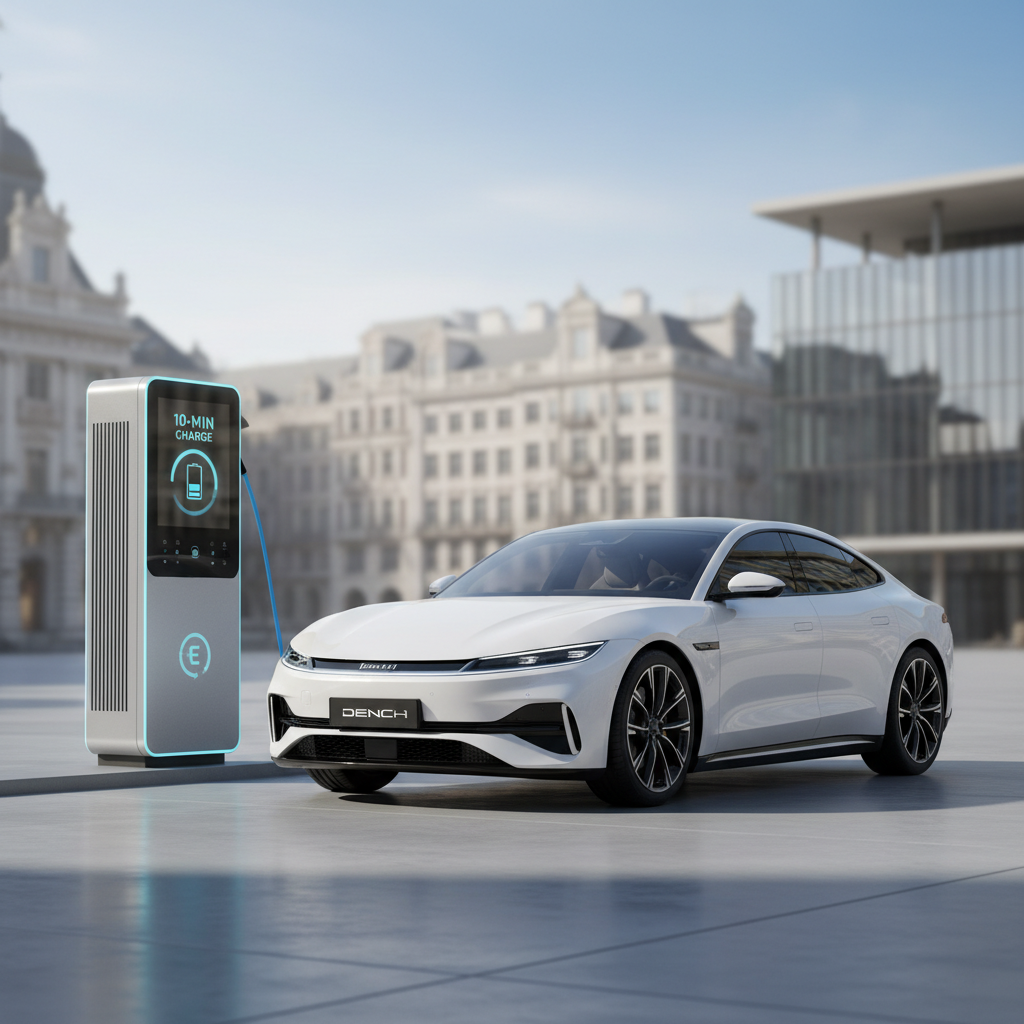
The charging demonstration happened on a Tuesday morning in Paris, documented on video by BYD’s European team. A Denza Z9GT plugged into one of the company’s Flash charging stations at 10% battery. The timer started. At 50 seconds, the car hit 20%. At three minutes eighteen seconds, it reached 50%. At nine minutes twenty-two seconds, the display showed 97% on a 122-kilowatt-hour battery pack. The charger held 300 kilowatts even at 80% state of charge, a rate that would cause most EV batteries to throttle down to protect cell longevity.
BYD filmed this because it represents something the company has been building toward for three years: proof that lithium iron phosphate batteries can charge as fast as the nickel-based chemistries that dominate premium EVs. The Z9GT uses Blade Battery 2.0, an LFP pack that’s cheaper to manufacture and more thermally stable than NMC or NCA chemistry. For years, the trade-off was charge speed. That constraint just lifted.
The Infrastructure Play Behind the Battery
The Flash charging station that delivered those numbers in Paris doesn’t run on grid power alone. Inside the T-shaped hardware cabinet sits a stationary LFP Blade battery buffer. When the station isn’t actively charging a vehicle, it draws power from the grid at a steady rate and stores it. When a Z9GT pulls up and requests 300-plus kilowatts, the station delivers a combination of live grid power and stored battery power. Peak capacity on one cable is 800 kilowatts.
This architecture decouples charging speed from local grid capacity. A parking garage in a historic Paris district might have a 200-kilowatt grid connection. Install a traditional DC fast charger and you’re limited by that connection. Install a Flash station with battery buffering and you can deliver 300 kilowatts to multiple vehicles by time-shifting the grid draw. The station becomes a mini energy storage system that happens to charge cars.
BYD has installed 5,000 of these stations in China. The company announced plans for 1,000 across Europe over the next twelve months. That deployment timeline is faster than any Western charging network has managed, and it’s happening without waiting for grid upgrades or utility partnerships in every city. The battery buffer lets BYD install chargers first and optimize grid connections later.
The Price Gap Nobody Is Addressing
In China, the Denza Z9GT starts at 339,800 yuan, which converts to about $46,500. In Europe, the same vehicle is expected to cost around 89,000 euros, approximately $96,000. That’s a 106% markup for what is mechanically the same car: 122 kilowatt-hours of Blade Battery 2.0, a single-motor rear-wheel-drive variant rated for 702 kilometers of CLTC range (roughly 430 miles WLTP), or a tri-motor all-wheel-drive version with 952 horsepower that does zero to sixty in 3.4 seconds.
The price difference reflects tariffs, homologation costs, and the reality that BYD is positioning Denza as a premium brand in Europe rather than a volume player. At $96,000, the Z9GT competes with the BMW i5 M60 xDrive, which starts at 99,500 euros in Europe. The BMW has slower charging, less range, and a smaller battery, but it carries established brand recognition. The Z9GT has better specs and comes from a brand most European buyers have never heard of.
BYD recruited regional celebrities and influencers to promote the European launch, presumably betting that local market appeal bridges the brand-awareness gap. But the company is making a different calculation: it doesn’t need to sell huge volumes in Europe to justify the Flash charging buildout. BYD establishes Denza as a premium technology showcase while using the Z9GT to anchor Flash charging locations. The charging network is the product. The Z9GT is the proof of concept.
What This Unlocks For Other Automakers
If BYD follows through on the 1,000-station European rollout, every automaker will have to answer a question they haven’t faced before: do we build our own fast-charging network or do we let BYD own this infrastructure layer? Tesla built Superchargers because no one else would. Volkswagen created Electrify America because it was required to by a diesel settlement. BYD is building Flash charging because it manufactures both the batteries and the vehicles, and it can monetize both sides.
The Flash stations use GB/T connectors in China, but BYD has confirmed they will deploy CCS2 connectors in Europe. That makes the network compatible with any EV that can accept high charge rates. Flash becomes a revenue stream independent of Denza vehicle sales. BYD could sell charging sessions to Porsche, BMW, and Mercedes drivers while collecting data on how those vehicles perform on its infrastructure.
BYD’s willingness to install battery-buffered chargers changes the economics for other networks. Ionity, Fastned, and Allego have all struggled with site acquisition because many locations don’t have sufficient grid capacity. If battery buffering becomes standard, site selection criteria shift. You can build chargers in urban cores, at highway rest stops with limited power infrastructure, or in regions where grid connections are expensive and slow to provision. The constraint that limited charging network growth for the past five years starts to ease.
The Cold Weather Test That Changes Fleet Economics
BYD demonstrated the Z9GT charging from 20% to 80% in ten minutes at minus 10 degrees Celsius. Cold-weather charging has been the Achilles heel of electric fleets. A delivery van or taxi that needs to charge mid-shift in a Scandinavian winter currently faces 40-minute charge times or worse. At ten minutes to 80%, charging becomes a fuel stop, not a logistics problem.
The Blade Battery 2.0 achieves this through active thermal management that preheats the pack during the drive to the charging station. The vehicle’s navigation system knows when you’ve selected a charging destination and begins warming the cells to optimal temperature before you arrive. That’s not new technology, but BYD’s implementation appears more aggressive than Western automakers have been willing to deploy, likely because LFP chemistry tolerates thermal stress better than nickel-based cells.
For fleet operators, this shifts the calculation on electric trucks and vans in cold climates. A logistics company in Norway or Canada can now plan routes assuming ten-minute charge stops even in winter. That opens up delivery corridors and shift structures that weren’t viable when winter charging added 30 minutes to every stop.
The Immediate Consequences For European Automakers
Volkswagen’s Trinity platform, promised for 2026, was supposed to deliver 200 kilowatts of charging and about 700 kilometers of range. BMW’s Neue Klasse, also targeting 2025-2026, aims for similar specs. Both platforms assume 18-20 minute charging sessions as best-case scenarios. BYD just cut that in half using a battery chemistry that costs less to produce.
The European response will likely split in two directions. Some automakers will accelerate partnerships with Chinese battery suppliers to access fast-charging LFP technology. Others will double down on their existing NMC battery roadmaps and argue that charging speed beyond 20 minutes doesn’t matter because most charging happens at home overnight. The partnership route cedes battery technology leadership to Chinese suppliers. The stay-the-course route assumes customers won’t care about a capability their vehicles lack once BYD makes it visible and available.
The harder question is what happens when BYD starts installing Flash chargers at retail destinations and parking garages across Europe. A grocery store in Frankfurt with six Flash charging spots becomes a competitive advantage for Denza and any other brand BYD allows on its network. If you can top up your battery in ten minutes while shopping, versus 30 minutes at a competitor’s charger, the infrastructure shapes the purchase decision. Tesla understood this in 2013. BYD is executing the same playbook with better battery technology and a willingness to install stations without waiting for perfect economics.
What The Pricing Strategy Reveals
The $96,000 European price tag for the Z9GT looks like a miscalculation until you map it against BYD’s broader strategy. The real volume play is the Seagull, Dolphin, and Seal models that BYD sells in China for $11,000 to $28,000. Those vehicles aren’t coming to Europe immediately, but they will once BYD has charging infrastructure in place and brand recognition established.
The Z9GT serves the same function the Model S served for Tesla: proof that the company can build a car wealthy early adopters will pay for, which funds infrastructure buildout and manufacturing scale. BYD already has manufacturing scale. It produced 3.02 million vehicles in 2023. The company doesn’t need the Z9GT to succeed in Europe to survive. It needs the Z9GT to demonstrate what’s possible so that when cheaper BYD and Denza models arrive, the charging infrastructure and brand credibility are already established.
European regulators haven’t figured out how to respond to this yet. BYD is investing in local manufacturing and charging infrastructure, which creates jobs and reduces range anxiety. But the company is also establishing a vertically integrated ecosystem that will be difficult for European competitors to match. By the time Volkswagen or Stellantis field comparable fast-charging technology, BYD will have hundreds of charging stations installed and operational data on how European drivers actually use them. That data advantage compounds over time.