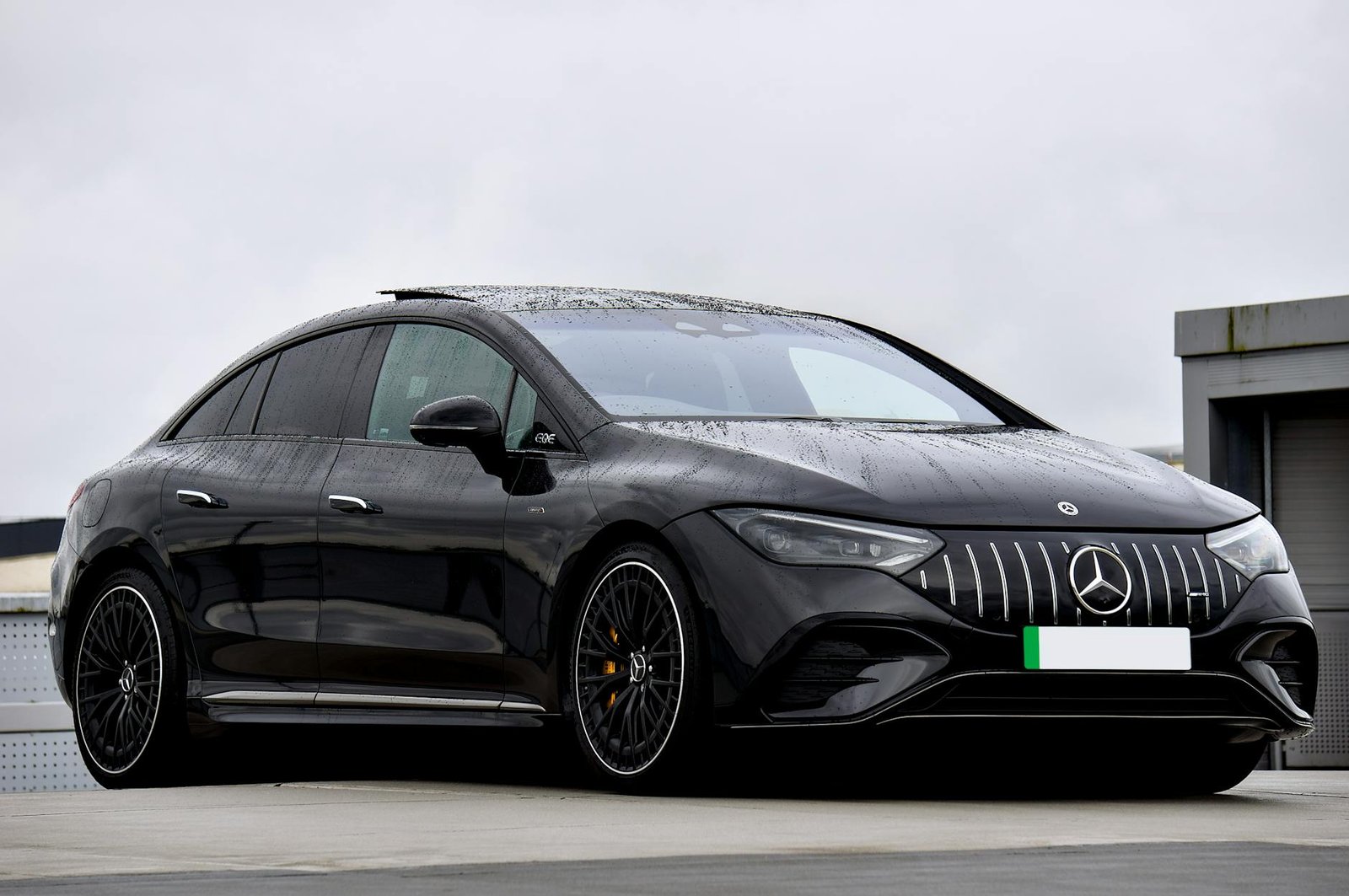
Mercedes just announced that the refreshed EQS sedan will add 199 miles of range in ten minutes at an 800-volt charging station. The 122 kWh battery, the 511-mile WLTP range, the 350 kW peak charging rate: all numbers that look spectacular in a press release. If you’re actually trying to understand whether faster EQS range charging solves Mercedes’ problems with this car, you need to look at what happens when you factor in where people actually plug in, and what those chargers can actually deliver.
The core constraint isn’t the car. It’s the grid connection feeding the charger you happen to find.
How 800-Volt Architecture Actually Works
An 800-volt electrical architecture does one thing exceptionally well: it moves the same amount of power through thinner wires at lower current. Power equals voltage times current (P = V × I), so doubling the voltage from 400V to 800V means you can halve the current to deliver the same power. Lower current means less heat, less resistive loss, and smaller, lighter cables throughout the vehicle.
For charging, this matters because DC fast chargers have current limits, not just power limits. A typical 400V charger might max out at 500 amps, giving you 200 kW. An 800V vehicle at that same 500-amp station can theoretically pull 400 kW, because the voltage doubled while the current stayed constant. That’s the engineering elegance of 800V: you’re not asking the charger to push more electrons through the cable, just pushing them at higher voltage.
Mercedes equipped the EQS with silicon-carbide power electronics and a battery that can split itself into two virtual 400V halves when connected to older chargers, each half charging at up to 135 kW simultaneously for a combined 270 kW. The regenerative braking system can recover up to 290 kW.
On paper, every part of this system is optimized for speed.
The Infrastructure Bottleneck Nobody Talks About
An 800-volt platform solves for a constraint that rarely binds in the real world. The actual constraint is the electrical service feeding the charging station, and that constraint doesn’t care about your vehicle architecture.
A single 350 kW charger requires roughly the same electrical service as 35 American homes. Installing one means either having a substation nearby or running extremely expensive cable from wherever the nearest high-capacity line exists. Most charging sites don’t have anywhere near this capacity. They have 150 kW or 250 kW stations because that’s what the local utility infrastructure can support without a six-figure upgrade.
Even at sites labeled as “350 kW capable,” the actual power delivery depends on how many stalls are in use and how the site’s total power budget is allocated. A charging site with four 350 kW stalls and a 700 kW total service can’t deliver full power to all four simultaneously. The site’s load management software throttles individual stalls based on total demand. Your EQS might show up expecting 350 kW and get 175 kW because two other vehicles are already charging.
The most relevant EQS range charging figure isn’t the peak 350 kW number. It’s what the car does at the median charging station you’ll actually encounter, which in the U.S. is still overwhelmingly 150 kW nominal power. At those stations, the 800V architecture provides almost no advantage. You’re limited by the station’s output, not the vehicle’s capability.
The Economics of Charging Infrastructure
Charging station operators face a brutal unit economics problem. A 350 kW station costs roughly $200,000 to install when you factor in the equipment, electrical work, and utility infrastructure upgrades. That station needs to deliver about 250 kWh per day, every day, at a sufficient margin over wholesale electricity costs, to generate acceptable returns on that capital.
EV adoption rates in most markets don’t support that utilization yet. A station that sees three vehicles per day, each charging for 20 minutes, isn’t anywhere close to covering its fixed costs. This is why charging networks deploy 150 kW stations instead: lower upfront cost, lower electrical service requirements, and they can still serve the existing vehicle fleet adequately.
The transition to 800V vehicles doesn’t change this calculation much. Charging networks will upgrade to higher-power stations when utilization rates justify the investment, not when vehicles become capable of accepting that power. The vehicle capability is necessary but not sufficient. Until there’s enough charging volume to support the capital outlay, the infrastructure lags.
Mercedes is building a car for an infrastructure that doesn’t exist yet at scale. The EQS can theoretically add 199 miles in ten minutes, but only at the small fraction of charging stations that can actually deliver 350 kW to an 800V vehicle. Everywhere else, the charging speed is bound by the station’s capabilities, and those capabilities are determined by local electrical infrastructure and the station operator’s capital budget.
What The Range Figures Actually Mean
The 511-mile WLTP range is a different kind of misdirection. WLTP is a standardized European test cycle, and it consistently returns numbers about 20-30% higher than the EPA ratings Americans actually use for trip planning. The realistic EPA range for this EQS will likely land around 380-410 miles, not 511.
That maximum range only exists when you’re not using the performance capabilities Mercedes spent considerable engineering effort developing. The dual-motor AWD configuration, the increased power output, the 290 kW regenerative braking: all of these consume energy when you use them. Drive the EQS the way you’d drive an S-Class, with brisk acceleration and sustained highway speeds, and the real-world range drops considerably.
Every EV faces the same physics. The gap between advertised range and real-world range matters more in a luxury sedan starting above $100,000 because the buyer’s expectations are calibrated differently. An S-Class owner expects to drive 400 miles on the highway without thinking about it. The EQS can do that under ideal conditions, but only if you drive conservatively and potentially stop for a charge that might not be as fast as the spec sheet suggests.
The Real Cost Structure
The 122 kWh battery in the EQS costs somewhere between $12,000 and $15,000 at current battery prices of roughly $100-120 per kWh. That’s a substantial portion of the vehicle’s cost structure, optimized for a use case (long-range highway driving without charging stops) that the charging infrastructure doesn’t fully support yet.
Compare this to the approach BMW took with the i7, which offers around 300-320 miles of EPA range with a smaller battery pack. BMW is betting that 300 miles is enough for the luxury sedan buyer, and that the money not spent on a larger battery can go into interior appointments, technology, and margin. Mercedes is betting the opposite: that range anxiety is still a primary barrier and that maximum range justifies the cost.
Neither approach is obviously wrong, but they reflect different assumptions about what constraint actually binds for the buyer. If the constraint is psychological (range anxiety), the EQS makes sense. If the constraint is practical (charging infrastructure quality), the i7’s approach of optimizing around the charging experience rather than maximum range might be more relevant.
What This Reveals About Market Positioning
The EQS upgrade tells you that Mercedes still sees range as the primary selling point for luxury EVs, even after three years of the original EQS being on the market. The range improvement, the 800V architecture, the faster charging capability: these are all solutions to the “how far can it go” question.
The pricing strategy for a vehicle with this much battery capacity suggests tight margins. Mercedes is absorbing the cost of that 122 kWh pack to hit the range target, rather than positioning the EQS as a premium-priced range leader. The market apparently won’t support charging a significant premium for maximum range, even in the luxury segment.
Features arriving after launch via over-the-air updates (enhanced autonomous driving capabilities, additional connected services) point to a different constraint: software and validation timelines. Mercedes is shipping the hardware with the capability, but the software to enable those features isn’t ready. This is increasingly common in the industry, and it means buyers are paying for capabilities they can’t use immediately.
What Actually Matters for Buyers
If you’re considering an EQS, the relevant questions aren’t about peak charging speeds or maximum WLTP range. They’re about the charging infrastructure along your actual routes and whether your driving patterns align with what the car is optimized for.
Do you regularly drive more than 300 miles in a day? The extra range matters. Do you have access to 350 kW charging stations on those routes? The 800V architecture matters. Are you mostly doing shorter trips with overnight charging at home? The EQS is over-specified for that use case, and you’re paying for battery capacity you’re not fully utilizing.
The updated rear-axle steering reducing the turning circle to 10.9 meters is more practically useful than the peak charging speed for many buyers. The improved NVH (noise, vibration, harshness) reduction, the enhanced air suspension, the MBUX Superscreen spanning the entire dashboard: these are daily-use features that affect ownership experience more than whether you can theoretically add 199 miles in ten minutes at a charger you might encounter twice a year.
The market will determine whether Mercedes’ bet on maximum range was the right constraint to optimize for. The EQS range charging capabilities are solving for a world where 350 kW charging stations are common, and that world doesn’t exist yet in most markets. Until it does, the real-world charging experience will remain limited by infrastructure, not by the vehicle’s capabilities.