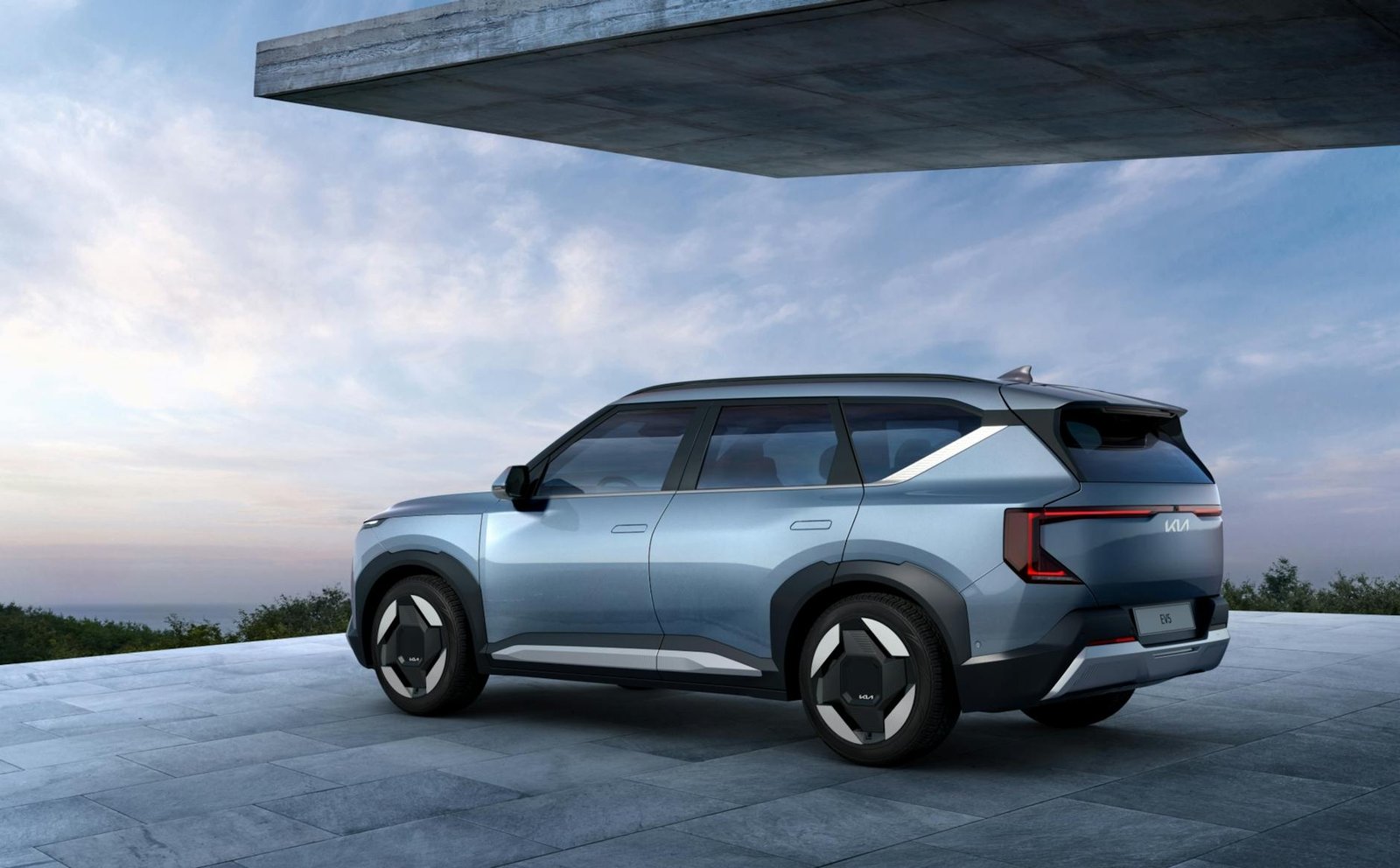
Excerpt: Rivian’s R2 launches in 2026 at $45,000, targeting the mass market EV segment. Why that timing and price point create path-dependent constraints that will shape the company’s next five years.
Rivian has announced plans to launch the R2, a mid-size SUV starting at $45,000, in early 2026. The pricing puts it directly against Tesla’s Model Y, and the timing puts Rivian at a specific point in the EV adoption curve where the order of moves matters as much as the moves themselves. This isn’t just another vehicle launch. It’s a commitment to a specific manufacturing cost structure, battery supply chain, and customer base that will constrain every decision Rivian makes for the next five years.
The question isn’t whether the Rivian R2 is a good SUV. The question is whether Rivian can reach the production volumes needed to justify the capital already committed to building it, and whether those volumes arrive soon enough to fund the next model after that.
The Sequence That Built to $45,000
Rivian started with the R1T pickup and R1S SUV, both luxury vehicles priced above $70,000. That wasn’t a choice driven by market research or brand positioning. It was driven by the economics of being a startup automaker with no production scale. When you’re building your first 50,000 vehicles per year, your per-unit costs are high across every component: stamping, battery packs, motors, electronics. The only way to cover those costs is to sell expensive vehicles with high gross margins per unit.
The R1 platform served its purpose. It established Rivian as a credible automaker. It generated revenue while the company learned how to manufacture at scale. It bought time to develop a second platform. But it also locked in a set of supplier relationships, manufacturing processes, and cost structures built for low-volume production.
Now Rivian is attempting to jump from that high-cost, low-volume foundation to a mass-market vehicle that needs to sell in the hundreds of thousands per year to justify its existence. The $45,000 price point for the R2 isn’t aspirational. It’s mandatory. Go much higher and you’re still in the premium segment, competing for the same limited pool of early adopters who already bought their first EV. Go lower and your margins disappear before you reach break-even volumes.
This creates the first path-dependent constraint: Rivian R2 production costs must hit a specific target, which means battery costs must hit a specific target, which means Rivian needs contracts with battery suppliers at volumes those suppliers are willing to commit to. Battery manufacturers don’t give you mass-market pricing until you can prove mass-market volumes. But you can’t prove mass-market volumes until you have mass-market pricing.
The Capital Trap of Platform Development
Most coverage of new EV models focuses on features: range, acceleration, charging speed, interior space. Those matter to buyers, but they don’t explain why some automakers succeed at scaling and others don’t. The determining factor is capital efficiency in platform development.
Rivian spent billions developing the R1 platform. That capital is sunk. It’s gone. The R2 represents a second platform, which means a second multi-billion dollar capital commitment for tooling, stamping dies, battery pack assembly lines, and production validation. This is capital Rivian is spending now, in 2024 and 2025, to start production in 2026. The company is betting that R2 sales volumes in 2026 and beyond will generate enough cash to fund the next platform after that, likely a smaller, cheaper vehicle.
But here’s the constraint: Rivian can’t delay R2 production to wait for better battery prices or lower commodity costs. The company has already committed the capital. The factory is being retooled. Suppliers have contracts. Every month of delay adds carrying costs without adding revenue. Rivian is locked into a 2026 launch whether market conditions are favorable or not.
This differs fundamentally from Tesla’s path. Tesla started with the Roadster in 2008, moved to the Model S in 2012, then the Model 3 in 2017. Each platform was funded by the cash flow from the previous one. By the time Tesla launched the Model 3 at mass-market pricing, the company had nearly a decade of manufacturing learning and supplier relationships. Tesla could negotiate battery prices from a position of proven volume.
Rivian is attempting to compress that timeline. The R1 platform launched in 2021. The R2 platform launches in 2026. That’s five years between platforms instead of Tesla’s five to nine. Faster iteration sounds good, but it means less time to optimize costs on the first platform before committing capital to the second.
The Volume Cliff That Nobody Discusses
The automotive industry has a brutal rule: you need about 100,000 to 150,000 units per year from a single platform to amortize the fixed costs of that platform. Below that volume, your per-unit costs stay too high to compete on price. Above that volume, costs drop fast enough that you can either cut prices to gain market share or keep prices steady and improve margins.
Rivian produced approximately 57,000 vehicles in 2023. The company’s production capacity at its Illinois plant is being expanded to support higher volumes, but getting from 57,000 annual units to 150,000 annual units isn’t a smooth ramp. It’s a cliff. You either commit the capital to build capacity for 150,000+ units and then fill that capacity, or you stay stuck at sub-100,000 units with permanently high costs.
The Rivian R2 is the vehicle meant to get Rivian over that cliff. The R1T and R1S can’t do it because pickup and large SUV segments combined don’t offer enough volume potential at Rivian’s current price points. The mid-size SUV segment that the R2 targets is much larger, but also much more competitive. Tesla’s Model Y, Ford’s Mustang Mach-E, Hyundai’s Ioniq 5, Kia’s EV6, and Volkswagen’s ID.4 all compete here. Rivian is entering as the sixth or seventh credible option, not the first or second.
This creates the second path-dependent constraint: Rivian needs R2 volumes to ramp fast enough to reach cost competitiveness, but fast ramps require either significant price incentives (which destroy margins) or product differentiation compelling enough to overcome buyer familiarity with established competitors. The order matters. If Rivian cuts prices too early to drive volume, it trains the market to expect discounts and makes it harder to maintain pricing power later. If Rivian holds pricing too long and volumes ramp slowly, fixed costs stay high and the company burns through cash reserves before reaching sustainable margins.
The Retail Strategy That Can’t Be Reversed
Rivian sells direct to consumers through its own retail locations and website, following Tesla’s model. This choice made sense for the R1 platform. Selling $80,000 luxury vehicles doesn’t require thousands of retail touchpoints. A small number of showrooms in wealthy metro areas can handle the volume. Direct sales also let Rivian control the customer experience and capture the full retail margin instead of splitting it with dealers.
But direct sales becomes a constraint at mass-market volumes. The Rivian R2 at $45,000 targets buyers who are less likely to order a vehicle sight unseen. They want test drives, trade-in handling, financing options, and local service availability. Building out that retail and service infrastructure costs billions in real estate, staff, and inventory. Traditional dealerships already have that infrastructure. They built it over decades and amortize it across multiple brands.
Rivian can’t easily switch to a dealer network now. The direct sales infrastructure is built. The brand promise is set. The operational systems are in place. Adding franchised dealers at this point would require either running two parallel sales channels (expensive and confusing) or abandoning the direct model (damaging to brand perception and existing customer relationships). Rivian is locked into direct sales for the R2, which means it must fund retail expansion at exactly the moment it’s also funding production ramps and working capital for higher inventory levels.
Tesla faced this same constraint but had the advantage of being the only compelling EV option for most of the 2010s. Buyers were willing to travel to test drive a Tesla and tolerate limited service locations because there were no comparable alternatives. Rivian doesn’t have that luxury. The R2 launches into a market with multiple strong EV options, all backed by established dealer networks offering familiar purchase experiences.
What the Price Reveals About Battery Costs
A $45,000 starting price for the Rivian R2 tells you something specific about Rivian’s battery cost assumptions for 2026. The vehicle has a range target of over 300 miles for the base version, which suggests a battery pack around 75 to 85 kilowatt-hours assuming Rivian achieves efficiency similar to the Model Y. At current battery prices of roughly $120 per kilowatt-hour at the pack level, that’s $9,000 to $10,200 just for the battery.
Add the electric motors, power electronics, structural components, interior, assembly labor, and overhead, and you’re at $35,000 to $38,000 in manufacturing costs for a vehicle selling at $45,000. That’s a gross margin of 15 to 22 percent, which sounds reasonable until you remember that it has to cover research and development, sales and marketing, general and administrative costs, and interest on debt. Most automakers need 25 to 30 percent gross margins to reach overall profitability.
This means Rivian is betting that battery prices will drop to around $100 per kilowatt-hour or below by 2026-2027, giving the company room to either cut prices further or improve margins. If battery prices stay flat or drop slower than expected, Rivian has three choices: raise R2 prices (which hurts volume), accept lower margins (which extends the path to profitability), or reduce battery capacity (which hurts the vehicle’s competitiveness).
The order of those choices matters because each one affects the next. If you raise prices and lose volume, your fixed costs per unit go up, forcing further price increases or margin compression. If you cut battery capacity to save costs, you need to cut prices to stay competitive with longer-range alternatives, which brings you back to margin compression. There’s a narrow path where everything works, and it requires battery costs, production volumes, and market pricing to all move in the right direction at the right time.
What to Look for in 2026 and Beyond
The real test of the Rivian R2 strategy isn’t initial reviews or first-quarter sales numbers. It’s whether production volumes reach 12,000 to 15,000 units per quarter by the end of 2026. That’s the minimum run rate needed to hit 50,000 to 60,000 units in the first full year, which establishes a credible path toward the 100,000+ annual volume needed for platform viability.
Watch Rivian’s quarterly reports for gross margin trends on the R2. If margins improve sequentially through 2026 and 2027, it means production costs are dropping as volumes ramp. That’s the path to sustainability. If margins stay flat or compress, it means the company is either cutting prices to drive volume or struggling with production costs, neither of which is sustainable long-term.
Also watch for announcements of additional R2 variants or derivatives. A stretched-wheelbase version, a coupe-like variant, or a commercial version would all signal that Rivian is trying to amortize the R2 platform across more models to improve capital efficiency. The faster those derivatives arrive, the more confidence Rivian has in the underlying platform economics.
The path Rivian chose starting in 2021 determines what’s possible now. The R2 must succeed not just as a product but as a business model that generates enough cash to fund the next phase. The company can’t go back and choose a different starting point. It can only execute on the path it’s on, and that path has very little margin for error.