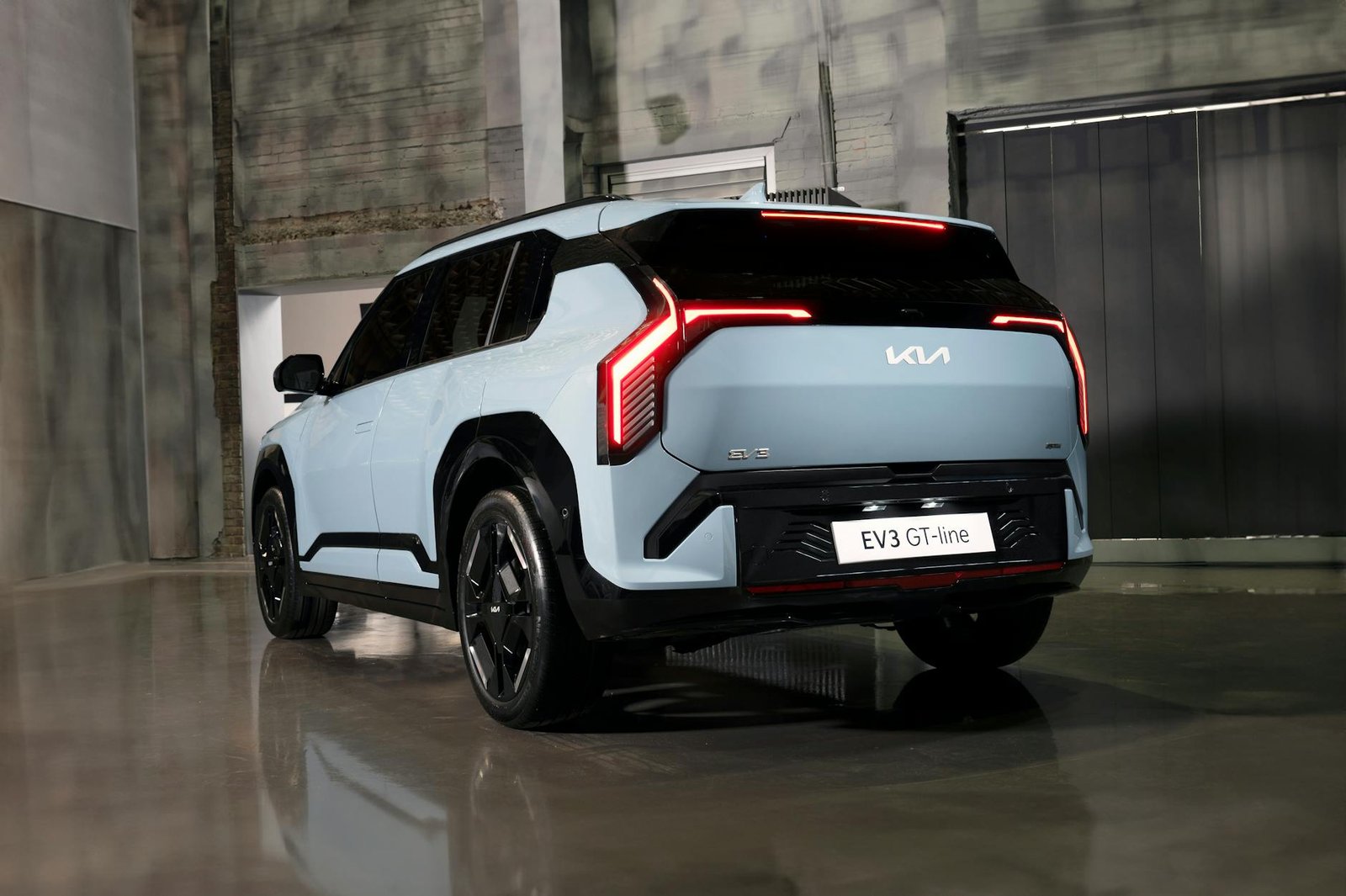
Kia is about to launch the EV3, a compact electric crossover that everyone expects will sell in high volume. The vehicle slots below the mid-size EV6 and three-row EV9 in Kia’s lineup, targeting the sweet spot where most Americans actually shop for cars. Making a profitable small EV turns out to be one of the hardest engineering challenges in the industry right now. The physics works against you at every step.
Small vehicles need small batteries to keep weight and cost reasonable. Small batteries mean less range. Less range in a market obsessed with range anxiety means you need to add back battery capacity, which adds weight and cost, defeating the original purpose of building a small, affordable EV. This constraint loop has killed or delayed nearly every compact EV program attempted in the past five years. The Kia EV3 represents one manufacturer’s attempt to break that loop with specific engineering choices about battery chemistry, motor efficiency, and thermal management.
The Battery-to-Vehicle Size Problem
Start with basic physics. A battery pack that can deliver 300 miles of EPA range in a mid-size crossover weighs somewhere between 900 and 1,100 pounds, depending on cell chemistry and packaging efficiency. That same pack in a smaller, lighter vehicle should theoretically deliver more range because there’s less mass to move. But the relationship isn’t linear.
Aerodynamic drag scales with frontal area, which doesn’t shrink proportionally when you make a vehicle smaller. A compact crossover might be 15 percent shorter than a mid-size model but only 8 percent narrower, so the frontal area reduction is modest. Rolling resistance depends on tire contact patches, and those can’t shrink much without compromising handling and braking performance. The suspension, climate control, and electrical systems all draw roughly the same power regardless of vehicle size.
Practically, you can’t just scale down a mid-size EV battery pack by 30 percent and expect a proportional price reduction with acceptable range. Efficiency gains from lower vehicle mass get eaten by fixed energy costs that don’t scale. A battery pack sized for 250 miles in a compact crossover might weigh 700 pounds and cost $8,000 at current cell prices of roughly $115 per kilowatt-hour. Before motors, inverters, thermal management, or any of the actual vehicle structure, that’s $8,000 in battery cost alone.
Compact crossovers traditionally sell in the $25,000 to $35,000 range. The battery cost alone consumes 23 to 32 percent of that price bracket. Add the electric drivetrain components, and you’re at 35 to 40 percent of vehicle price going to the EV-specific hardware. In an internal combustion compact crossover, the engine and transmission might represent 15 to 18 percent of vehicle cost. The math doesn’t balance unless you accept razor-thin margins or price the vehicle above its competitive set.
Why Cheaper Batteries Don’t Solve This Alone
Cell prices have dropped from around $140 per kilowatt-hour in 2023 to approximately $115 per kilowatt-hour in late 2024 for volume production. Projections show continued decline toward $80 per kilowatt-hour by 2027 or 2028. That would cut battery pack costs by roughly 30 percent, saving perhaps $2,400 on that 250-mile pack.
Helpful, yes. Sufficient? No. Battery cost reduction is a percentage decrease applied to an already-large absolute number. Reducing an $8,000 battery to $5,600 still leaves you with a $5,600 battery in a compact vehicle. Meanwhile, the rest of the vehicle hasn’t gotten cheaper. Electric motors, inverters, onboard chargers, and DC-DC converters are all manufactured components with their own cost structures that aren’t following the same steep decline curve as lithium-ion cells.
The thermal management system is particularly stubborn. Battery packs need active cooling to prevent degradation and maintain fast-charging capability: liquid cooling loops, pumps, radiators, and control logic. These components cost roughly the same whether you’re cooling a 75-kilowatt-hour pack or a 55-kilowatt-hour pack. The plumbing and thermal control hardware represents a fixed cost that scales poorly with battery size.
Kia’s approach with the EV3 involves using lithium iron phosphate (LFP) cells instead of nickel-based chemistry for at least some variants. LFP cells are cheaper per kilowatt-hour (currently around $95 compared to $115 for nickel-manganese-cobalt cells). They’re also safer and more tolerant of heat, which can simplify thermal management. The tradeoff is lower energy density. An LFP pack delivering the same usable energy weighs about 15 to 20 percent more than an NMC pack. In a compact vehicle where mass efficiency matters, that’s not a trivial penalty.
The Manufacturing Scale Trap
Building EVs profitably requires manufacturing volume to amortize tooling costs and negotiate component prices. A typical automotive production line needs to build at least 80,000 to 100,000 units annually to approach breakeven on platform-specific tooling. The most successful compact crossovers in the US market sell between 150,000 and 250,000 units per year. The Kia EV3 needs to hit those numbers to justify its development cost and production capacity allocation.
Reaching that volume with an EV is harder than with a gasoline vehicle. You need access to battery cell supply in matching volume. A compact EV with a 60-kilowatt-hour pack selling 150,000 units per year requires 9 gigawatt-hours of annual cell production dedicated to that single model. That’s roughly the output of one mid-sized battery factory, which takes three to four years to build and costs between $2 billion and $4 billion depending on location and capacity.
Kia doesn’t own its battery supply chain. The company sources cells from SK On and other suppliers under long-term contracts. Those suppliers are building capacity, but they’re serving multiple automakers across multiple vehicle programs. Allocation becomes a negotiation based on committed volume, contract terms, and market conditions. If the EV3 sells better than expected, can Kia secure additional cell supply within six to nine months? If it underperforms, can they redirect contracted cells to other programs without penalty? These are commercial and logistical constraints that determine whether a vehicle program succeeds regardless of product quality.
What Trade Press Coverage Misses
Most coverage of new EV launches focuses on range numbers, charging speeds, and feature lists. The Kia EV3 will likely be praised for offering competitive range at a lower price point than mid-size EVs. This framing misses the actual engineering achievement, which isn’t hitting a range target (that’s straightforward if you’re willing to add battery capacity) but rather optimizing the entire vehicle system to extract maximum efficiency from a smaller, lighter pack.
Real efficiency gains come from unglamorous engineering work: reducing parasitic losses in the inverter, optimizing motor winding design for the specific duty cycle of urban driving, tuning the thermal management system to minimize pump energy, selecting low-rolling-resistance tires that don’t compromise handling. Kia claims the EV3 achieves around 4.0 miles per kilowatt-hour in combined driving, roughly 10 to 12 percent better than the EV6 on an efficiency basis. That gap represents thousands of engineering hours optimizing dozens of subsystems.
Production localization is the other missed point. Kia manufactures the EV3 in South Korea, which means it doesn’t qualify for US federal tax credits under current Inflation Reduction Act rules. That’s a $7,500 price disadvantage against domestic-built competitors. To offset this, Kia needs to either price the vehicle $7,500 lower than a comparable domestic EV or deliver $7,500 worth of additional value through better range, features, or brand perception. Both paths are difficult. Pricing lower erodes already-thin margins. Delivering more value requires adding content, which increases cost and contradicts the goal of building an affordable compact EV.
Indicators That Would Signal Real Progress
Watch for actual production numbers three to six months after launch. Initial sales are often constrained by limited inventory and represent early adopters rather than mainstream demand. If Kia is building 6,000 to 8,000 EV3 units monthly by mid-2025, that suggests the model is finding real market traction and that battery supply is flowing as planned.
Pay attention to variant mix. If the majority of sales are base models with smaller batteries, price sensitivity is the dominant purchase factor. If higher-spec versions with larger packs are moving, buyers are treating this as a primary vehicle and are willing to pay for more range. The mix tells you whether Kia is actually solving the compact EV value equation or just selling a cheaper version of something that still doesn’t quite work for most buyers.
Monitor warranty claims related to battery degradation in the first 18 to 24 months. LFP chemistry is supposed to be more durable than NMC, but real-world performance depends on how well the battery management system is tuned and how customers actually use the vehicle. Higher-than-expected degradation rates would signal that the cost savings from LFP chemistry came with hidden compromises in longevity.