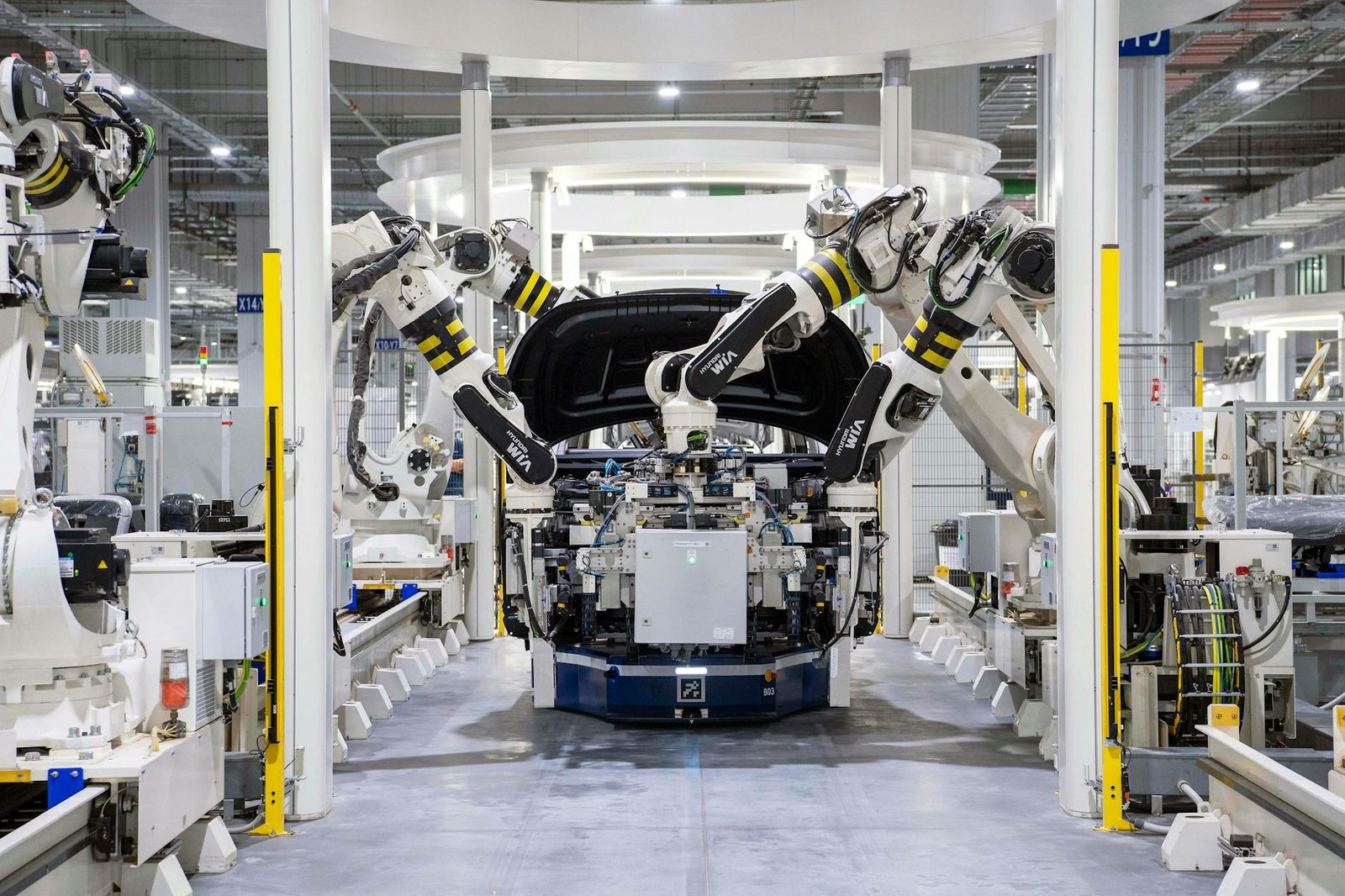
Rivian just announced it will build 300,000 vehicles annually at its future Georgia manufacturing facility, up from the original 200,000 target. That’s a 50% increase announced before the factory has produced a single vehicle. The headline sounds impressive, but what does it actually take to go from zero to 300,000 vehicles per year?
Capacity Versus Reality
When an automaker announces manufacturing capacity, they’re describing a theoretical maximum under ideal conditions. Think of it like a highway speed limit: the sign says 65 mph, but actual traffic flow depends on weather, construction, how many cars are on the road, and whether someone’s broken down in the right lane.
The Rivian Georgia plant capacity number assumes multiple production lines running at design speed, minimal downtime, steady parts supply, trained workers at every station, and demand sufficient to justify running at full tilt. In the automotive industry, the gap between nameplate capacity and actual production typically runs 15-30% in the first several years of operation. Toyota, widely considered the manufacturing gold standard, treats 85% capacity utilization as normal operating rhythm.
Rivian’s existing plant in Normal, Illinois provides the baseline for comparison. That facility has stated capacity around 150,000 units annually. In 2023, Rivian produced 57,232 vehicles there. Through Q3 2024, production has improved significantly but still hasn’t approached the theoretical maximum. The gap reflects the difference between what a factory can theoretically do and what it can reliably do while maintaining quality, managing supplier constraints, and responding to actual customer demand.
The Capital Intensity Problem
Automotive manufacturing operates at a scale most industries never touch. A modern vehicle assembly plant costs between $1 billion and $2 billion to build and equip, depending on production volume and level of automation. The Rivian Georgia plant investment has been estimated at over $5 billion, though exact figures shift as plans evolve.
That money buys buildings, stamping presses, body welding lines, paint systems, and final assembly equipment. The stamping presses alone can cost $50-100 million each, and a typical plant needs multiple presses to form all the different body panels. Paint systems require climate-controlled environments and sophisticated air handling to prevent contamination. Battery pack assembly adds another layer of specialized equipment with tight tolerance requirements.
Those billions in capital costs get amortized across the vehicles produced. If the Rivian Georgia plant produces 100,000 vehicles in its first full year of operation, each vehicle carries $50,000 in plant cost amortization alone (assuming $5 billion total investment). At 200,000 units, that drops to $25,000 per vehicle. At the announced 300,000 capacity, it falls to about $16,700 per vehicle. The difference between these scenarios determines whether the plant makes economic sense.
Automakers chase volume so aggressively because the fixed costs of a modern factory create enormous pressure to run at high utilization rates. Every empty production slot represents sunk capital earning nothing. Ramping to high utilization takes years, not months, and requires demand the company hasn’t yet proven it can generate.
The Supplier Coordination Challenge
A vehicle contains roughly 30,000 parts. Even if Rivian handles final assembly and major component production (battery packs, drive units), hundreds of suppliers provide everything from wiring harnesses to seats to glass to interior trim. Each supplier needs to hit volume targets that match the assembly plant’s schedule.
Scaling supplier networks is where many production ramps stumble. A tier-one supplier might commit to delivering 50,000 seat sets annually based on initial projections, then need to retool for 75,000 when the automaker revises targets upward. That retooling takes time and capital. The supplier wants firm purchase commitments before investing. The automaker wants flexibility to adjust based on demand. These tensions create constant friction in production ramps.
Battery cell supply adds another constraint layer. Rivian sources cells from Samsung SDI and plans to produce some in-house, but building battery cell capacity requires years of lead time and billions in investment. Announcing that your assembly plant can handle 300,000 vehicles means nothing if you can’t source 300,000 battery packs worth of cells. The battery supply chain, not final assembly, often determines actual production volume in the EV industry.
The Rivian Georgia plant will need suppliers within regional proximity to minimize logistics costs and inventory buffers. Building that supplier network from scratch takes years. Established automakers benefit from existing supplier relationships and shared components across multiple vehicle programs. Rivian is building this infrastructure while simultaneously trying to achieve profitability on current production.
Where Companies Actually Are
Rivian currently builds the R1T truck and R1S SUV at its Illinois facility. Production quality has improved substantially since initial launch issues in 2021-2022, but the company remains unprofitable on a per-vehicle basis. The upcoming R2 platform, planned for the Georgia facility, represents Rivian’s attempt to reach profitable scale through a lower-priced, higher-volume vehicle.
The Georgia plant timeline extends several years into the future. After pausing construction in 2024 to focus on profitability at the Illinois plant, Rivian now projects the facility won’t begin production until 2028 at the earliest. That’s six years from initial announcement to first production vehicle, and likely another two to three years before the plant approaches anything close to stated capacity.
Tesla’s Gigafactory timeline offers useful comparison: ground broken in 2014, initial production in 2016, but took until 2019 to approach original capacity targets. Tesla had the advantage of existing automotive manufacturing experience from Fremont, established supplier relationships, and simpler vehicle architecture than Rivian’s skateboard platform. Even with these advantages, the ramp took five years from first production to high utilization.
Other EV startups provide cautionary context. Lucid Motors announced a 365,000 vehicle annual capacity for its Arizona facility. Actual 2023 production: 8,428 vehicles. The gap between announced capacity and realized production represents the difference between building a factory and building a profitable automotive business.
The Demand Assumption
Capacity announcements implicitly assume demand will materialize to fill that capacity. Rivian’s current vehicles (R1T, R1S) serve the premium segment at price points above $70,000. The company has found its early adopter audience but hasn’t yet proven ability to sell at mass-market volume.
The R2, targeted for the Georgia plant, aims at a lower price point around $45,000, putting it in direct competition with Tesla Model Y, Ford Mustang Mach-E, and a growing field of EV crossovers from established manufacturers. Rivian’s brand recognition remains a fraction of these competitors. Convincing 300,000 customers annually to choose an R2 over a Model Y requires either substantial brand building or significant product differentiation.
Recent EV market dynamics add uncertainty. Growth rates have moderated from the explosive 2020-2022 period. EVs continue gaining market share, but the pace has slowed enough that multiple manufacturers have revised production targets downward. Ford delayed EV spending, GM adjusted timelines, and even Tesla has seen growth rates decline from previous peaks. Rivian is planning capacity increases into a market showing signs of demand softening.
Rivian needs capital to complete the Georgia facility. That capital comes from either operating cash flow (currently negative), debt markets, or equity raises. Each production delay or demand shortfall makes the next financing round more expensive or more dilutive to existing shareholders. The company is racing to reach profitability before capital markets lose patience.
What the Press Release Skips
Capacity announcements receive coverage as straightforward facts: company X will build Y vehicles at facility Z. Less attention goes to the conditional nature of these projections. The Rivian Georgia plant will have 300,000 unit capacity if demand materializes, if supplier networks scale appropriately, if production quality meets targets, if capital remains available to complete construction, and if the company successfully navigates the inevitable technical challenges of launching new vehicle programs.
Revising capacity estimates upward before production begins costs nothing. The real test comes when the factory needs to actually produce vehicles profitably. Rivian has shown it can build compelling products, but building 57,000 vehicles annually (2023 production) and building 300,000 are completely different challenges. The latter requires process discipline, supplier management, and cost control at levels Rivian hasn’t yet demonstrated.
The Illinois facility provides the evidence base. If Rivian reaches 100,000 units annually in Normal with acceptable quality and improving unit economics, the Georgia expansion becomes more credible. If Illinois production remains constrained by quality issues, supplier problems, or demand limitations, the Georgia capacity targets look increasingly optimistic.
Signals Worth Tracking
Several concrete indicators will show whether Rivian’s Georgia plant capacity translates to actual production. Watch Illinois production trends first. If the company can’t push production above 80,000-90,000 units in 2025 at the existing facility, that suggests demand or execution constraints that would affect Georgia as well.
Monitor R2 reservation numbers and conversion rates. Rivian has reported strong early interest, but converting reservations to actual purchases determines whether 300,000 unit capacity makes sense. Tesla’s Cybertruck provides a recent example: over 1 million reservations translated to much more modest actual production, partly due to pricing changes and partly due to customers canceling as delivery approached.
Track supplier announcements. When tier-one suppliers begin announcing investments to support the Georgia facility, that signals the supply chain is aligning with Rivian’s targets. Silence from suppliers suggests they remain skeptical about volume projections.
Watch for Rivian’s path to profitability. The company has stated goals to reach positive gross margin, then operating profit. If these milestones slip repeatedly, it indicates the business model hasn’t yet achieved sustainable economics. Building a bigger factory doesn’t solve unit economics problems; it amplifies them.