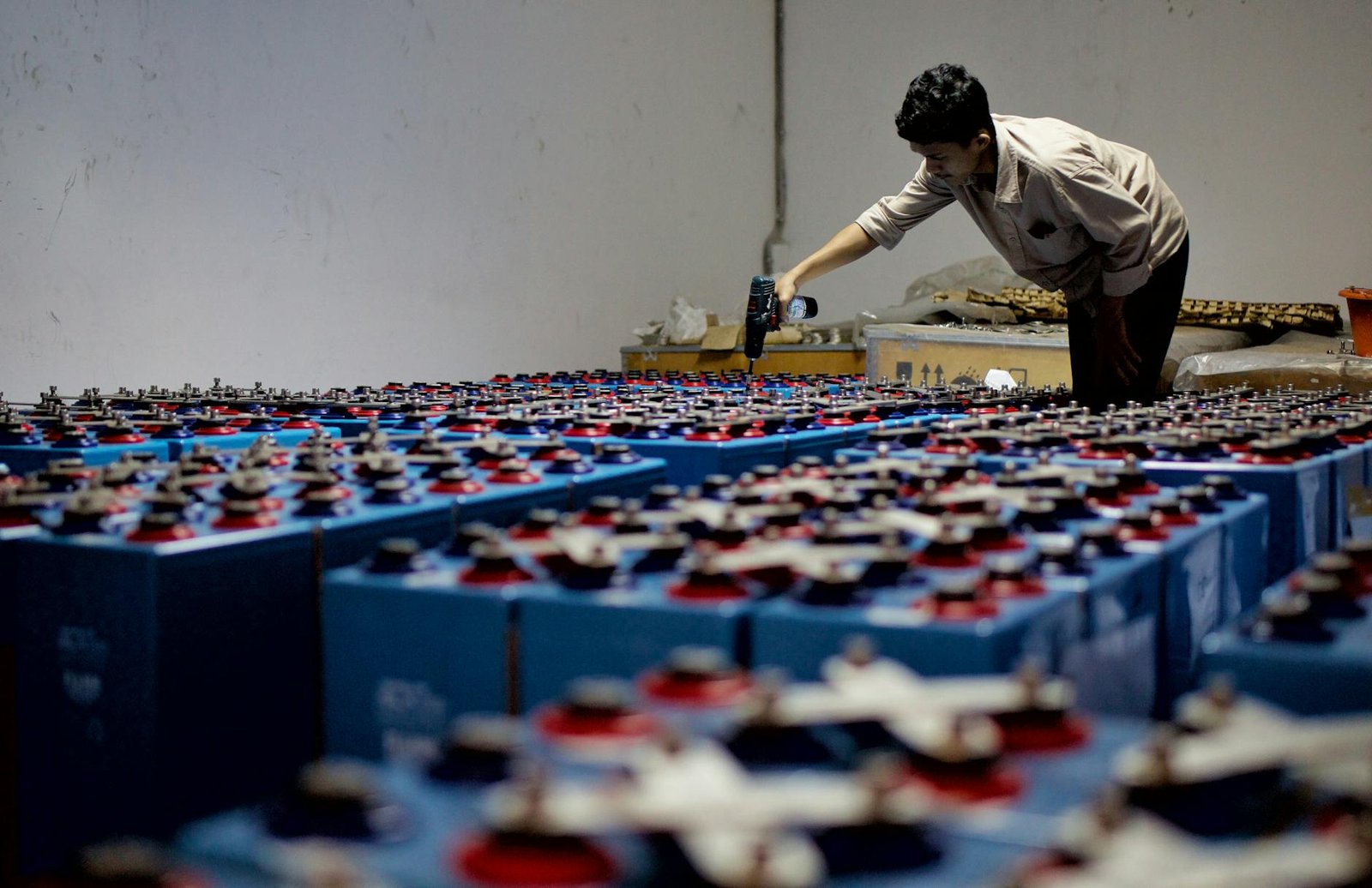
Rivian just installed over 100 retired battery packs at its Illinois factory, creating a 10 megawatt-hour energy storage system that will shave peak demand charges and keep production running during grid stress. The announcement sounds like corporate sustainability theater until you examine the economics: these batteries cost almost nothing to acquire, they still hold 50-70% of their original capacity, and the alternative is paying $150 per kilowatt-hour for new lithium-ion cells to do the same job.
For years, grid storage conversations centered on when new batteries would get cheap enough to compete with natural gas peakers. Used EV batteries create a different equation. The cells already exist. Someone already paid for the mining, refining, and manufacturing. If a battery pack retains 60% capacity but costs nothing to acquire, it delivers energy storage at a fraction of the $/kWh of new cells, even after accounting for integration costs.
What Actually Happens to a Battery Pack After 100,000 Miles
When Rivian pulls a battery pack from an R1T at 100,000 miles, that pack typically retains between 85% and 90% of its original capacity. It no longer suits a vehicle where customers expect 300+ mile range, but it hasn’t reached end-of-life. The degradation curve for lithium-ion cells is front-loaded: capacity drops faster in the first few years, then the decline slows. A pack that fell from 135 kWh to 120 kWh in five years might take another eight years to reach 100 kWh.
For stationary storage, this degradation profile matters differently. A grid battery doesn’t move. It doesn’t need high energy density. It doesn’t experience thermal stress from fast charging on a road trip. The system at Rivian’s Normal plant will cycle once or twice per day, charging when electricity is cheap and discharging during peak demand hours. That’s a gentler duty cycle than highway driving, which slows the remaining capacity degradation further.
The actual constraint on second-life battery use isn’t capacity retention. It’s aggregating and repackaging cells from different vehicles with different degradation states into a system that works as a single dispatchable asset. This costs money. Redwood Materials solved this with software. Their Pack Manager platform monitors individual pack health in real time and routes power accordingly. If one pack has degraded to 55% capacity while another still holds 75%, the system adjusts charge and discharge rates to balance the load. These packs came from warranty returns, engineering test vehicles, and high-mileage fleet trucks. They have different thermal histories, different numbers of charge cycles, and slightly different chemistries depending on when Rivian manufactured them.
Why This Only Makes Economic Sense Right Now
The business case for second-life batteries depends on new battery prices staying high and used batteries staying cheap. That window exists today because the EV market expanded faster than recycling infrastructure could scale. Rivian has accumulated warranty returns and test packs faster than it can process them. Those packs have zero book value; they’re technically liabilities sitting in a warehouse waiting for disposal. Converting them into a 10 MWh storage system transforms a disposal cost into a capital asset.
The Illinois factory pays demand charges based on peak power draw. During summer afternoon production peaks, the plant might pull 15-20 megawatts from the local utility. Demand charges work differently than energy charges: you pay for your highest 15-minute power draw each month, regardless of total consumption. If the storage system can shave even 2-3 MW off that peak by discharging during those critical windows, the savings add up quickly. At $10-15 per kW-month in demand charges, reducing peak draw by 3 MW saves $30,000-45,000 monthly, or roughly $360,000-540,000 per year.
That payback timeline assumes the batteries came free. Once you account for Redwood’s integration costs, installation, and the Pack Manager software, the actual capital outlay probably runs $3-5 million for a 10 MWh system. That’s still 60-70% cheaper than equivalent new battery storage, which would cost $8-10 million at current lithium-ion prices of $150/kWh for large-scale installations.
This cost advantage evaporates if new battery prices drop below $100/kWh or if demand for second-life batteries drives up acquisition costs. Right now, automakers view used packs as waste management problems. If grid storage demand accelerates and companies start bidding for retired EV batteries, the zero-cost assumption breaks. JB Straubel’s comment about “massive amounts of domestic battery assets” reveals the play: secure access to this feedstock before other people realize it’s valuable.
The Grid Constraint Nobody Wants to Talk About
U.S. electricity demand stayed essentially flat from 2007 to 2023. Utilities planned around 1% annual growth, if that. Data centers and reshoring manufacturing just changed the forecast: grid operators now expect demand growth of 2-4% annually through 2030. That’s 150-300 terawatt-hours of additional consumption annually, requiring 50-100 gigawatts of new generating capacity. The grid cannot expand that fast. Permitting a new transmission line takes seven to ten years. Building a new natural gas plant takes three to five years. Even fast-tracking solar and wind projects, you’re looking at 18-36 month timelines.
Stationary storage doesn’t solve the capacity problem. It solves the timing problem.
If a factory can shift its load by three hours using battery storage, that’s three hours the grid doesn’t have to serve that peak demand with expensive peaker plants. Multiply that across hundreds of industrial facilities, and you defer billions in generation and transmission infrastructure.
The 600 GWh storage figure that Redwood and Rivian cite for 2030 U.S. needs isn’t a forecast. It’s based on avoiding grid constraints. Without that much storage, you get rolling blackouts or you get utilities rejecting new load requests. Texas grid operators already told cryptocurrency mining operations and AI data center developers they can’t connect without providing their own backup power. This constraint is already operational.
Second-life batteries can’t deliver all 600 GWh, but they can deliver 50-100 GWh if the collection and integration infrastructure scales. Automakers need to stop treating used battery packs as waste and start treating them as inventory. Software platforms must manage mixed-chemistry, mixed-health battery arrays. Financing structures must recognize these systems have 10-15 year useful lives, not the 3-5 years that warranty-return batteries might suggest.
What the Ford Announcement Actually Tells You
Ford announced in late 2023 that its Kentucky battery factory would start packaging lithium iron phosphate cells into stationary storage units starting in 2026. Those are new cells going straight into grid storage instead of vehicles. Ford made that decision because manufacturing capacity exceeded EV demand projections. The company built a battery factory sized for 500,000 EVs annually, but current production runs at 250,000 units. Rather than idle the factory or lay off workers, Ford redirected output to stationary storage.
Battery manufacturing capacity is expanding faster than EV adoption. That capacity has to go somewhere. Second-life applications absorb used packs, but new-but-diverted battery production fills the much larger grid storage gap. The Rivian partnership with Redwood uses packs that already exist. Ford’s pivot sends newly manufactured cells directly to storage applications, bypassing vehicles entirely.
The distinction matters because it changes the supply curve. Second-life batteries have inherent volume limits: you can only repurpose as many packs as EVs retire each year. With 3 million EVs on U.S. roads and typical 10-12 year lifespans, you might get 200,000-300,000 packs annually available for second-life use. At an average 60 kWh per pack (accounting for degradation), that’s 12-18 GWh per year. Useful, but nowhere near the 600 GWh total requirement.
New batteries diverted from EV production have no such constraint. If Ford can build 100 GWh of battery capacity annually in Kentucky, all 100 GWh can theoretically flow to stationary storage if the economics justify it. The constraint shifts from battery availability to project development: who’s building the storage facilities, who’s financing them, and who’s buying the power?
What to Watch: When Automakers Start Bidding Wars Over Used Packs
The current second-life battery market is a buyer’s market. Redwood Materials can negotiate favorable terms with Rivian because Rivian has limited alternatives for disposing of warranty returns. That changes once multiple parties compete for the same feedstock. If three different energy storage developers all want access to retired GM Ultium packs, GM suddenly has pricing power.
Watch for announcements where automakers retain ownership of second-life batteries instead of selling them outright. That signals they see future value worth capturing. Watch for joint ventures where the automaker takes an equity stake in the storage developer. That indicates they expect the residual value to exceed current disposal value.
Also watch pack-level design changes. Rivian’s next-generation batteries will likely include provisions for easier disassembly and repackaging for stationary use. If you see automakers standardizing pack formats across model lines or designing quick-disconnect systems that simplify repurposing, that confirms they’re building for second-life value from day one.
The system at Normal uses 100+ packs because that’s what was available and what the facility needed. The next installation will use 200 packs, or 300, or 1,000. Scaling is the test. If Redwood can integrate mixed-health battery arrays at megawatt-hour scale, they can do it at gigawatt-hour scale. If they can’t, the entire second-life battery thesis remains a niche application for automakers with excess inventory and factories with demand charge problems.