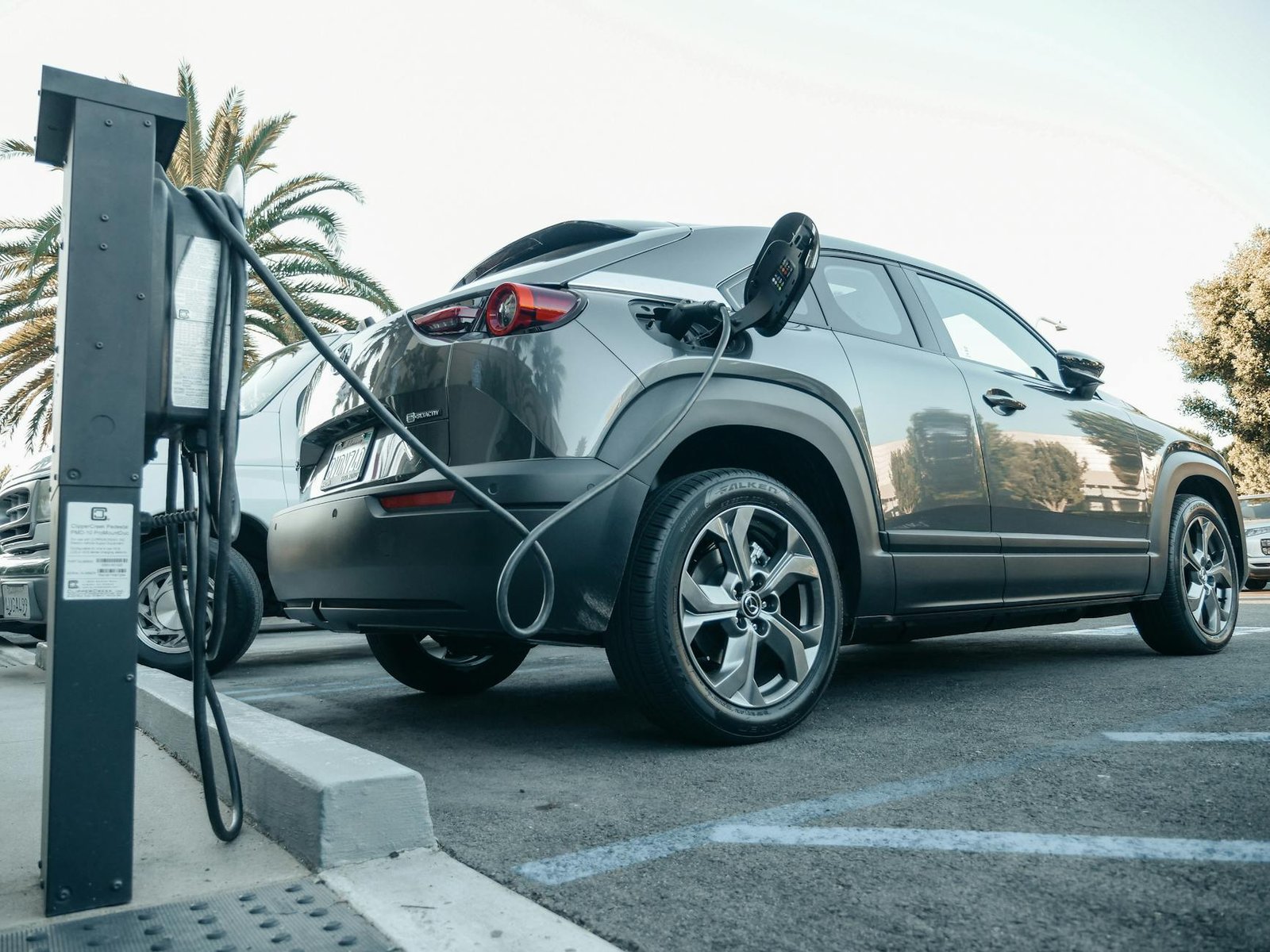
Excerpt: States are charging EV owners $200-400 annually before infrastructure shifts away from gasoline, locking in revenue assumptions that misread both how roads get funded and what happens when adoption accelerates.
The Hefty Fee
Thirty-two states now charge electric vehicle owners annual registration fees that exceed what the average gasoline driver pays in state fuel taxes. Texas collects $400 upfront plus $200 annually. Ohio charges $200 per year. Georgia implemented $214 annually. The stated logic: EVs use roads but don’t buy gasoline, so they’re freeloading on infrastructure.
The fee structure assumes a funding model that’s already failing, then implements a solution to a problem that won’t materialize for another decade. This is path dependence in its crudest form: building the next system on the assumption that current constraints will persist unchanged.
Where the $95 Actually Goes
The average American drives 13,476 miles per year in a car getting 25.4 mpg. That’s 531 gallons. At the federal gas tax rate of 18.4 cents per gallon, that yields $98 annually. Add state fuel taxes and the number typically doubles. Georgia’s average gas driver pays about $230 per year in combined state and federal fuel tax. Pennsylvania’s is higher.
These revenues don’t fund roads proportionally to use. They fund a political allocation process where highway money gets distributed based on formulas written decades ago, mixed with general fund transfers, tolls, and bonds. The gas tax is a proxy, a rough behavioral tax on driving that happens to correlate with miles driven and vehicle weight, at least for combustion vehicles.
Proposed EV fees ignore this entirely. A $200 annual charge equals buying 1,087 gallons of gas at federal rates, or driving over 27,600 miles in an average sedan. The fee treats a vehicle that drives 5,000 miles per year identically to one that drives 25,000 miles. It charges a 3,500-pound sedan the same as a 9,000-pound electric truck. Revenue grab disguised as fairness, implemented before EVs constitute more than 1.4% of the vehicle fleet.
The Real Constraint: When Tax Base Erosion Actually Starts
Fuel tax revenue doesn’t collapse when EVs hit 10% of new sales. It collapses when they hit 50% of the fleet, which given a 12-year average vehicle lifespan means erosion starts becoming acute around 2035-2040. Until then, the overwhelming majority of miles driven are still in gasoline vehicles paying fuel taxes.
Four million EVs on the road today out of 290 million total registered vehicles represents background noise in infrastructure funding. Even if every one of those EVs drove twice the national average, which they don’t, the lost revenue would be less than 3% of total fuel tax collections. The Highway Trust Fund’s actual problem? The federal gas tax hasn’t been adjusted since 1993. Inflation has eroded its real value by 64%.
A single penny increase to the federal gas tax would generate more revenue than a $200 annual EV fee applied to today’s entire EV fleet.
But hiking the gas tax requires political consensus, while adding a surcharge to a vehicle type that represents a small, typically affluent demographic is administratively simple and politically safer. The EV fee avoids the infrastructure funding problem rather than solving it.
Why Front-Loading Fees Distorts Adoption
The timing matters because EV adoption follows a cost curve that hasn’t reached parity with combustion vehicles for most buyers. The federal $7,500 tax credit faces ongoing restrictions and qualification changes. Buyers are now making purchase decisions based on total cost of ownership, and that calculation includes registration fees.
A $250 annual fee over a 10-year ownership period adds $2,500 to the effective purchase price of the EV. For a buyer comparing a $35,000 EV to a $32,000 gasoline equivalent, that registration premium tips the economics back toward gasoline, precisely at the moment when battery costs and charging infrastructure were starting to make EVs competitive on pure operating economics.
This wouldn’t matter if EVs were already cost-advantaged. They’re not. The path to fleet-wide adoption depends on crossing a threshold where EVs become the rational default choice for most buyers, not just early adopters or policy-subsidized purchases. Front-loading fees before that threshold is reached slows the transition, which delays fuel tax revenue erosion, which lets states avoid the hard decision to reform road funding for longer.
The Duty Cycle Nobody’s Measuring
Road infrastructure damage scales with the fourth power of axle weight. A fully loaded semi causes roughly 10,000 times more pavement damage than a sedan. Yet EV fees are flat, while fuel taxes at least correlate weakly with vehicle weight through fuel consumption, heavier vehicles burn more fuel per mile.
Oregon’s OReGO program charges 1.9 cents per mile, which gets closer to actual use-based funding. A driver covering 13,476 miles would pay $256 annually, comparable to many flat EV fees but applied based on actual road use. The problem: per-mile programs require either odometer reporting or GPS tracking, both of which trigger privacy concerns and administrative overhead.
The flat fee is administratively cheap but economically nonsensical. It charges the urban EV driver doing 6,000 city miles the same as the rural truck owner doing 18,000 highway miles. It extracts maximum revenue from minimal-impact vehicles while letting high-impact vehicles skate if they happen to be efficient. This optimizes for collection simplicity rather than cost causation.
What Happens When the Installed Base Flips
If EVs reach 25% of new vehicle sales, roughly where China’s market is today, the US fleet composition starts shifting meaningfully by 2030. By 2035, EVs could represent 20-25% of registered vehicles. At that point, fuel tax revenue begins declining noticeably, and the political coalition that resists gas tax increases starts fracturing because the revenue shortfall becomes undeniable.
States that implemented high flat EV fees early will find themselves in an awkward position. They’ll have a two-tier system where EVs pay a flat premium and combustion vehicles pay per-gallon, but the premium won’t scale with adoption. If EVs constitute 30% of the fleet by 2038, those registration fees will need to triple to maintain revenue neutrality. Either raise EV fees to politically untenable levels or finally reform the entire structure.
The correct sequence is the opposite: transition to mileage-based road funding before EV adoption accelerates, so that the new system is in place and tested before it needs to carry the full revenue load. Instead, states are layering a stopgap fee onto a failing gas tax system, which means they’ll need to overhaul the entire funding mechanism later under fiscal pressure, exactly when it’s hardest to build political consensus.
The Actual Precedent Being Set
What’s being established here isn’t a sustainable road funding model. It’s a precedent that transportation infrastructure funding should be divorced from damage causation and actual use, and instead tied to vehicle type as a proxy for political tractability. That’s dangerous because it means future reforms will have to unwind an entire category of special fees rather than simply adjusting a rate.
The better approach exists: treat the current fuel tax system as a bridge, index it to inflation immediately to restore its real value, and run parallel pilots of mileage-based user fees in multiple states with different tracking mechanisms. By 2030, enough data would exist to pick the least-invasive workable system and begin mandatory phase-in as EV adoption crosses 15% of new sales.
Instead, we get $250 flat fees on 1.4% of the fleet, implemented before the infrastructure funding gap is acute, generating political opposition to EVs without solving the actual problem. By the time the real transition stress hits, the precedent will be set that EVs are special cases requiring penalty fees rather than participants in a reformed system. That makes the later reform harder.