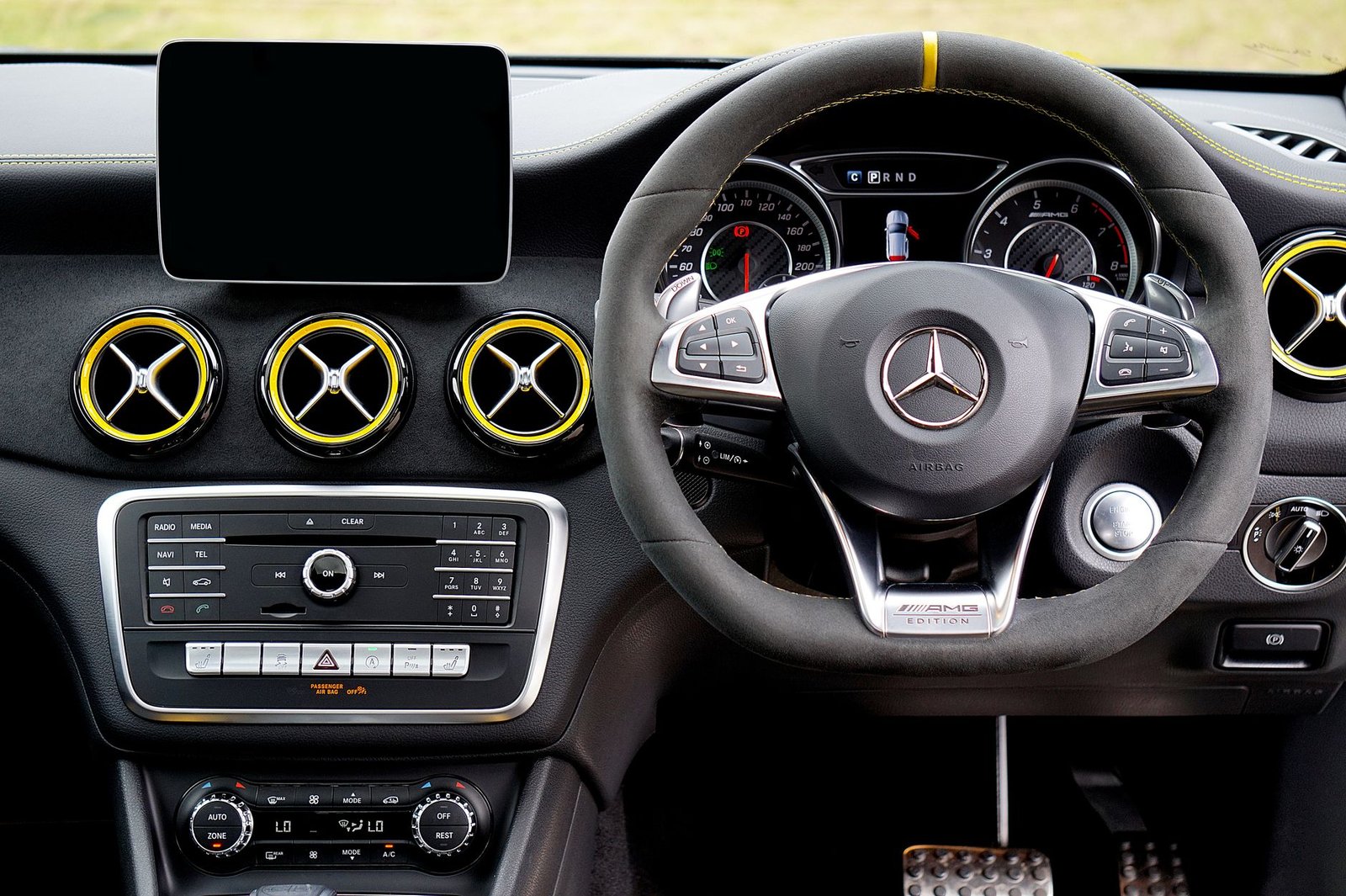
Mercedes-Benz recently announced that its MB.Drive Assist Pro system, launching on electric and combustion vehicles early next year, will require drivers to keep their hands on the wheel when driving on surface streets. On highways, the system operates hands-free. This is a deliberate engineering choice, not a limitation. The company conducted customer research in Europe and found that drivers preferred the hand-on-wheel requirement in urban environments. Meanwhile, Tesla’s FSD (Supervised) allows hands-off operation in most conditions, provided you’re watching the road and the interior camera confirms your attention. Both systems are classified as Level 2 by SAE standards, meaning the driver remains responsible. The underlying technology is similar, but the companies have made different capital allocation decisions about driver assistance systems.
Mercedes is spending money on sensors. Tesla is spending money on training data. Mercedes’ MB.Drive Assist Pro uses radar, ultrasonic sensors, multiple cameras, and an Nvidia-powered computer to process all that data. Tesla’s FSD relies exclusively on cameras. Christoph von Hugo, Mercedes’ Head of Active Safety, has argued that “different sensor inputs increase performance and safety. Relying on one just is not enough.” That’s not purely a technical opinion. It’s a capital allocation philosophy. Every radar unit costs money. Every ultrasonic sensor adds complexity to the supply chain. Mercedes is betting that hardware diversity creates a better product than software optimization alone.
The Engineering Logic Behind Hand Placement
Requiring hands on the wheel in cities is about liability design rather than capability. Mercedes draws a sharp line between SAE levels: with Level 2 systems, the driver is responsible; at Level 3, the car and its software stack are responsible within the operational design domain. Mercedes markets its system as “Level 2++,” but that’s marketing terminology. SAE defines Level 2 as any system where the driver must supervise, regardless of how capable the automation feels. The hand-on-wheel requirement is a forcing function. It makes supervision physical, not just theoretical.
This matters because enforcement mechanisms cost money in different ways. Tesla’s approach requires monitoring the driver’s attention through an interior camera, then issuing warnings when attention wanders. That’s a software problem with ongoing development costs. Mercedes’ approach uses the steering wheel’s torque sensor, which is already present for other safety systems. That’s a hardware solution with near-zero marginal cost once the vehicle is built. But it limits the marketing message. You can’t advertise your car as having “full self-driving” if you require constant steering wheel contact. The hand-on rule makes the system’s limitations obvious to anyone sitting in the driver’s seat.
Mercedes offers a Level 3 system (Drive Pilot) in limited conditions in Germany and in a few U.S. states, which makes the car legally responsible under certain low-speed highway conditions. Expanding Level 3 to broader operational domains would require additional sensing capability, likely including LiDAR, along with additional regulatory certification. The capital requirement jumps significantly. Mercedes appears to have decided that broadly expanding that expense isn’t justified by current customer demand. European buyers told them they preferred the hand-on-wheel requirement in cities anyway. That’s a data point worth examining. If your most safety-conscious market actively prefers a system that keeps them engaged, the business case for spending extra capital on wider Level 3 certification becomes weaker.
What the Sensor Stack Actually Costs
The multi-sensor approach isn’t free. Automotive radar sensors cost roughly $50 to $150 per unit in volume. A handful of them adds a few hundred dollars to the bill of materials. Ultrasonic sensors are cheaper, around $5 to $15 each, so a full set adds perhaps $60 to $180. The camera array is harder to price because it depends on resolution and processing requirements, but automotive-grade cameras typically run $20 to $100 each. Then there’s the Nvidia compute module, which likely uses a variant of the Drive platform. Nvidia doesn’t publish automotive pricing, but industry estimates put these modules between $500 and $1,000 for the hardware alone, before software licensing.
Add it up and you’re looking at roughly $1,000 to $2,000 in additional hardware costs per vehicle for the sensor suite, compared to a camera-only approach. That’s before installation labor, wiring harness complexity, or the supply chain overhead of managing multiple sensor vendors. For a manufacturer building 500,000 vehicles per year, that’s $500 million to $1 billion in additional capital deployed into sensors rather than other features. The question isn’t whether Mercedes can afford it. The question is whether customers will pay enough of a premium to justify that capital allocation versus putting the same money into battery capacity, interior materials, or manufacturing efficiency.
Tesla’s bet is that cameras are sufficient if you have enough training data. The company has collected billions of miles of real-world driving footage from its fleet. That data trains the neural networks that interpret camera feeds. This is a different capital allocation: less hardware cost per vehicle, but massive ongoing investment in data infrastructure, labeling, and model training. The compute costs for training large neural networks run into the millions of dollars per training cycle, and Tesla has to maintain that infrastructure continuously. Mercedes’ approach frontloads capital into hardware but reduces the ongoing software development burden because sensor fusion is a more constrained problem than pure computer vision.
What Customer Interviews Reveal About Value
InsideEVs interviewed three Tesla owners about whether they’d switch to Mercedes if it meant accepting a hand-on-wheel requirement. Antonio Hidalgo, a Tesla owner in Los Angeles, said he wouldn’t switch even though he prefers Mercedes’ interior quality. Mharlon Barrientos, who owns a Model Y in Indianapolis, called the hands-on requirement “a step back” but said it wouldn’t disqualify Mercedes if he liked the rest of the car. Lucian Capellaro, who commutes on Laurel Canyon, viewed the hand-on-wheel rule as a safety advantage because it keeps the driver ready to intervene.
These responses suggest the market is segmented. Some buyers value the feeling of full automation highly enough that any physical supervision requirement is disqualifying. Others see it as acceptable or even preferable. The capital allocation question becomes: which segment is larger and more profitable? Tesla is betting on the first group and building for minimal supervision. Mercedes is betting on the second group and building for maximum redundancy. Neither answer is obviously wrong, but they require different capital structures. Tesla’s approach scales better if software advantages compound. Mercedes’ approach scales better if hardware reliability matters more than feature perception.
The comparison isn’t direct, but there’s a parallel in how companies allocate capital between hardware differentiation and brand perception. Some e-bike makers spend money on proprietary drive systems. Others use off-the-shelf components and compete on design. Both strategies work in different market segments. The same applies to driver assistance systems.
The Certification Costs
Level 3 certification makes the manufacturer legally responsible during automated driving, which fundamentally changes the insurance and liability structure. That requires validation testing far beyond what Level 2 systems need. Expanding Level 3 would require additional sensing hardware, but the certification process is often the larger expense. It involves demonstrating to regulators that the system can handle every edge case within its operational design domain, which means documented testing for thousands of scenarios, extensive simulation validation, and ongoing monitoring requirements.
The National Highway Traffic Safety Administration requires manufacturers to report crashes involving automated systems. Level 3 systems face additional scrutiny because the manufacturer accepts liability during automated operation. This creates ongoing legal exposure that requires reserved capital. Insurance companies price this risk into coverage for autonomous system developers. Tesla has managed this by keeping FSD classified as Level 2, which keeps liability with the driver. Mercedes has chosen to keep its Level 3 system tightly constrained rather than broaden the certification burden. The capital being saved on legal reserves and ongoing validation testing is substantial, even if it doesn’t show up on a hardware bill of materials.
Where the Money Should Actually Go
The efficient capital allocation probably isn’t at the extremes. Pure camera systems work well in good conditions but struggle in rain, fog, and low light. Multi-sensor systems with redundant radar and ultrasonic sensors add cost but genuinely improve performance in degraded conditions. The question is whether customers pay enough of a premium for that improved performance to justify the hardware cost. Mercedes seems to think luxury buyers will. Tesla seems to think the mass market won’t.
The hand-on-wheel requirement makes sense as a risk management tool if you’re deploying a system across a smaller, higher-priced fleet. It reduces legal exposure without significantly impacting the customer experience for buyers who already expected to supervise the system. For a mass-market product, that requirement might be a competitive disadvantage. The capital discipline question is whether Mercedes can command enough of a price premium to make the conservative approach profitable, or whether Tesla’s aggressive scaling will make the camera-only approach the industry standard through sheer volume.
Watch for which approach gains regulatory favor in Europe and China. If regulators start requiring sensor redundancy for highway speeds, Tesla’s capital allocation suddenly looks less efficient. If regulators accept camera-only systems with sufficient validation data, Mercedes’ sensor spending looks like unnecessary cost. The market hasn’t decided yet which architecture wins. That makes this a genuine capital allocation gamble for both companies.