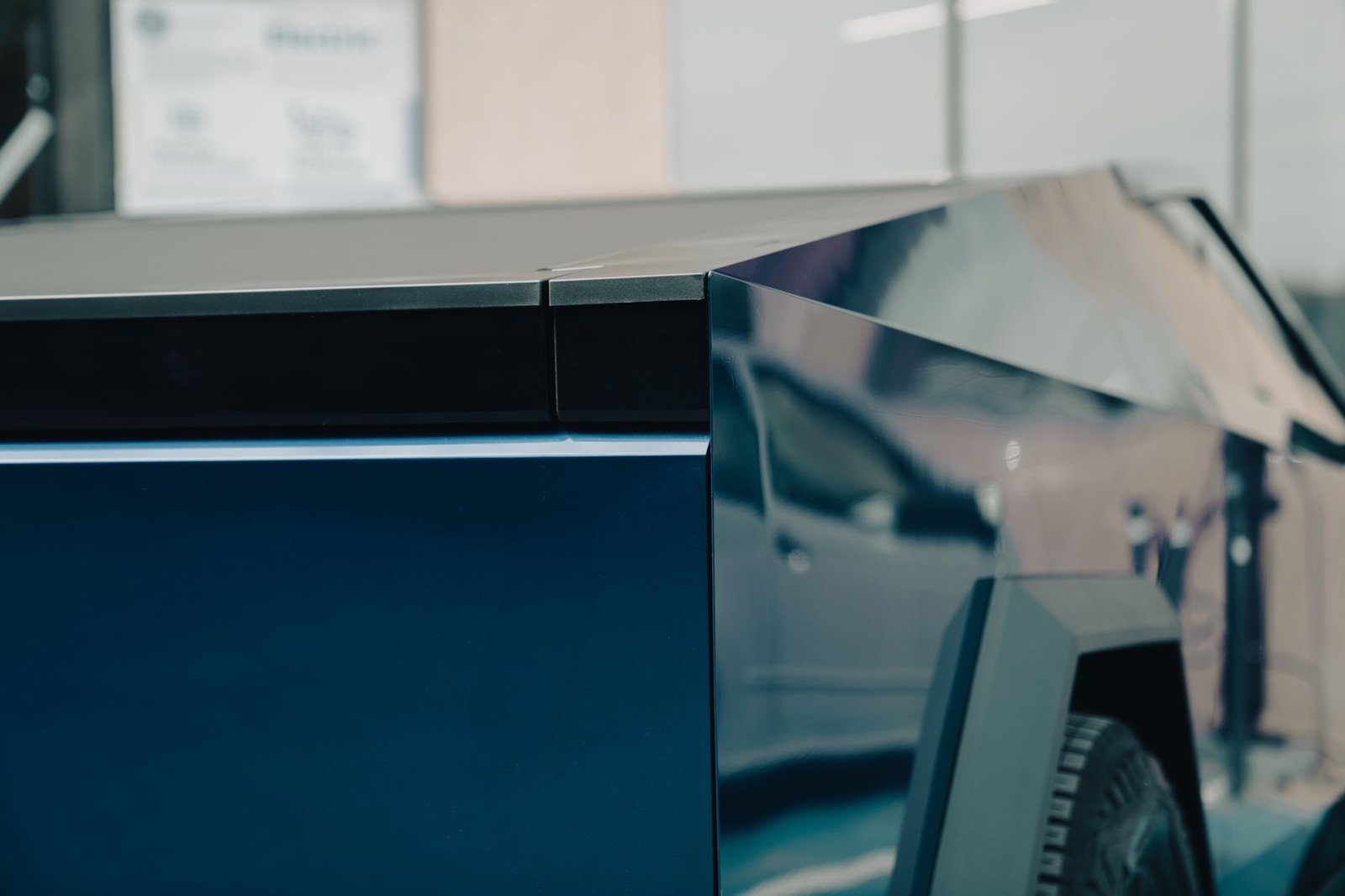
Tesla raised Cybertruck prices by $5,000 this month while announcing plans to launch the Cybercab robotaxi. One product exists, sells poorly, and just got more expensive. The other is a concept vehicle with no production timeline, regulatory pathway, or proven autonomous driving system capable of operating without human supervision. Guess which one gets the stage time?
This is not about whether robotaxis will eventually work. It’s about what companies choose to fund when capital is finite and execution is hard. Tesla is spending engineering hours, supplier relationships, and investor patience on a vehicle that cannot legally operate in most jurisdictions. Meanwhile, the Cybertruck that ships today carries a higher price than it did earlier, yet Tesla sold fewer of them. That’s a capital discipline problem masquerading as innovation.
What Changed Beyond the Press Release
The Cybertruck now starts at roughly $74,990 for the base rear-wheel-drive model, with the all-wheel-drive trim running near $84,990 and the Cyberbeast topping out close to $99,990. These figures reflect upward pricing adjustments since initial deliveries began. The entry price has climbed several thousand dollars from its earlier level, though Tesla hasn’t published a detailed pricing history or explained the cost drivers behind each increase.
Volkswagen confirmed it will launch an electric version of its classic camper van. The ID. Buzz finally reaches the U.S. market after years of concept teasers and European sales. Unlike the Cybercab, the ID. Buzz has crash ratings, a dealer network, and customers who can actually buy one. It targets a segment that values usability over spec sheet bragging rights.
Tesla’s robotaxi reveal came with the usual fanfare but no new information on the core constraint: regulatory approval for unsupervised autonomous driving. The National Highway Traffic Safety Administration has not created a comprehensive framework for certifying Level 4 autonomous vehicles without conventional controls, and Tesla has not obtained the state-level driverless deployment permits that competitors like Waymo hold in the jurisdictions where they operate. These are not minor bureaucratic hurdles. They are foundational requirements that determine whether the Cybercab can operate at all.
The Ordering Error in Robotaxi Capital
Tesla is attempting to build market excitement for a product that cannot yet be sold, serviced, or insured as a driverless vehicle under current law. The capital required to develop the Cybercab splits into two buckets: the vehicle itself and the autonomy stack. The vehicle is the easier part. Tesla knows how to design chassis, integrate motors, and manage battery thermal systems. The hard part is the software that replaces the driver, and that software is not a solved problem.
Full Self-Driving (FSD) in its current form requires constant human supervision. It is classified as a Level 2 system, meaning the driver is legally responsible for all vehicle actions. Moving from Level 2 to Level 4 is not an incremental software update. Proving the system can handle edge cases without human intervention requires extensive validation testing. It requires sensor and system redundancy, fail-safe protocols, and regulatory sign-off at both state and federal levels.
Tesla has spent years collecting data from customer vehicles running FSD in supervised mode. That data is valuable, but it does not substitute for the formal safety case required by regulators. Waymo operates driverless taxis in limited geographies after years of testing and coordination with local governments. Cruise paused operations after safety incidents, and GM subsequently cut funding to the unit. These are companies that started earlier, raised capital specifically for autonomy, and still face regulatory and technical hurdles. Tesla is entering the same race while also funding Cybertruck production, battery development, and factory expansions.
The capital sequencing is backwards. Tesla is marketing a robotaxi before demonstrating unsupervised autonomy in a commercial deployment at scale. Generating press coverage for a concept vehicle is easier than fixing the margin structure on a truck that customers are increasingly reluctant to buy at current prices. But only one of those activities generates meaningful revenue this year or next.
The Physics of Autonomous Driving Costs
Developing a Level 4 autonomous system costs billions, not millions. Waymo’s parent has poured well over $10 billion into the effort across more than a decade. Cruise burned through billions before GM cut funding. The expense comes from sensor hardware, compute power, simulation infrastructure, test fleet operations, and the human engineers required to label data and refine neural networks.
Tesla’s approach relies on vision-only sensing, using cameras instead of lidar. This reduces per-vehicle hardware costs but increases the computational challenge. Training a vision system to match lidar reliability requires far more data and validation. Lidar provides direct distance measurements. Cameras infer distance from image patterns, which is harder to certify as safe under all lighting and weather conditions.
The cost structure also includes liability. Once Tesla deploys a robotaxi without a human driver, it becomes legally responsible for crashes. Insurance actuaries will price that risk based on real-world performance data, which does not yet exist for Tesla’s system at Level 4. Waymo carries specialized insurance policies negotiated after years of testing. Tesla will need similar coverage, and the premiums will reflect the uncertainty.
Compare this to the capital required to fix Cybertruck margin issues. Reducing per-unit production costs involves negotiating supplier contracts, optimizing factory throughput, and redesigning components for manufacturability. These are known problems with established solutions. Tesla has solved them before on Model 3 and Model Y. Applying that expertise to Cybertruck would cost less than funding a robotaxi program and would generate positive cash flow sooner.
What Buyers Are Actually Doing
Cybertruck buyers are rarer than the early hype suggested, and demand has softened as prices climb. The truck accumulated large reservation numbers before launch, with figures reportedly running into the millions, but reservations are not purchases and deposits were refundable. Tesla’s stated ambition of roughly 250,000 units annually at full ramp remains far ahead of actual delivery volumes. The gap between people who clicked a button online and people who finalized financing at current prices is wide and growing wider.
SpaceX reportedly purchased a meaningful share of Cybertrucks over the past year. That is not organic demand. A related entity buying inventory does not constitute market validation. Real external demand is softer. Buyers who want a truck have cheaper options with better dealer support and no waiting list. Buyers who want an EV have cheaper options with more range and faster charging curves. Buyers who want both are a small group, and Tesla priced many of them out.
VW’s ID. Buzz targets a different buyer, but the contrast is instructive. The ID. Buzz is not the fastest EV or the longest range or the cheapest. VW built a specific product for people who want a recognizable design, flexible interior space, and a vehicle that handles like a van instead of a sports sedan. VW identified a segment, built a product for it, and priced it to move volume. Tesla built a truck for people who want to make a statement, then raised the price until the statement became too expensive for most.
Capital Discipline as Competitive Advantage
The smarter play is obvious: stop talking about robotaxis until the technology and regulation align, and fix the products that customers can buy today. Lower Cybertruck prices to match demand curves. Invest in charging infrastructure to reduce range anxiety. Partner with dealers or build service capacity to handle the repair backlog. These are boring, low-headline activities that compound into durable competitive advantage.
Tesla’s brand value comes from being first to prove EVs could be desirable, fast, and practical. That brand is an asset, but it erodes when the company prioritizes announcements over execution. Every dollar spent designing a robotaxi that cannot yet be sold as a driverless vehicle is a dollar not spent reducing the cost of the Model Y or expanding Supercharger coverage in regions where competitors are gaining ground.
VW is not a perfect company. It has made costly mistakes, particularly with early EV software and platforms that underperformed. But launching the ID. Buzz shows focus. VW identified a segment, developed a product, and brought it to market. The company is not promising full autonomy or Mars colonies. It is selling vans to people who want vans. That is capital discipline.
The Conditional Path Forward
Robotaxis will eventually work if enough capital and time are applied. The physics are not impossible. The regulatory frameworks will develop once safety data becomes convincing. But the timeline is measured in years, not quarters, and the costs are massive. Tesla can afford to fund autonomy research. It cannot afford to fund autonomy research while also subsidizing Cybertruck production losses and launching new vehicle programs without clear margin paths.
The better strategy is sequential. Prove unsupervised autonomy in limited deployments first. Run pilot programs in permissive jurisdictions like Arizona or Texas. Collect crash data and refine the system. Work with regulators to establish safety benchmarks. Then scale. Building the robotaxi before proving the autonomy is showmanship, not strategy.
Capital allocation is about choices. Tesla chose to raise Cybertruck prices instead of lowering production costs. It chose to announce a robotaxi instead of scaling driverless deployments in controlled environments. These choices reveal priorities, and the priorities reveal a company optimizing for attention rather than execution. The stock market may reward that in the short term. Customers and competitors will not.