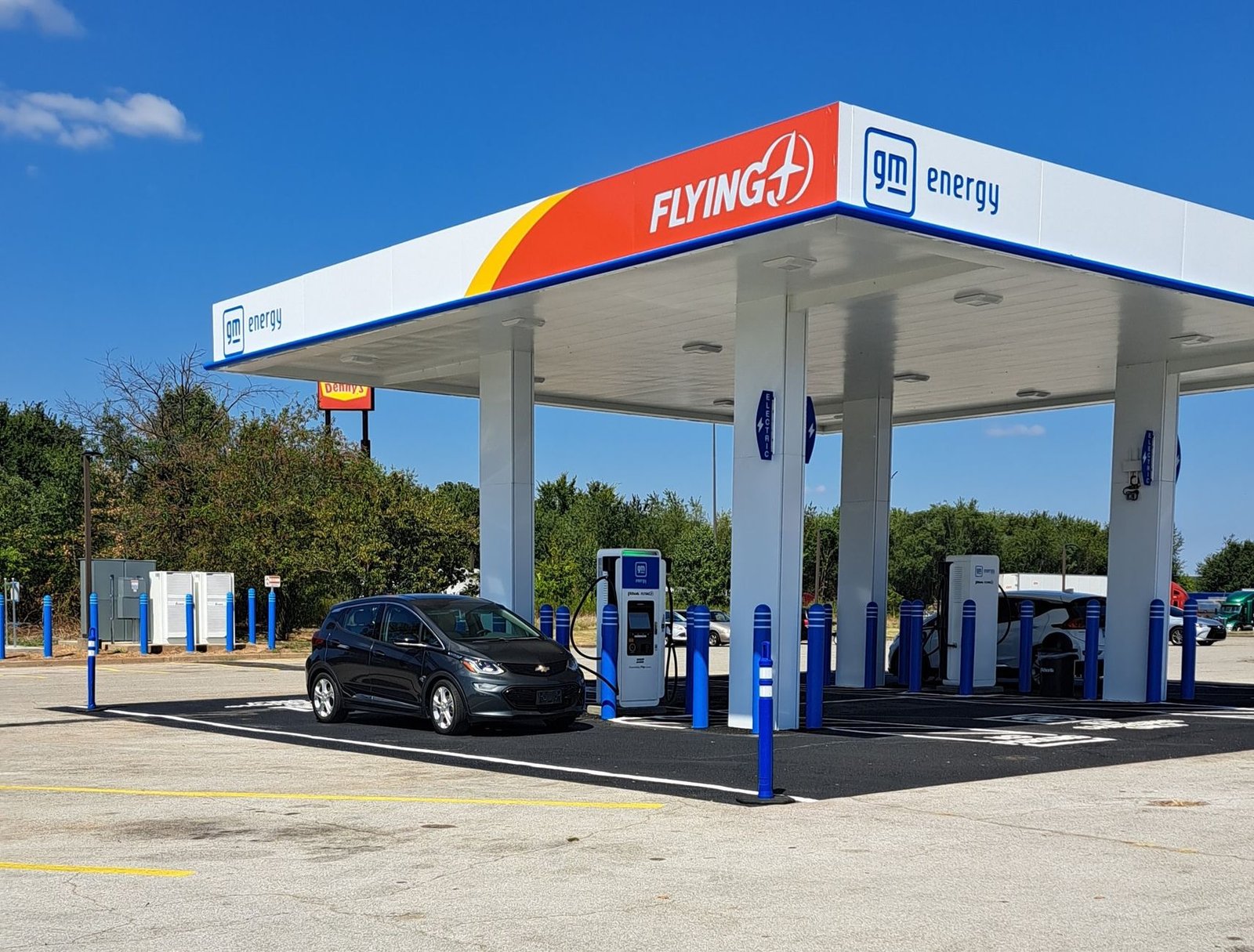
You’re standing in front of a Chevy Blazer EV at the dealership. The sales rep just told you GM works with “all the major charging networks.” Across town, someone else is configuring a Ford Mustang Mach-E, hearing roughly the same pitch. Both of you will drive off the lot believing charging access is solved. Both of you are about to discover the gap between network partnerships and actually plugging in when you need to.
The GM EV charging story centers on software integration: apps that find chargers, payment systems that work across networks, seamless authentication at the plug. The public charging story, like NYC’s 600-curbside-charger buildout or EVgo’s partnership to deploy Tesla Superchargers, focuses on physical infrastructure: more stalls, faster speeds, better locations. These are fundamentally different approaches to the same friction point. One assumes the hardware exists but is too annoying to use. The other assumes ease of use doesn’t matter if there’s nowhere to plug in.
The Features Everyone’s Selling
GM’s pitch revolves around eliminating friction at chargers that already exist. You tap your car’s screen, navigate to a ChargePoint or Electrify America stall, plug in, and the payment happens automatically through your vehicle account. No fumbling with apps, no creating logins for six different networks, no wondering if your credit card will work at this particular unit. The industry calls this Plug and Charge. GM is layering on network aggregation: one interface to search Tesla Superchargers, IONNA locations, and legacy CCS networks.
NYC’s expansion adds 600 Level 2 curbside chargers across all five boroughs over three years, targeting neighborhoods with limited off-street parking. EVgo is deploying Tesla’s V4 Superchargers, which work with both CCS and NACS connectors via longer cables. In practice, current V4 stalls in North America deliver up to around 325 kW, with higher speeds gated by future cabinet upgrades. These installations aim to put hardware where people actually park: residential streets, municipal garages, grocery store lots.
Both strategies cite impressive numbers. NYC’s current curbside chargers run at high occupancy and deliver energy over 85 percent of occupied time. Tesla’s V4 hardware is designed for higher-voltage architectures that can eventually enable faster charging sessions for compatible vehicles. GM’s integration claims to cover the large majority of US DC fast chargers at launch through its aggregation of the major networks.
What the Pitch Glosses Over
The software solution assumes you can reach a charger in the first place. If you live in a dense urban neighborhood without garage access, app integration is irrelevant when the nearest functional DC fast charger is a 20-minute drive and has two stalls with a long wait. GM’s seamless payment experience doesn’t help when the charger you navigated to is offline, or when it’s occupied by someone charging to 100 percent because parking is scarce and they’re gaming the system.
Curbside Level 2 chargers take hours to deliver meaningful range. NYC’s units can top up a battery over the course of an overnight session, which works if you park overnight on the same block consistently. It fails if you circle for 30 minutes looking for street parking and end up four blocks away. The 600-charger expansion sounds substantial until you divide it across five boroughs and realize it’s roughly 120 chargers per borough, competing with hundreds of thousands of registered EVs and every Uber driver working a 12-hour shift.
The EVgo-Tesla Supercharger partnership solves a real problem: Tesla’s hardware is reliable, and opening it to other brands increases utilization. But “hundreds” of Superchargers planned across US cities is a rounding error when Tesla’s proprietary network already has well over 2,000 stations in the US. EVgo adding Superchargers helps EVgo’s brand recognition more than it changes the charging landscape for a driver in Phoenix or Baltimore. Those longer cables EVgo is installing cut both ways: they improve access for vehicles with charge ports in odd locations, but they also invite cable management chaos at busy urban sites where people don’t coil them back neatly.
Neither approach confronts the utilization mismatch. NYC touts 85 percent energy delivery during occupied time as proof of success, but that stat hides the frustration: if a charger is occupied most of the day and you need it during that window, the network failed you. High utilization means the system is saturated, not that it’s working well. Building more chargers helps, but only if you build enough to push utilization well below saturation during peak hours. Nobody’s proposing that, because the unit economics don’t close at low utilization rates.
Who Each Approach Actually Serves
GM’s integrated software model works for drivers who already have reliable home charging and use public infrastructure occasionally for road trips or top-ups. If you charge at home 90 percent of the time, the app-free Plug and Charge experience at an Electrify America station on I-95 is a genuine quality-of-life improvement. You’re not dependent on public charging; you’re just reducing the hassle when you occasionally need it. This is the suburban homeowner with a garage, the person who bought an EV because they rarely drive more than 200 miles in a day.
The curbside Level 2 buildout serves a completely different buyer: the urban renter or apartment dweller with no dedicated parking. This person needs charging infrastructure to substitute for a home outlet, not supplement it. They park wherever they find a spot, so the chargers need to be dense enough that one is usually within a block. The three-year buildout timeline and per-kilowatt-hour pricing (not yet set, but mentioned with “affordability” caveats) suggest this will be expensive and slow to arrive at meaningful scale. For now, this buyer is better off with a plug-in hybrid or skipping EVs entirely until their building installs garage chargers.
The EVgo-Tesla partnership serves fleet operators, rideshare drivers, and anyone who needs predictable DC fast charging in metro areas. Tesla hardware reliability and EVgo’s site selection in urban centers create a known quantity: you can plan your route around these chargers with reasonable confidence they’ll work. But you’re paying a premium in time (waiting for a stall during peak hours) and money (DC fast charging often costs several times what home charging costs per kilowatt-hour). This works if charging cost is an operational expense you can pass through to customers or write off. For a household budget, it’s a last resort.
The Constraint That Actually Matters
The decision point isn’t software polish or charger speed. It’s where you sleep. If you park in the same spot overnight and can run a cable to it, EV ownership is straightforward regardless of public network quality. The GM EV charging integration makes your occasional public charging smoother, which is nice but not essential. If you cannot charge at home, you’re dependent on public infrastructure being both dense and underutilized, which nowhere in the US has achieved yet outside of a few square miles in select cities.
The NYC expansion targeting “high residential density, limited off-street parking” neighborhoods is directionally correct but undersized. 600 curbside chargers over three years, even with multiple connectors per site, cannot support mass EV adoption in a city where roughly 1.5 million households rely on street parking. The math requires thousands more, and the already-high utilization rates suggest demand is outpacing supply before the expansion even begins. EVgo’s hundreds of Superchargers face the same scale problem: helpful, but not transformative.
The Choice You’re Actually Making
If you have home charging, buy the EV with the best GM EV charging software integration you can afford, because the hardware network will remain uneven for years and a good app layer reduces frustration. The Blazer EV or Equinox EV makes sense here. If you don’t have home charging and can’t install it, buying an EV right now means accepting you’ll spend many hours per month managing charging logistics: hunting for open stalls, sitting in your car or killing time nearby, paying several times what home charging costs. For most people in that position, a plug-in hybrid with 40 miles of electric range and a gas engine for longer trips is the rational compromise until curbside or workplace charging reaches saturation.
The infrastructure is improving, but not at the pace required to make EVs viable for non-homeowners in the next three to five years. The software is getting better, but it can’t solve a hardware scarcity problem. The buyer who ignores this reality and expects seamless GM EV charging from day one without a home plug will spend the first six months resenting the vehicle, then either install a home charger at significant cost or trade the EV in at a loss.