A truck depot manager in Southern California just got quoted $12 million to upgrade the electrical service to their yard. They wanted to install enough chargers for 50 electric Class 8 trucks. The utility said they’d need a new substation. The timeline was 36 months, and the depot would be responsible for most of the cost. The manager shelved the electrification plan.
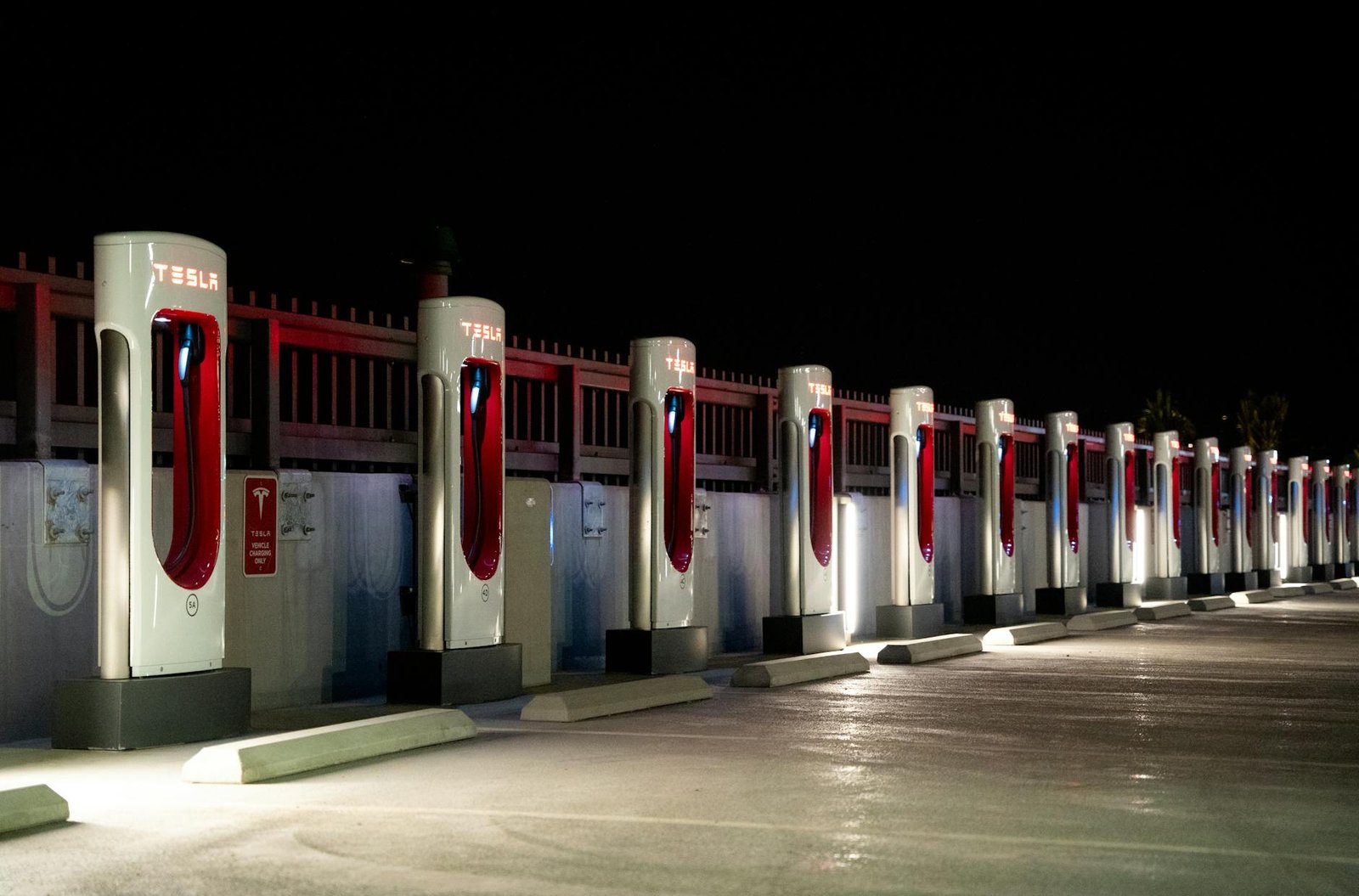
EV Realty’s new flagship charging hub in San Bernardino proves the point from the other direction. They installed 76 high-power charging ports with a total capacity of 9 megawatts, designed to serve 200+ medium and heavy-duty trucks daily. The site sits near the San Bernardino Intermodal Facility, surrounded by 60+ million square feet of warehouses and nearly 17,000 trucks operating in the region. Nobody is building these hubs at scale because the grid connection cost alone creates a business model problem that most fleet operators can’t solve.
The Belief: Build It and They Will Charge
Electric trucks are becoming cost-competitive with diesel, charging technology exists (Kempower installed units here that can deliver up to 1.2 MW per port using the new MCS standard), and fleet operators in logistics hubs need the infrastructure. Therefore, EV truck charging will scale the same way light-duty EV charging scaled at gas station chains and highway rest stops.
Power density is the problem. A typical highway DC fast-charging station for passenger cars might install 8 to 12 chargers with a total site capacity of 1-2 MW. The San Bernardino hub needs 9 MW for 76 ports because Class 8 trucks carry battery packs in the 300-500 kWh range. Charging one truck in 30-45 minutes requires as much power as charging 10 sedans simultaneously.
Delivering 9 MW continuous load requires electrical service the grid was not designed to provide at industrial sites. Most warehouses and truck terminals operate on 1-2 MW service connections, sufficient for lighting, HVAC, and forklifts. Quadrupling or quintupling that demand means infrastructure upgrades that cost millions and take years to permit and build.
Where the Grid Breaks Down
Utilities price electrical service upgrades based on the incremental capacity being added and the distance from existing infrastructure that can support the load. In dense logistics regions like the Inland Empire, substations are already running near capacity because of warehouse growth over the past two decades. Adding 9 MW at a single site often means either building a new substation or running new high-voltage lines from a substation miles away.
EV Realty secured $75 million in growth equity from NGP Energy Capital, plus additional investment from Outpost, a truck terminal operator. That capital covered not just the chargers and software (Synop handles power management and fleet reservations), but the grid connection and site development. A typical fleet operator doesn’t have access to that kind of financing for what is essentially utility infrastructure.
Southern California Edison provided the grid capacity for this site, but the process involved coordination through California Energy Commission programs like EnergIIZE Commercial Vehicles and air quality funding through the South Coast Air Quality Management District’s Carl Moyer Program. Those programs exist because the economics don’t work without subsidies.
The capital cost per truck served is higher than most logistics companies will pay, especially when diesel refueling infrastructure costs almost nothing by comparison.
What About On-Site Battery Storage?
The obvious engineering solution is to install stationary battery storage at the charging hub, which would let the site draw power from the grid slowly over 24 hours and discharge it quickly when trucks need to charge. Peak demand drops, and the required grid connection capacity theoretically shrinks.
The math doesn’t work. A 9 MW charging hub serving 200 trucks per day needs to deliver roughly 80-100 MWh of energy daily, assuming an average truck takes 400-500 kWh per charge. Buffering even half that load with batteries would require a 40-50 MWh stationary storage system, which costs $12-20 million at current battery prices. The payback period stretches beyond the useful life of the equipment unless electricity rates show extreme time-of-use variation, which they typically don’t in most industrial rate structures.
Stationary storage makes sense at sites where trucks charge overnight and the grid connection can trickle-charge the batteries during off-peak hours. It does not solve the problem at high-throughput hubs where trucks arrive unpredictably throughout the day and need to charge quickly between shifts.
Why the Model Works for EV Realty but Not for Fleet Operators
EV Realty’s business model is shared infrastructure. The San Bernardino hub serves multiple fleets, including J.B. Hunt Transport, Gate City Beverage, and Nevoya, an all-electric carrier. John Verdon, Nevoya’s Chief Commercial Officer, noted the site provides “valuable operational flexibility with both megawatt charging and vehicle domicile options.” The high capital cost gets spread across multiple customers, and the utilization rate stays high enough to justify the investment.
A fleet operator running their own depot can’t achieve the same utilization. Their trucks charge during predictable windows, leaving the infrastructure idle much of the day. The capital cost per truck is two to three times higher when the chargers sit unused 60% of the time. EV truck charging requires utility-scale infrastructure but delivers value at the fleet level, and the economics only work when you aggregate demand across multiple operators.
Patrick Sullivan, EV Realty’s CEO, framed the site’s purpose clearly: “Fleets operating here are doing some of the most important and demanding work in the supply chain. They need reliable, affordable access to high-power charging so they can move beyond pilots and make electrification a real business decision.” The phrase “move beyond pilots” is doing a lot of work. Most fleet electrification programs are still pilots because the infrastructure cost at scale remains unsolved.
The Constraint Nobody Wants to Talk About
The San Bernardino hub sits at the intersection of Interstates 10 and 215, near the ports of Los Angeles and Long Beach, in a region that functions as the sorting and distribution point for freight moving across the country. Truck density is high, the logistics companies are large and creditworthy, and public funding is available to de-risk the project.
Most truck depots are not located in the Inland Empire. They are spread across secondary cities and rural corridors where truck volumes are lower, grid capacity is weaker, and subsidies are harder to access. The math that barely works in San Bernardino collapses in those locations. EV Realty is acquiring additional sites, but the constraint is not technology or demand: it is grid capacity and the cost to access it.
The assumption that EV truck charging will scale naturally once the trucks are cost-competitive ignores the fact that charging infrastructure for heavy-duty vehicles is not a distributed problem. It is a grid problem, and grids were not built for this load profile. Until utilities treat truck charging hubs as core infrastructure and ratepayers accept the cost of upgrades, the business model depends on venture capital, public subsidies, and shared-use facilities in high-density corridors.
That model works for 10 or 20 sites nationwide. It does not work for the thousands of depots that would need similar infrastructure if Class 8 electrification reaches even 20% market share.