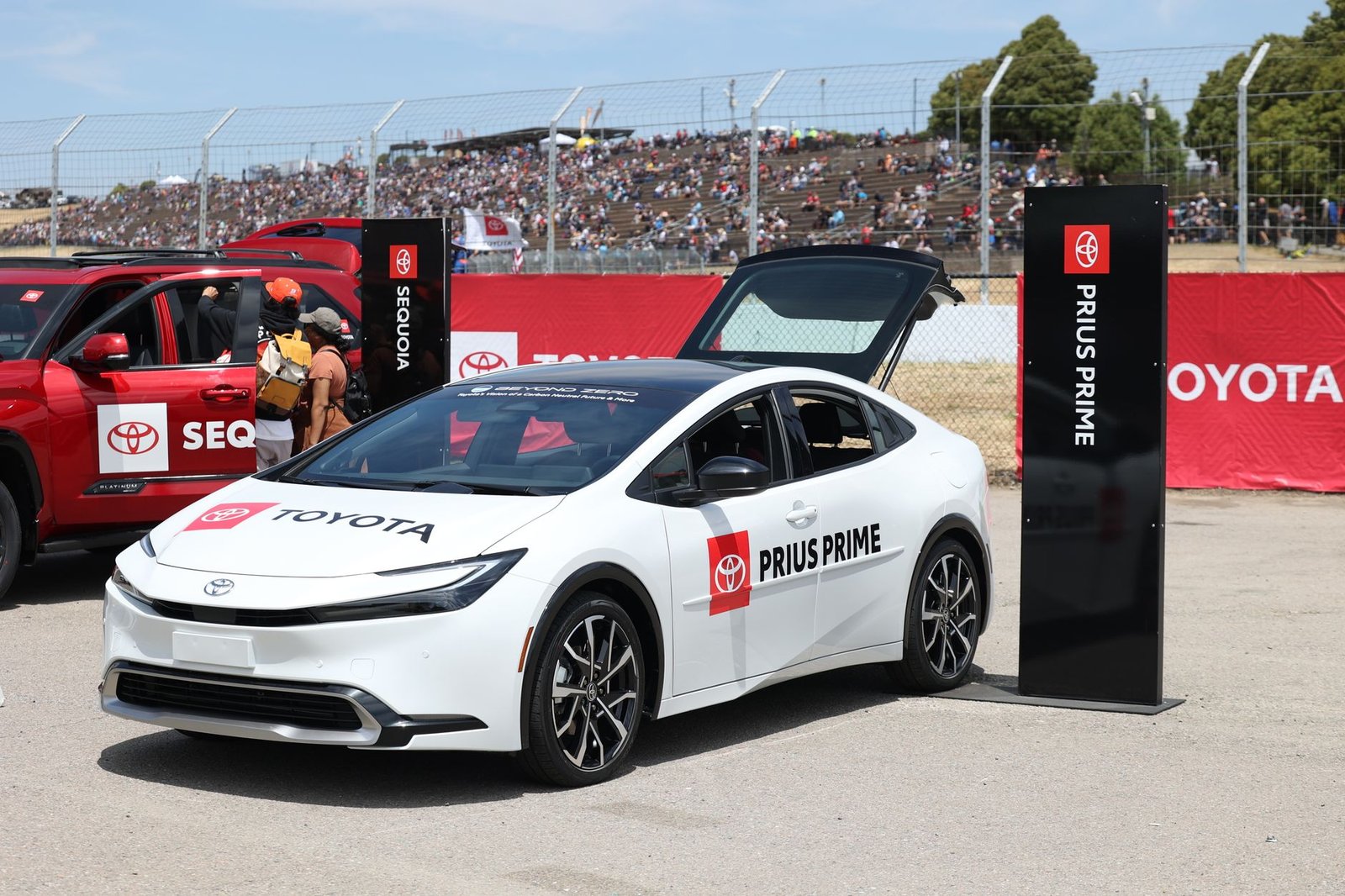
Toyota’s third-quarter electrified vehicle share crossed 60% for the first time, according to industry reports tracking hybrid, plug-in hybrid, and battery-electric vehicle deliveries. The automaker shipped more electrified powertrains than conventional gas engines in a single quarter, marking a watershed moment in its product mix. But the number conceals a critical friction point: most buyers choosing these vehicles aren’t making a conscious decision to electrify. They’re buying the Camry or RAV4 they always wanted, which now happens to include a hybrid system as standard equipment. The distinction matters because it reveals how Toyota is solving the adoption problem the rest of the industry is still fighting.
The automotive press treats electrification rates as a proxy for consumer demand. Higher percentages suggest buyers are embracing electric powertrains and rejecting internal combustion. Toyota’s 60% electrified sales figure appears to validate this narrative. But disaggregate the number and a different pattern emerges. The majority of that 60% comes from hybrid vehicles where the customer faced no incremental decision at purchase. The Camry Hybrid isn’t a separate model buyers must actively choose over the gas version. As of the 2025 model year, it’s the only Camry available in the U.S. market. The RAV4 Prime plug-in hybrid commands a premium and a waitlist. The bZ4X battery-electric crossover moves slowly at higher price points. Toyota’s electrified sales grew primarily by eliminating the gas option, not by winning over skeptical buyers through performance or cost advantages.
The Ordering Error in Adoption Metrics
Industry analysts measure electrification by counting powertrains. A vehicle with any degree of battery assistance counts as electrified, regardless of whether the buyer considered alternatives or simply bought the only version available. This creates a reporting distortion. When Ford electrifies the F-150 by launching the Lightning as a separate SKU, every sale represents an active choice. The buyer considered the gas F-150, weighed range and charging infrastructure, and selected the electric version despite higher upfront cost and operational uncertainty. When Toyota hybridizes the Camry by discontinuing the conventional powertrain, every sale counts identically in electrification statistics but represents zero incremental adoption friction.
The metric conflates two distinct market dynamics. True adoption occurs when buyers overcome switching costs to choose unfamiliar technology. Toyota’s hybrid strategy avoids that friction entirely by making hybridization the path of least resistance. The customer walks into a dealership expecting to buy a Camry. The salesperson quotes a single price for a single powertrain. No decision tree, no comparison shopping, no risk evaluation. The hybrid system becomes invisible infrastructure rather than a feature requiring justification. This explains why Toyota’s electrification rate can climb while actual customer behavior around electric powertrains remains unchanged.
Why Hybrid Standardization Works
A hybrid powertrain adds roughly $2,000 to $3,000 in manufacturing cost compared to a conventional engine and transmission. That cost includes the electric motor, battery pack, power electronics, and integration engineering. Toyota recovers this premium through two mechanisms that don’t require convincing skeptical buyers to pay more for electrification. First, the automaker folds the incremental cost into the base price of the now-hybrid-only model. The 2025 Camry starts at roughly $28,400, which includes the cost structure of hybridization in a single transaction price. No separate hybrid premium appears on the window sticker. The customer compares that price against competitive sedans, not against a cheaper gas Camry that no longer exists.
Second, fuel savings offset the higher transaction price within the ownership period most buyers consider. The 2025 Camry Hybrid achieves roughly 50 combined mpg compared to about 32 mpg for the prior gas model. At 12,000 miles annually and $3.50 per gallon, the hybrid saves roughly $490 per year in fuel costs. Over a typical 60-month loan term, that yields roughly $2,450 in savings, enough to offset most or all of the incremental powertrain cost. The buyer doesn’t perform this calculation explicitly. They see a competitive purchase price and lower fuel costs as separate attributes, both favorable. The hybrid system disappears into the value proposition rather than presenting as a premium feature requiring justification.
Contrast With Plug-In and Battery-Electric Friction
Plug-in hybrids and battery-electric vehicles can’t use this strategy because the cost delta and operational changes remain too large to absorb invisibly. The RAV4 Prime starts several thousand dollars above the standard RAV4 Hybrid. That premium buys roughly 42 miles of electric range and access to federal tax credits, but it also requires the buyer to evaluate charging infrastructure, plan daily driving patterns, and assess whether their garage can accommodate a Level 2 charger. The purchase decision becomes explicitly about electrification, creating the same friction Toyota’s hybrid-only strategy avoids.
The bZ4X battery-electric crossover carries even higher friction. Starting around $37,000 before incentives, it competes with the RAV4 Hybrid in the low-$30,000s and the RAV4 Prime in the mid-$40,000s. The customer must accept limited range, public charging dependency, and uncertainty about long-term battery degradation. Each attribute requires active evaluation and risk tolerance. Toyota sells only a few thousand bZ4X units per quarter in the U.S. market, compared to tens of thousands of RAV4 Hybrids. The electrification rate looks healthy in aggregate, but the buyer behavior shows clear preference for the technology that requires no behavioral change.
What Buyers Actually Optimize For
The standard economic model assumes buyers evaluate total cost of ownership and choose rationally. In practice, most buyers optimize for avoiding regret and minimizing decision complexity. A hybrid Camry presents low regret risk. If the battery system fails, the engine still runs. If gas prices fall, the efficiency still helps. If charging infrastructure improves, the vehicle wasn’t designed around assumptions that might prove wrong. The buyer made no bet on the future of energy infrastructure. They bought a sedan that happens to use less fuel, with no operational change required.
Battery-electric vehicles demand the opposite calculation. The buyer must forecast fuel prices, grid reliability, charging network expansion, and their own driving patterns over a five to seven year ownership period. Any forecast error creates regret risk. If charging networks don’t expand as expected, range anxiety intensifies. If electricity rates rise faster than gas prices, the operating cost advantage shrinks. If driving needs change and require longer trips, the vehicle becomes limiting rather than enabling. Most buyers lack the tools to evaluate these variables confidently, so they default to technologies that don’t require the forecast.
Toyota’s hybrid-only strategy exploits this behavioral pattern. By eliminating the conventional powertrain option, the automaker removes the comparison that would highlight the hybrid premium. By keeping battery packs small enough to avoid charging infrastructure, they eliminate the forecast variables that create purchase friction. The result is high electrified sales figures driven by reduced decision complexity rather than improved cost parity or enhanced desirability of electric powertrains themselves.
The Capital Discipline Advantage
Building a dedicated electric vehicle platform requires spending billions before the first unit reaches a customer. That capital must be recovered through premium pricing, high-volume sales, or both. Tesla justified the capital outlay by targeting buyers willing to pay $80,000 or more for a Model S that delivered performance and technology unavailable elsewhere. Ford and GM are attempting to justify EV platforms by achieving cost parity with gas vehicles at high production volumes. Both strategies require either premium buyers or mass-market scale to work financially.
Hybridizing existing platforms costs a fraction of that capital and generates more immediate returns at current production volumes. Toyota doesn’t need the Camry Hybrid to outsell competitors or command luxury pricing. The vehicle sells at mid-market prices in volumes the existing factory already produces. The hybrid system adds margin without requiring new factories, dedicated battery supply chains, or charging partnerships. The automaker can electrify its fleet incrementally, model by model, recovering investment within each product cycle rather than betting on a future where full electrification justifies massive upfront capital.
Why This Strategy Has Limits
Hybrid-only product strategies work for sedans, crossovers, and light trucks where duty cycles match hybrid strengths. Stop-and-go traffic, moderate speeds, and short trips allow regenerative braking to recover energy efficiently. Highway-dominated driving profiles show smaller benefits because the electric motor contributes less at sustained speeds. Heavy-duty trucks, commercial vehicles, and high-performance cars operate outside the sweet spot where hybrid systems deliver compelling value without operational trade-offs.
Regulatory pressures also constrain the strategy’s long-term viability. California and several other states adopted rules under the Advanced Clean Cars II program requiring rising percentages of zero-emission vehicle sales, phasing in from the 2026 model year toward 2035, though several states have delayed or softened enforcement amid legal and political challenges. Conventional hybrids don’t count toward the core zero-emission requirement regardless of fuel efficiency gains. Toyota will need battery-electric vehicles (and potentially qualifying plug-in hybrids) to fully serve these markets, forcing the company into the same capital-intensive platform decisions and customer friction challenges it has largely avoided through hybridization. The question becomes whether the automaker can translate its hybrid adoption playbook into battery-electric success, or whether the operational differences make that experience non-transferable.
The Underlying Lesson
High electrified sales percentages don’t necessarily signal buyer enthusiasm for electric powertrains. They often indicate successful friction reduction through product portfolio management. Toyota proved buyers will accept hybrid technology when it appears as standard equipment on vehicles they already want, priced competitively with alternatives, and requiring zero behavioral change. That model works until regulations or competition force a shift to plug-dependent powertrains where the friction can’t be eliminated through clever packaging. The companies currently losing money on every EV sold are solving a harder problem: convincing buyers to accept operational trade-offs for technology they don’t yet trust. Toyota’s approach delays that challenge but doesn’t avoid it. When the company eventually needs customers to choose battery-electric vehicles over hybrids, the 60% electrification rate will matter less than whether buyers developed trust in electric powertrains or just accepted fuel efficiency improvements that happened to use batteries.