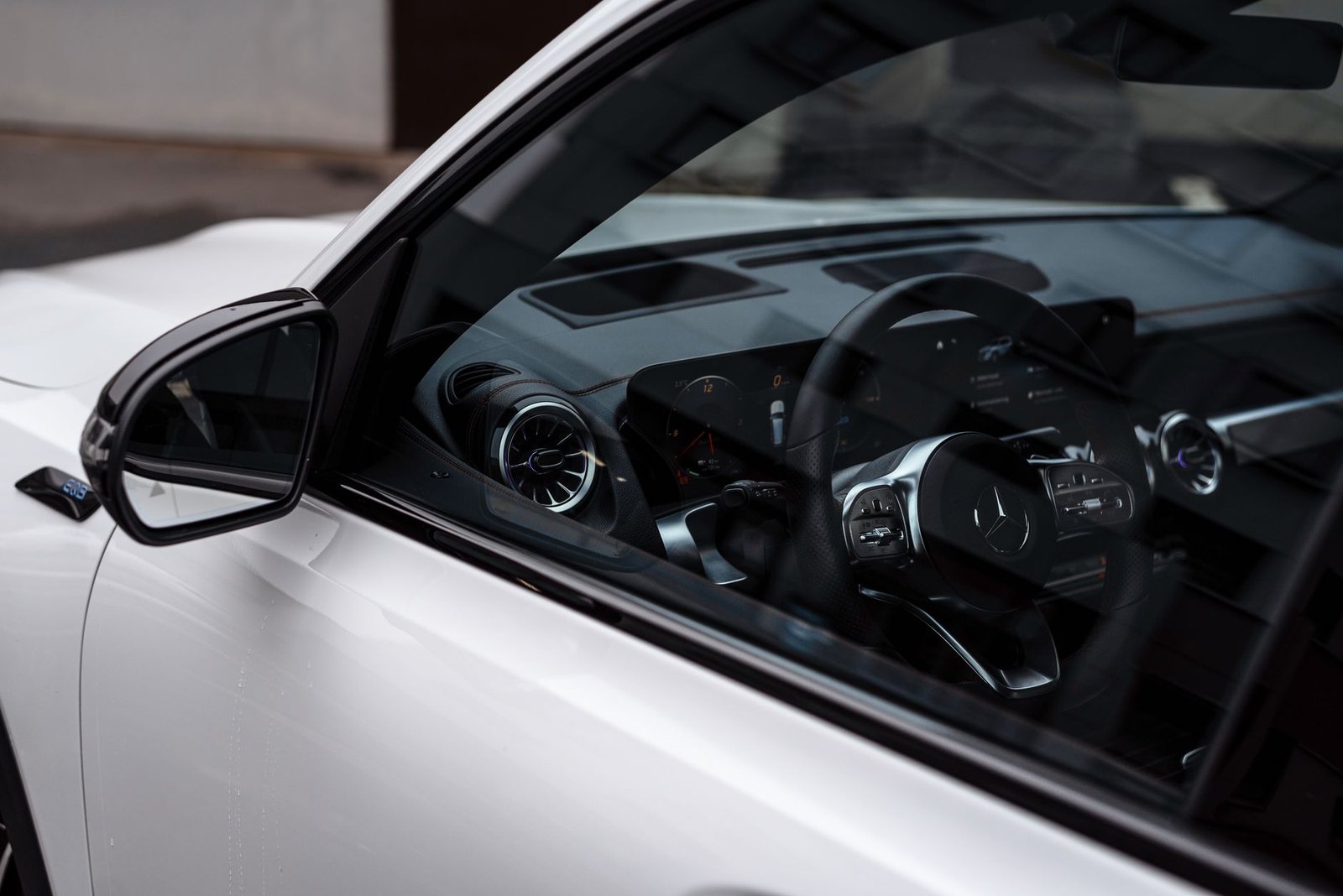
The Mercedes-Benz GLC 400 4Matic covered 393 miles across Hungary and Austria on a single charge stop, draining its 94-kWh battery to 7% at the destination. That’s well beyond what a naive highway consumption rate would suggest, thanks to a single fast charging stop. The gap between rated range and highway reality, and the charging strategy that bridged it, tells you more about EV road trip physics than any press release will.
This wasn’t a hypermiling exercise. The GLC spent 80% of the route on highways at 80 mph, conditions that punish battery range harder than most driving scenarios. At that speed, the vehicle consumed energy at 21.4 kWh per 100 km, which translates to roughly 2.9 miles per kWh. Run that math against the 94-kWh usable capacity and you get about 273 miles of realistic highway range, not the 418 miles Mercedes quotes under its rated cycle. The 145-mile difference is aerodynamic drag doing what physics requires.
What the Single Charging Stop Actually Delivered
The vehicle stopped once, at an EnBW Smatrics station in Melk, Austria, arriving with 31% battery remaining after covering roughly 192 miles. The charging session lasted 17 minutes, adding 51 kWh and bringing the battery to 81%. That’s enough energy to cover the remaining 201 miles to the destination in Austria’s Alps, with just 7% left at arrival.
The charging power peaked at 275 kW during the session, though Mercedes advertises a higher capability of up to 330 kW. The gap likely reflects battery temperature, since the pack wasn’t preconditioned before plugging in. Even without preconditioning, the average power during the session held at 180 kW, fast enough to avoid the trip-killing dead time that plagues older EVs with slower charging curves.
Here’s the relevant calculation: 51 kWh delivered in 17 minutes requires an average of about 180 kW sustained. That’s architecture, not advertising. The GLC uses an 800-volt electrical system, which allows higher charging currents without overheating the cables or the battery cells. The charger itself had capacity to spare, but the vehicle’s thermal limits and state of charge dictated the actual power delivered.
Why Highway Consumption Diverges from Rated Range
The 418-mile rated range assumes a standardized test cycle that includes city driving, moderate speeds, and regenerative braking opportunities. Highway driving at 80 mph eliminates most of those benefits. Aerodynamic drag increases with the square of velocity, so doubling speed from 40 mph to 80 mph quadruples the drag force. Rolling resistance and drivetrain losses also rise, though not as steeply.
To achieve the rated 418 miles, the GLC would need to consume just 15.8 kWh per 100 km, or about 3.9 miles per kWh. That’s roughly 35% better efficiency than what the highway run delivered. The difference isn’t a flaw in the vehicle. It’s the cost of moving a two-ton SUV through air at Interstate speeds. No battery chemistry or motor efficiency improvement changes the drag equation.
The single lunch stop strategy worked because the charging speed stayed high enough to add range faster than highway driving consumed it. At 180 kW average, the vehicle was adding roughly 540 miles of rated range per hour of charging, or about 355 miles per hour at the observed highway consumption rate. That 17-minute stop recovered around 100 miles of highway range, enough to close the gap between the first leg’s endpoint and the final destination.
How Charging Speed Reframes Range Anxiety
The InsideEVs road trip included eight EVs, and the GLC required among the least total charging time to complete the route. That’s not because it had the largest battery. It’s because the combination of usable capacity and sustained charging power allowed a single stop to cover the deficit between starting charge and destination distance.
Compare that to older EV architectures limited to 50-150 kW charging speeds. A vehicle charging at 100 kW would need roughly 30 minutes to add the same 51 kWh the GLC absorbed in 17 minutes. On a road trip, that difference compounds across multiple stops. It’s also the difference between a charging stop that feels like a brief interruption and one that feels like waiting.
But charging speed only matters if the infrastructure supports it. The high-power charger in Melk could deliver what the GLC requested. In regions where 150-kW chargers are still the norm, the vehicle’s 275-kW peak capability becomes irrelevant. The architecture is ready. The grid isn’t universally caught up.
What the Consumption Math Means for Buyers
If you’re shopping for an EV and the manufacturer quotes 418 miles of range, assume you’ll get roughly 65% of that at sustained highway speeds. That’s not pessimism. It’s drag reality. The GLC’s observed 273 miles of highway range aligns with what the physics predicts for a vehicle of its size and shape at 80 mph.
The strategic insight is that highway range matters less than charging speed once you accept that a stop is inevitable. A vehicle with 350 miles of rated range and slow charging will be more frustrating on long trips than one with 275 miles of highway range and the ability to add 100 miles in 15 minutes. The time cost of charging is friction. The energy cost of highway driving is physics. You can optimize around the first. You cannot negotiate with the second.
This also clarifies why different EVs perform differently on the same route despite similar battery capacities. Aerodynamic efficiency, thermal management, and charge curve shape all affect how much energy you can deploy and recover per hour of travel. The GLC’s relatively blunt SUV shape costs it some efficiency compared to a sedan, but the fast charging compensates enough to make highway trips practical without the range paranoia that defined earlier EV generations.
Where This Leaves the GLC Against Competitors
The Mercedes GLC Electric competes against the BMW iX3, Audi Q4 e-tron, and Tesla Model Y in the premium electric SUV segment. These rivals have usable battery capacities spanning roughly the 75-95 kWh range. The differentiation comes down to charging architecture and software-managed thermal systems.
Tesla’s advantage has been its charging network density and the Model Y’s slightly better aerodynamics, which narrows the consumption gap at highway speeds. The German entrants are catching up on charging speed but still lag on network coverage in most markets. The GLC’s 275-kW observed peak puts it ahead of the Q4 e-tron’s roughly 175-kW limit, while the newer 800-volt iX3 is rated for even higher peak charging in markets where that vehicle is available.
The practical takeaway is that EPA or WLTP range numbers are poor predictors of road trip experience. Charging speed, network reliability, and consumption at actual highway speeds matter more. A 20% difference in rated range becomes negligible if one vehicle charges 40% faster.
The Actual Constraint Remains Infrastructure
The GLC demonstrated that nearly 400 miles of travel is achievable with current battery and charging technology if the infrastructure cooperates. But that’s the constraint. The high-power charger in Melk delivered what the vehicle could accept. Most highway corridors in the U.S. still have gaps where 150-kW is the best available option, and rural areas often have nothing faster than 50-kW units that were competitive in 2018 but are now bottlenecks.
The vehicle technology has outrun the grid investment in many regions. Until charging networks achieve the power levels and density that current EV architectures can exploit, range anxiety will persist not because batteries are inadequate but because the charging stop might take three times longer than it should. The GLC proved the hardware is ready. The map of where you can use it is still filling in.
Excerpt: The Mercedes GLC Electric covered 393 miles at highway speeds with one 17-minute charging stop, but its observed consumption reveals why rated range numbers mislead buyers about road trip reality.