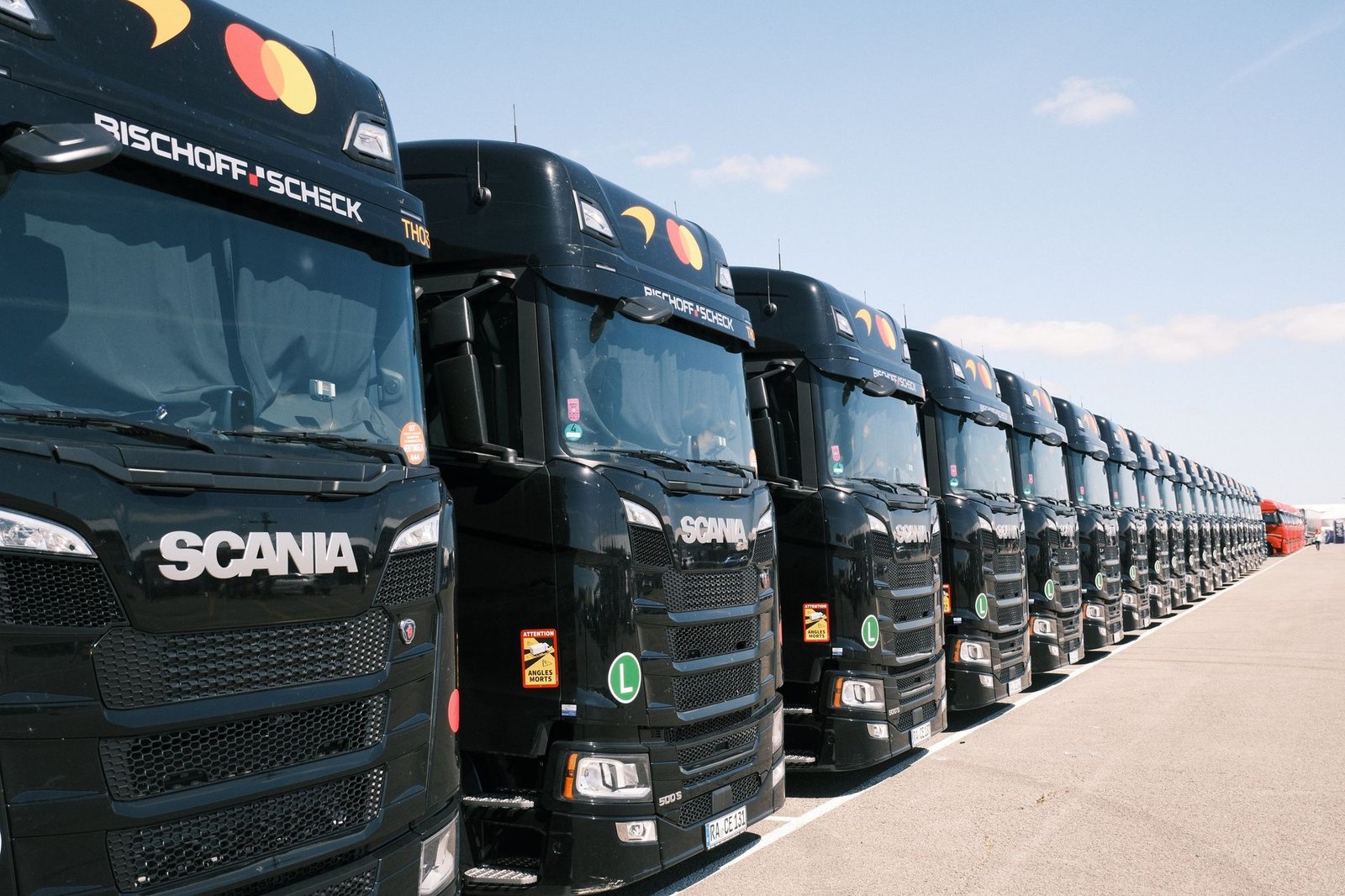
Scania recently announced an electric semi with 447 miles of range, matching the MAN eTGX and substantially exceeding what Tesla has shipped to European customers. The headline sounds like a spec-sheet victory, but the interesting question isn’t who hit which number. It’s why getting from 300 miles to 450 miles in a Class 8 truck requires fundamentally different engineering choices than the same jump in a passenger car, and what those choices reveal about the physics of moving 40 tons down a highway.
When you see a new Scania electric truck with 447-mile range and up to 356 kWh of additional battery capacity, the natural reaction is to compare it to Tesla’s Semi or other competitors. But the more useful analysis starts with the energy equation that every electric truck manufacturer faces: how much battery can you physically fit before the weight penalty erases the range benefit? And once you’ve stuffed in the maximum practical battery, how much does aerodynamics actually matter when you’re already hauling 80,000 pounds?
The Coefficient of Drag Problem at Highway Speeds
A loaded semi consumes roughly 2 kilowatt-hours per mile at highway speeds. That’s around 10 times what a Tesla Model 3 uses, but the ratio changes depending on how fast you’re going and what you’re hauling. At lower highway speeds, rolling resistance is a larger share of the load: the tires flexing against the pavement account for a substantial fraction of energy loss. As speed rises, aerodynamic drag takes over, since drag increases with the square of velocity. Every 5 mph faster costs meaningfully more energy, and by highway cruising speeds most of that increase comes from pushing air out of the way.
This is where Scania’s cab design enters the picture. European regulations now allow truck cabs to extend beyond the traditional flat-front profile if the extra length improves aerodynamics or safety. Scania claims the new cab reduces energy consumption by up to 3 percent. That sounds modest until you multiply it across 447 miles. Put differently, at 2 kWh per mile a 3 percent efficiency gain effectively stretches the range by roughly 13 miles without adding a single cell.
The catch is that aerodynamic improvements show diminishing returns. Getting from a drag coefficient of around 0.65 to 0.55 (typical for a modern aero tractor) might save close to 10 percent. Going from 0.55 to 0.50 might save another 3 percent. But dropping below 0.45 requires radical changes like fully enclosed wheel fairings or boat-tail rear sections, which introduce new problems. Fairings can trap heat around the brakes. Boat-tails add weight and reduce maneuverability in tight loading docks. Every percentage point of drag reduction past a certain threshold costs more in weight, complexity, or operational compromise than it saves in energy.
Battery Placement as a Thermal and Structural Constraint
Scania places the additional battery packs along the frame behind the tractor’s cab. This isn’t an arbitrary choice. It’s one of the few locations where you can add several thousand pounds of batteries without disrupting weight distribution or requiring a complete chassis redesign. The frame rails behind the cab are already reinforced to handle the fifth-wheel coupling loads. Adding battery boxes in that space keeps the center of gravity low and maintains roughly the same front-to-rear weight ratio as a diesel truck with full fuel tanks.
The alternative locations are worse. Putting batteries under the frame between the axles works for smaller trucks, but a Class 8 tractor needs that space for the driveline and air tanks (and exhaust aftertreatment in diesel versions). Mounting batteries high on the frame raises the center of gravity, which reduces stability in emergency maneuvers. Mounting them too far forward shifts weight off the drive axle, reducing traction. Mounting them too far back reduces the load on the drive and steer axles, which can compromise braking and handling.
Thermal management becomes the binding constraint once you’ve maximized battery placement. A 356 kWh pack delivering 2 kWh per mile at high efficiency still dumps several kilowatts of waste heat continuously during highway driving. That’s manageable with liquid cooling, but now add fast charging. At 750 kilowatts via MCS (Megawatt Charging System), the same pack charges from 10 to 80 percent in well under half an hour, generating a far larger heat load. The cooling system has to handle both scenarios without adding so much weight or complexity that the truck becomes uneconomical to maintain.
This is why battery capacity in electric trucks scales differently than in cars. A passenger EV can grow its pack by adding cells under the rear seats or extending the floor pan. A Class 8 truck hits hard practical limits because there’s little additional space that doesn’t compromise either weight distribution or cooling. The MAN eTGX uses a larger usable pack to achieve the same 447-mile range as the Scania electric truck. The difference comes down to efficiency, not just battery size.
What 750 kW Charging Actually Requires
The Scania electric truck supports up to 750 kW via MCS and 375 kW via CCS (Combined Charging System). The MCS standard was designed specifically for heavy-duty vehicles because CCS, even at its higher power ceilings, can’t deliver enough power to make electric trucking economically competitive with diesel on long-haul routes. A diesel Class 8 truck can take on well over 100 gallons in about 10 minutes, adding several thousand kilowatt-hours of chemical energy (before conversion losses). Matching that raw refueling rate electrically would require tens of megawatts, which is obviously impractical.
But 750 kW gets you close enough. Charging a 356 kWh pack from 20 to 80 percent adds roughly 214 kWh; at an average rate below the 750 kW peak this takes on the order of 20 minutes. At 2 kWh per mile, that’s roughly 107 miles of range. The economics work if the truck routes include charging stops that coincide with mandatory driver rest breaks. In the European Union, truck drivers must take a 45-minute break after 4.5 hours of driving. At an average of 55 mph, that’s about 247 miles between breaks. A 447-mile range covers that distance with margin for detours or traffic, and a 20-minute charge during the break adds enough range for the next leg.
The infrastructure requirement is steep. A 750 kW charger pulls well over 1,000 amps at typical truck pack voltages. The cable requires active liquid cooling to prevent overheating. The electrical service to the charging site needs a dedicated transformer capable of handling multiple megawatts if more than one truck charges simultaneously. A four-stall MCS charging plaza requires roughly the same electrical capacity as a small factory. This is why MCS charging networks are rolling out at freight hubs and dedicated truck stops first, not at general-purpose rest areas.
The Comparison Nobody Wants to Make
Tesla’s Semi has been conspicuously absent from the European market in any volume. The commonly cited range for the Tesla Semi is around 500 miles for the top configuration, though real-world European operation would likely fall short of that, and Tesla has published little on a European-homologated figure. Independent of the exact number, European long-haul routes tend to be longer than typical US regional-haul routes, and a truck that can cover 720 kilometers (447 miles) handles a substantially larger percentage of routes without requiring mid-trip charging. The average long-haul trip in the EU is roughly 450 to 500 kilometers (280 to 310 miles), but the distribution has a long tail.
The range positioning likely comes down to battery chemistry and cooling architecture. Tesla uses cylindrical 4680 cells with a nickel-rich cathode chemistry optimized for energy density. European truck makers lean toward cell formats and chemistries chosen for thermal stability under sustained high-power charging. The trade-off is straightforward: energy per kilogram maximizes range for a given battery weight, while prioritizing thermal robustness maximizes operational uptime and charging flexibility.
There’s no clear winner. Higher energy density matters more in weight-sensitive applications like California’s farm-to-distribution-center routes, where every pound of battery reduces payload capacity. Thermal robustness matters more in European long-haul applications, where trucks charge multiple times per day at varying power levels and ambient temperatures. The engineering choices reflect different operational constraints, not different levels of technical sophistication.
What the Spec Sheet Hides
Range numbers for electric trucks are even less standardized than for passenger EVs. The 447-mile figure for the Scania electric truck comes from a standardized test cycle with specific assumptions about payload, speed, and ambient temperature. Real-world range varies by 20 to 30 percent depending on actual load, terrain, and weather. A truck hauling a light load on flat terrain in moderate weather will exceed the rated range. The same truck hauling a heavy load up a 6 percent grade in freezing rain will fall short by 100 miles or more.
Payload capacity is the other hidden variable. A diesel Class 8 tractor weighs roughly 17,000 to 19,000 pounds. An electric tractor with a large battery weighs several thousand pounds more. That extra battery weight comes directly out of payload capacity. In Europe, the maximum gross vehicle weight for a truck and trailer combination is generally 40 tons, with allowances up to 44 tons for zero-emission and certain intermodal combinations, compared to 80,000 pounds (about 36 tons) in the US. Regulators have granted zero-emission trucks additional weight allowance specifically to offset the battery penalty, but operators still have less room for error than the headline limits suggest. A Scania electric truck optimized for maximum range necessarily sacrifices some payload, which means it works best for higher-value, lower-density cargo like electronics or pharmaceuticals, not dense bulk commodities like grain or gravel.
Where the Market Goes Next
The 447-mile range is probably close to the practical maximum for a two-axle tractor using current battery technology. Pushing significantly further requires substantially more usable capacity, which drives up battery weight and starts encroaching on payload to the point where the truck becomes uneconomical for most freight. The next improvements will come from three sources: lighter battery packs (perhaps a 10 percent weight reduction over the next five years), more efficient powertrains (another 5 to 8 percent improvement), and better route-planning software that optimizes charging stops based on real-time traffic and electricity prices.
The real constraint isn’t range anymore. It’s charging infrastructure density. A Scania electric truck with 447 miles of range works fine for routes that pass within reach of an MCS charging site. But large portions of Europe still lack any high-power truck charging, and the build-out is slower than predicted two years ago. Until the charging network reaches a certain density threshold, electric trucks will remain confined to predictable regional routes, even if the vehicles themselves are technically capable of longer trips.
The physics are solved. The logistics are not.