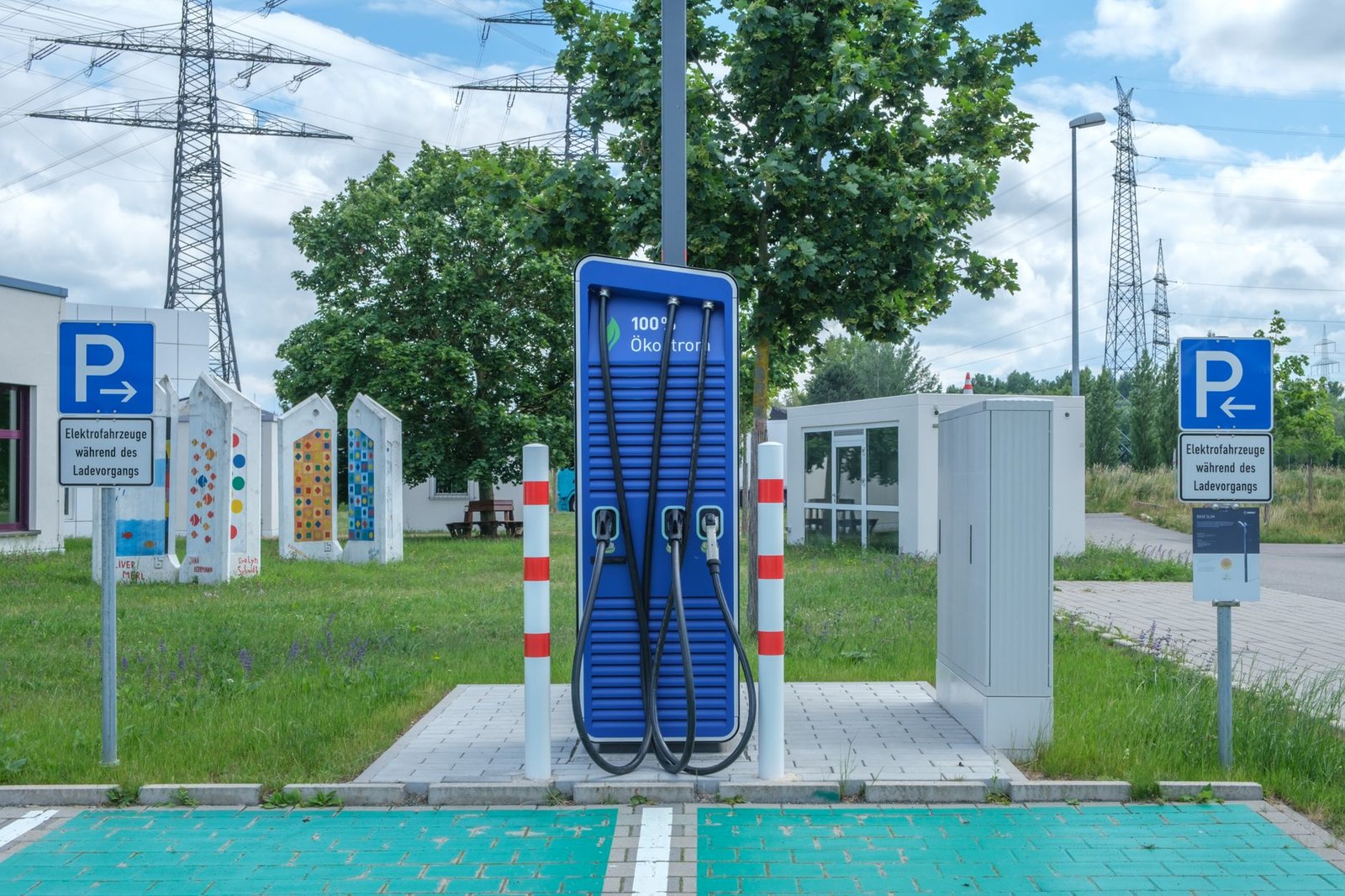
You pull into a shopping center parking lot on a Tuesday afternoon. Between the grocery store entrance and the coffee shop, there’s a row of eight charging stalls, each with a thick cable and a screen showing kilowatt-hour rates. Three cars are plugged in. Their drivers are inside buying groceries. This setup, once rare enough to photograph, is becoming unremarkable. EVgo recently announced plans to install more than 400 fast-charging stalls at grocery-anchored shopping centers across the United States. The question isn’t whether this will happen. The question is whether the physics and economics actually work the way the press releases suggest.
What “Fast Charging at the Grocery Store” Actually Means
When EVgo says it’s installing fast chargers at shopping centers, the term “fast” has a specific technical meaning. These are DC fast chargers, typically delivering between 50 and 350 kilowatts. Compare that to the Level 2 chargers you might see at a hotel, which deliver around 7 to 11 kilowatts. The difference matters because it changes what you can accomplish during a grocery run.
A 350-kilowatt charger can, under ideal conditions, add roughly 200 miles of range to a modern EV in about 15 to 20 minutes, assuming the battery is between 10% and 80% charged and the battery thermal management system is keeping cells at optimal temperature. That’s the ideal scenario, and few vehicles sustain peak rates for the full window. In practice, charging speed depends on ambient temperature, battery state of charge, and whether the vehicle’s battery management system throttles power to protect cell longevity. Cold weather can cut charging rates by 30% or more. A battery above 80% charged will accept power much more slowly, as the management system tapers current to prevent lithium plating.
The grocery store context matters because it aligns charging time with an existing behavior. The average American grocery trip runs roughly 40 to 45 minutes, according to time-use data. If you can add 150 miles of range in that window, you’ve eliminated the “I need to wait for my car” problem. The charger becomes infrastructure you use while doing something else, not a destination in itself.
The Grid Connection Problem Nobody Talks About
Installing eight 350-kilowatt chargers at a shopping center requires roughly a 2.8-megawatt connection to the grid. For context, a typical suburban grocery store draws on the order of a few hundred kilowatts. Adding fast chargers means the parking lot can suddenly demand more power than the building it serves.
This creates real problems. Most shopping centers weren’t built with multi-megawatt electrical service. Upgrading the connection requires trenching, transformer installation, and coordination with the local utility. In some cases, the utility needs to upgrade substations or distribution lines blocks away. These upgrades can take 18 to 36 months and cost anywhere from several hundred thousand to a few million dollars per site, depending on how far you are from existing high-capacity lines.
Battery storage can smooth some of this demand. A 1-megawatt-hour battery system can buffer the grid connection, charging slowly during off-peak hours and discharging rapidly when vehicles plug in. This reduces the peak load the utility sees, which can cut infrastructure costs. But the battery itself adds several hundred thousand dollars to project cost, plus maintenance and eventual replacement.
The economics only work if utilization is high enough. If four of your eight stalls are occupied during peak hours, you’re generating revenue. If one stall gets used twice a day, you’re burning money. This is why EVgo is targeting grocery-anchored centers specifically. High foot traffic increases the odds that someone will plug in.
Why Charging Companies Keep Betting on Retail
EVgo isn’t guessing about grocery stores. The company has been testing this model for years and reports that a large share of drivers who charge at retail locations visit a nearby store or restaurant. That number matters because it means the charger isn’t just serving EV drivers; it’s delivering foot traffic to tenants.
Shopping center owners care about this because anchor tenants like grocery stores drive traffic, but they need complementary uses to keep people on-site longer. A charging station does two things: it gives people a reason to pick this shopping center over another, and it extends dwell time. If you’re charging for 20 minutes, you might grab a coffee or browse a store you’d otherwise skip.
From EVgo’s perspective, retail sites solve the utilization problem. Highway rest stops see predictable traffic during travel hours but go quiet overnight. Urban fast chargers compete with home charging, which is cheaper and more convenient. Grocery stores generate consistent weekday and weekend traffic from local residents who need a top-up between longer trips.
The business model hinges on charging rates. EVgo typically charges between $0.36 and $0.56 per kilowatt-hour, depending on location and membership tier. A 50-kilowatt-hour charge, enough to add about 150 to 200 miles to a mid-size EV, costs roughly $18 to $28. That’s three to four times the cost of home charging, where electricity averages around $0.16 per kilowatt-hour nationally. The premium is acceptable if you’re charging while doing something else, less so if you’re standing next to your car waiting.
The Overcounting Problem in Charging Infrastructure
Press releases about charging infrastructure often count “stalls” rather than “locations,” and the distinction matters. A location with 24 stalls sounds impressive until you realize that those stalls share a limited grid connection. If all 24 stalls drew from a 2.8-megawatt connection simultaneously, each charger would deliver only about 117 kilowatts, not 350. A connection sized for eight vehicles at full speed can’t deliver peak power to all 24 at once.
This isn’t a design flaw. It’s a deliberate engineering trade-off. Sizing electrical infrastructure for absolute peak demand would be prohibitively expensive. Instead, charging networks design for typical peak usage, which might be 30% to 40% of total stalls occupied at once. This works fine until it doesn’t. On a holiday weekend, when travel volumes spike, you get queues.
The other issue is reliability. DC fast chargers are complex machines with multiple failure modes. Power electronics fail. Payment terminals freeze. Cables get damaged. Industry data suggests uptime rates between 85% and 95% for well-maintained networks. That means at any given time, one or two chargers per location might be offline. When you’re driving an EV, this uncertainty is the real anxiety, not range. You can calculate how far you can drive. You can’t guarantee the charger will work when you arrive.
What the Announcement Doesn’t Say
The EVgo expansion focuses on grocery-anchored properties, but the announcement doesn’t specify which grocery chains or how many stores will actually get chargers. “More than 400 stalls” spread across multiple states could mean dense clusters in high-EV markets like California and token installations elsewhere. The distribution matters because charging infrastructure exhibits strong network effects. A well-covered region becomes more attractive to EV buyers, which increases utilization, which justifies more investment. Sparse coverage doesn’t trigger that cycle.
The timeline also remains unspecified. Permitting, utility coordination, and construction can stretch a charging project across two to three years. Announcing 400 stalls doesn’t mean 400 stalls become operational simultaneously. It’s more likely we’ll see phased rollouts, with initial clusters in cities where EVgo already has utility relationships and permit experience.
What to Watch as This Plays Out
The real test isn’t whether EVgo installs the chargers. The company has access to capital and has executed large-scale deployments before. The test is whether the chargers get used enough to justify their existence. Utilization rates will tell the story. If EVgo reports that stalls average three to four sessions per day, the model is working. If it’s fewer than two, the economics are marginal.
Also watch for clustering. Successful charging networks tend to concentrate infrastructure in specific corridors and urban centers before expanding outward. If the EVgo deployment follows this pattern, it signals confidence in specific markets. If the stalls get scattered thinly across many states, it suggests the company is optimizing for coverage maps rather than actual usage.
Finally, watch how grocery chains respond. If property owners start viewing charging infrastructure as essential amenity rather than tenant favor, that indicates the market has matured. The shift from “this might attract customers” to “we’ll lose customers without this” marks the moment when charging infrastructure stops being experimental and starts being mandatory.