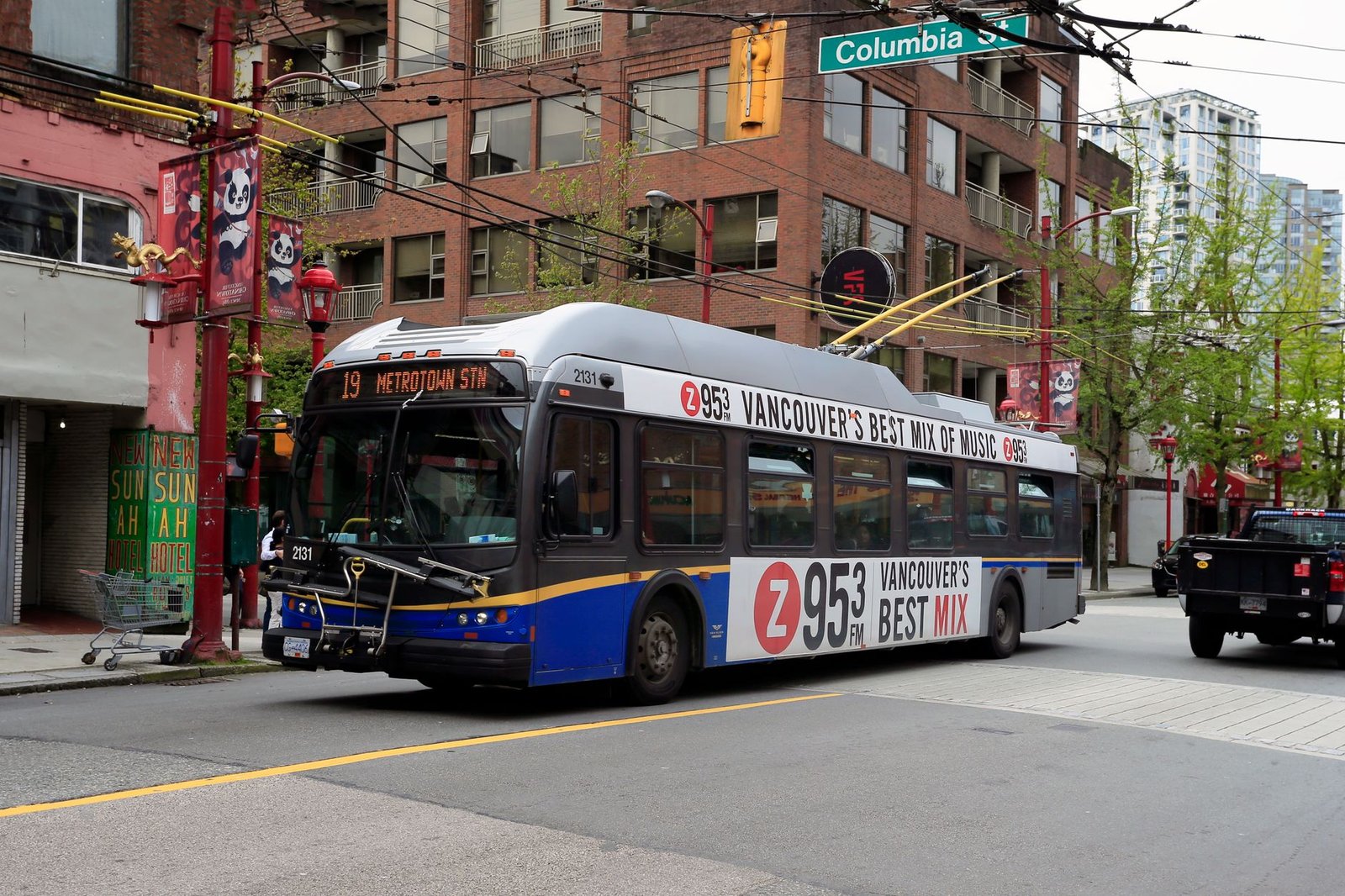
A pantograph unfolds from the roof of an electric bus, reaches up to contact an overhead wire, and begins charging at rates that would make most EV owners jealous. Austin’s transit agency just installed this equipment at two new park-and-ride facilities, joining a small but growing number of American cities using overhead charging for their electric fleets. The hardware looks decidedly old-school, like something borrowed from streetcars or electric trains. Which raises an obvious question: why are cities spending capital on 20th-century wire infrastructure when battery technology keeps improving?
The answer comes down to power delivery constraints and how transit agencies actually use their buses.
How Pantograph Charging Actually Works
The mechanism is straightforward. A charging pantograph mounts on the bus roof (though in some systems the pantograph is mounted on the overhead mast and lowers onto the bus). At designated charging points, usually at route terminals or depots, the pantograph extends to make contact with an overhead conductor rail. Current flows from the grid through the overhead wire, through the pantograph contact, and into the bus battery pack. When charging completes, the pantograph retracts and the bus continues its route.
The power levels matter. Overhead pantograph systems typically deliver 150 to 450 kilowatts, with some installations rated up to 600 kW. Compare that to the plug-in chargers most people picture: CCS fast chargers at public stations deliver 50 to 350 kW, and those are considered high-power options. The physical contact between pantograph and overhead rail can handle higher current than the enclosed pins in a plug-in connector, which have thermal limits that constrain charging speed.
Transit buses need different charging strategies than personal vehicles. A 40-foot electric bus carries a battery pack in the 400 to 600 kilowatt-hour range. That’s roughly five to eight times the capacity of a long-range electric sedan. A bus on active service runs 12 to 16 hours daily, covering 150 to 200 miles. The battery needs replenishment during the operating day, not just overnight.
Overhead charging enables what transit planners call opportunity charging. The bus pulls into a terminal, passengers disembark, the pantograph extends, and the battery absorbs enough energy in 5 to 10 minutes to complete the next route segment. This approach lets agencies specify smaller battery packs than they would need for depot-only overnight charging, reducing the vehicle’s purchase price and weight.
The Capital Allocation Problem
Here’s where the engineering tradeoffs become financial decisions. Installing overhead charging infrastructure costs roughly $400,000 to $800,000 per charging point, depending on site conditions and power supply requirements. That buys you the overhead conductor rail, the support structures, the electrical distribution equipment, and the grid connection work. A transit agency running 50 buses might install four to six charging points at strategic route terminals.
The alternative is simpler on the infrastructure side: equip depot charging stations and buy buses with larger battery packs. Plug-in depot chargers cost roughly $50,000 to $150,000 per unit for high-power installations. But the battery capacity increase costs $200 to $300 per kilowatt-hour at the pack level. Adding 200 kWh to handle all-day operation without mid-route charging adds $40,000 to $60,000 per bus. Multiply that across a 50-bus order and you’ve spent $2 to $3 million on additional battery capacity.
The math shifts depending on how the agency operates its routes. High-frequency urban routes with short turnaround times favor overhead charging. The buses spend brief periods at terminals anyway. The charging infrastructure serves multiple vehicles throughout the day. A single overhead charging point might serve 8 to 12 buses on different schedules. That utilization spreads the capital cost across the fleet.
Suburban routes with longer distances between terminals and more variable schedules make the case for larger batteries and depot charging. The buses don’t return to charging-equipped terminals frequently enough to make opportunity charging practical. The infrastructure sits idle more hours per day, weakening the economic case.
What Gets Left Out of Most Electric Bus Coverage
Most transit electrification announcements focus on the number of buses ordered and the greenhouse gas reductions. What they skip is the operating constraint that makes or breaks the project: grid capacity at depot locations.
Charging 30 to 50 buses overnight at a single depot requires serious electrical infrastructure. If each bus needs a 150 kW charger and the agency wants to charge 40 buses simultaneously, that’s 6 megawatts of demand. Many older bus depots have electrical service sized for building lighting and maintenance equipment, not industrial-scale charging loads. Upgrading the utility connection and installing on-site distribution equipment can cost $2 to $5 million before you’ve bought a single charger.
Overhead charging at route terminals distributes that electrical load geographically. Instead of concentrating 6 MW at one depot, the agency might install 600 kW at each of several terminal locations. Those sites often already have commercial electrical service that can accommodate the additional load with manageable upgrades. The grid infrastructure cost gets spread across multiple utility service territories and existing substations.
The distributed approach creates a different maintenance problem. Now the agency owns charging equipment at six locations instead of one centralized depot. Each site needs monitoring, routine maintenance, and occasional repairs. Personnel have to travel to multiple sites. Parts inventory gets more complicated. These operational costs rarely appear in project announcements but they accumulate over the system’s 15 to 20 year service life.
Why Some Agencies Choose Wires Anyway
The reliability equation matters more for transit than personal vehicles. If your car’s battery runs low, you change your plans. If a transit bus battery runs low mid-route, dozens of passengers get stranded and the agency dispatches a rescue vehicle. That service failure costs money in immediate operational response and longer-term ridership loss.
Overhead charging gives dispatchers more flexibility. A bus running behind schedule can take a shorter charging session and still complete its route. Battery state-of-charge becomes less critical to operational planning. The agency can rotate buses through different route assignments without worrying whether specific vehicles have enough range for specific routes.
This operational buffer has monetary value that’s hard to quantify in a capital budgeting spreadsheet. How much is it worth to reduce the risk of service disruptions? How do you price the dispatcher’s ability to reassign buses dynamically rather than matching specific vehicles to specific routes? These benefits are real but they don’t fit neatly into a net present value calculation comparing infrastructure options.
The technology also hedges against battery degradation uncertainty. Lithium-ion packs lose capacity over time. Transit agencies typically plan for roughly 20 percent capacity loss over a 12-year service life. But actual degradation depends on usage patterns, climate conditions, and thermal management performance. Starting with overhead charging and smaller battery packs means degradation has less impact on operational range. The bus that could complete its route with 15 minutes of opportunity charging when new can still do it after losing 20 percent of its capacity, because it refills multiple times a day rather than relying on a single charge to cover the whole route.
What the Numbers Actually Tell Us
Step back from individual project announcements and look at deployment patterns. European cities adopted overhead charging earlier and more extensively than American agencies. The infrastructure matches denser urban environments where buses run shorter, more frequent routes. Cities with legacy trolleybus systems had existing overhead wire infrastructure and maintenance expertise, reducing the implementation barriers.
American adoption has concentrated in specific niches. Airport shuttles and circulators running fixed high-frequency routes use overhead charging extensively. Regional transit agencies with longer suburban routes have favored depot charging and larger batteries. The technology choice maps to operational patterns, not to some universal best practice.
Battery costs keep dropping, which should tilt future decisions toward bigger packs and away from charging infrastructure. But the power delivery constraint doesn’t go away. If battery packs double in size, they need higher charging power to refill in practical timeframes. That pushes depot electrical infrastructure costs higher. The tradeoff persists at different price points.
What to Watch in Future Installations
The next few years will test whether overhead electric bus charging expands beyond early adopter cities or remains a niche solution. Three factors will determine which direction it goes.
First, watch for battery pack costs to drop below $100 per kilowatt-hour at the pack level. At that price point, the extra capacity needed for depot-only charging becomes cheap enough that agencies will question whether overhead infrastructure makes sense even for high-frequency routes.
Second, monitor utility rate structures for commercial charging. Some jurisdictions charge demand fees based on peak power draw during the billing period. Those fees can make high-power depot charging prohibitively expensive. If demand charges remain high, distributed overhead charging maintains its economic advantage. If utilities develop more favorable rate structures for fleet charging, the case for overhead infrastructure weakens.
Third, track announcements about charging standardization. The industry currently has multiple overhead charging approaches with different connector geometries and control protocols, though standards like OppCharge and the SAE/ISO pantograph specifications are gaining traction. Buses from one manufacturer often can’t use overhead charging infrastructure designed for another manufacturer’s vehicles. If the sector converges on a standard, it reduces the risk of agencies getting locked into obsolete equipment. Without standardization, agencies have good reason to stick with plug-in charging despite its limitations.
Capital allocation in transit electrification isn’t about picking the most advanced technology. It’s about matching infrastructure investments to actual operational constraints and usage patterns. Overhead wires look antiquated next to battery improvements and autonomous vehicle concepts. But they solve a specific problem: delivering high power to vehicles that need it during brief service intervals. That problem isn’t going away, which means the old-school solution will keep showing up in new installations.