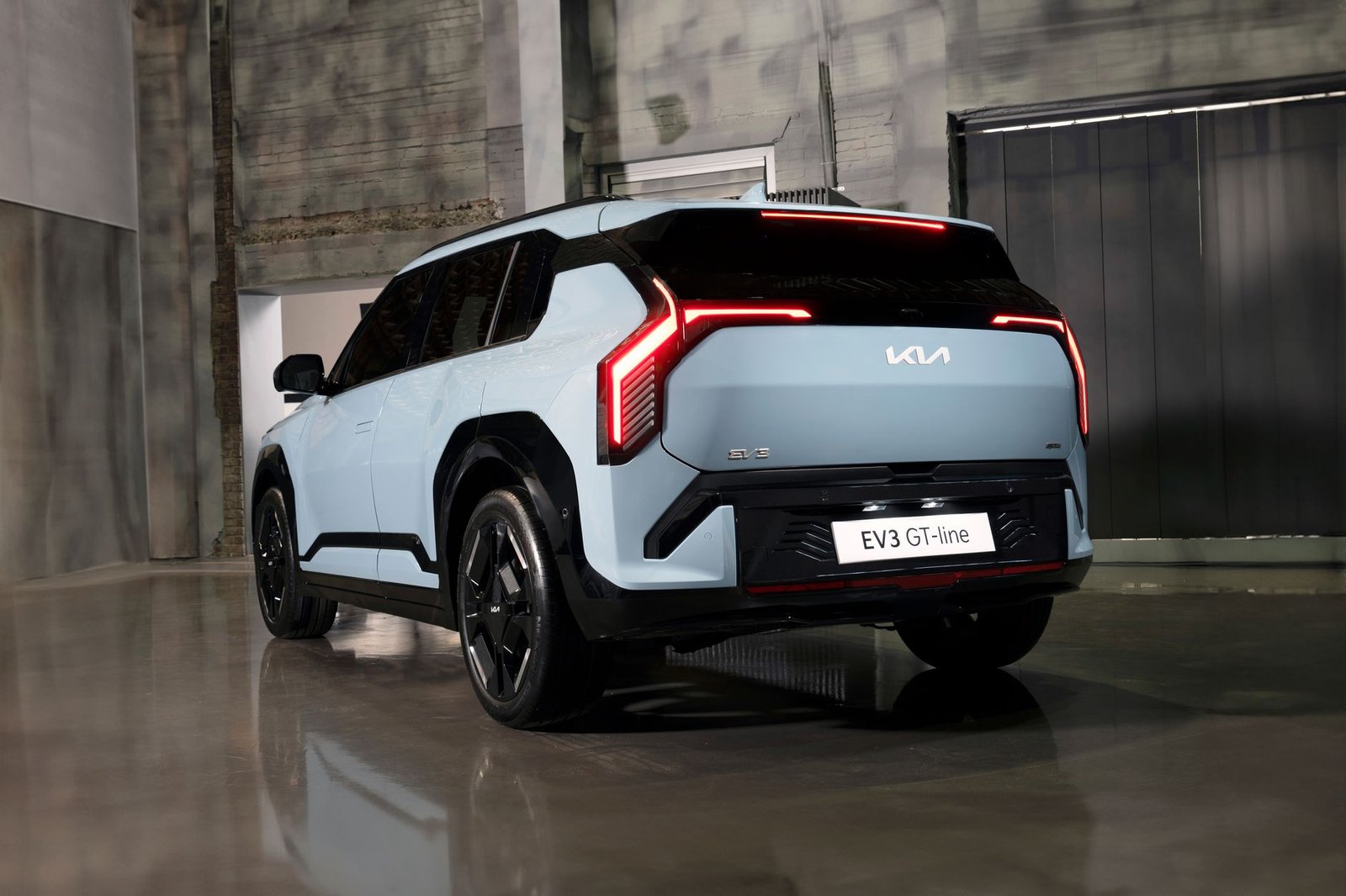
The Kia EV3 arrived in U.S. dealerships mid-2026 carrying a 321-mile EPA range estimate and a $29,890 base price. On paper, it looks like the rare affordable EV that doesn’t ask buyers to compromise on usable range. But the physics of achieving 321 miles at that price point required a charging architecture decision that limits how the vehicle scales across model variants. The EV3 runs on a modified 400-volt version of Kia’s E-GMP platform, not the 800-volt architecture that powers the EV6 and EV9. This is a deliberate cost reduction that makes the $30,000 price possible. The constraint emerges when you try to scale battery capacity within a 400-volt framework.
## What the Range Numbers Actually Deliver
The 321-mile range figure applies only to the front-wheel-drive configuration with the 81.4 kWh battery pack. According to EPA testing, that same battery delivers 280 miles in the all-wheel-drive variant, a 13% reduction driven by the added motor’s parasitic losses and increased mass. The smaller 58.3 kWh pack offers 221 miles in front-wheel-drive form. Kia positions this as a range tier system, but it’s more accurately a cost-versus-capacity trade-off forced by the platform’s voltage ceiling.
The 400-volt architecture caps peak charging power at roughly 127 kW for the large battery and roughly 100 kW for the small pack, per Kia’s specifications. Compare that to the EV6, which hits 240 kW on its 800-volt system. The 10-to-80% charge time difference is modest in absolute terms: about 31 minutes for the EV3’s large battery versus roughly 18 minutes for the EV6. But the constraint becomes visible when you examine energy throughput per minute. Over a 10-to-80% charge, the EV6 moves about 2.1 kWh per minute on average, while the EV3 manages roughly 1.3 kWh per minute. That’s a meaningful reduction in the rate at which the battery absorbs energy, consistent with the roughly 2:1 gap in peak charging power.
## The Voltage Ceiling and Its Second-Order Effects
Voltage architecture determines the current required to deliver a given amount of power, which in turn dictates thermal management complexity and copper mass in the wiring harness. A 127 kW charger on a 400-volt system pulls about 318 amps at peak. The same 127 kW on an 800-volt platform requires only about 159 amps. Lower current reduces resistive losses (which scale with the square of current) and allows smaller-gauge conductors. Kia’s decision to use 400 volts reduced upfront component costs but locked in higher thermal management overhead and constrained the ceiling for future pack capacity expansion.
The EV3’s 81.4 kWh battery already pushes close to practical charging limits for a 400-volt system. Scaling to a hypothetical 100 kWh pack within the same voltage framework would either require accepting slower charge speeds or pushing amperage into ranges that demand heavier cooling and thicker cables. The Niro EV, which the EV3 effectively replaces, used a 64.8 kWh pack. Kia reports the EV3’s pack achieves higher energy density than the Niro’s battery, per data shared at the media drive. That density gain is part of what allowed the jump to 81.4 kWh without proportionally increasing pack volume or mass. But density improvements have a ceiling, and the next step change in range would require either a larger physical pack or a higher voltage platform.
## What the Cargo and Interior Numbers Reveal
The EV3 measures 169.3 inches long, slotting it between subcompact and compact crossovers. Kia lists cargo capacity at roughly 26 cubic feet with the rear seats upright. That’s 54% more cargo volume than the Chevy Bolt’s 16.9 cubic feet and 30% more than the Nissan Leaf’s 20 cubic feet. Fold the seats and the EV3 offers roughly 56 cubic feet, though Kia didn’t provide an official seats-down figure. The frunk adds 0.9 cubic feet, enough for a charging cable and little else.
The cargo advantage stems from packaging efficiency. The E-GMP platform positions the battery as a structural floor, lowering the cargo deck and removing the need for a transmission tunnel. Adding a rear motor for all-wheel-drive variants eats into cargo volume or requires a taller rear subframe. Kia appears to have chosen the subframe route, preserving cargo space at the cost of slightly higher mass and aerodynamic drag. The all-wheel-drive GT-Line variant tested by InsideEVs carried a $44,235 price (including destination) and the 41-mile range penalty relative to the front-drive version.
## The i-Pedal Learning Curve and What It Signals
The EV3 includes Kia’s i-Pedal 3.0 regenerative braking system, activated by holding the left steering-wheel paddle. It offers multiple intensity levels and now remembers the last setting between drives, a usability refinement that sounds minor but addresses a frequent complaint from earlier Kia EVs. The system allows one-pedal driving with full regen to a stop in the highest mode. Physics limits how aggressive regen can be: braking force can’t exceed what the motor’s generator mode can absorb without exceeding thermal limits or safe deceleration rates. The EV3’s front motor produces 201 hp (with the AWD configuration adding a rear motor for a higher combined output), which caps peak regen power at roughly the motor’s rating. That’s adequate for most deceleration scenarios but won’t match the bite of a heavier vehicle with a larger motor.
The i-Pedal refinement points to a broader pattern in EV development: diminishing returns on headline specs and increasing focus on friction reduction in daily use. Remembering the regen setting between drives doesn’t sell cars in showrooms, but it removes a recurring annoyance that compounds over hundreds of drive cycles. Kia also reports the EV3 achieves a 0.263 drag coefficient, per specifications shared at the media event. That’s competitive with sedans and helps offset the crossover body’s frontal area penalty. Small aerodynamic gains matter more in EVs than combustion vehicles because highway efficiency directly translates to range, and range remains the primary purchase barrier for most buyers.
## The Market Position and Its Durability
Kia claims roughly 1,300 EV3 units reached dealer inventory by the time U.S. sales began. One source cites 514 units sold in an unspecified “first full month,” though no date was provided for that figure. If accurate, that’s a sell-through rate suggesting demand is present but not overwhelming. For context, the discontinued Chevy Bolt routinely moved 2,000 to 3,000 units monthly at similar price points. The EV3’s pricing advantage is real but narrow. The base Light trim at $29,890 undercuts the $29,990 Nissan Leaf by $100 and lands near the roughly $29,000 Chevy Bolt. The Wind trim at $34,990 lands in a gap where few competitors exist.
The $30,000 EV segment depends on regulatory incentives that shift unpredictably. The EV3 does not currently qualify for the $7,500 federal tax credit, which requires North American assembly, because it is imported from Korea. Kia delayed the U.S. launch until mid-2026 despite selling the EV3 overseas since 2024, likely waiting for either incentive clarity or component sourcing shifts. The Land FWD at $38,690 and the AWD GT-Line at $44,235 push into price territory where the vehicle competes against its own siblings. The EV6 starts around $43,000 with better charging performance and arguably stronger brand positioning as a dedicated EV platform. The EV3’s case weakens as you move up the trim ladder.
## The Actual Constraint on Scaling
The EV3’s value proposition rests on delivering acceptable range at minimum cost. Minimum cost means minimum margin, and thin-margin vehicles can’t absorb market shocks. A sharp spike in battery cell prices erases the profit. A new tariff on imported components forces a price increase that kills the sub-$30,000 positioning. Kia’s 400-volt platform choice reduced upfront engineering spend but created a ceiling on how much further they can push range or charging speed without redesigning the powertrain. The next EV3 refresh will face a choice: accept the 400-volt limits or re-engineer for 800 volts and eat the cost increase.
Cost-optimized EVs require stable input costs and predictable demand to justify the narrow margins. The EV3 works as a product today because battery costs fell far enough to make 321 miles feasible at $30,000. If cell prices reverse course or tariffs hit Korean imports, the pricing math breaks immediately. The 400-volt architecture is defensible for a first-generation affordable EV. Whether it’s defensible for a second generation depends on how much range buyers will demand in 2028 and whether Kia can fund an 800-volt redesign out of current-generation profits.